
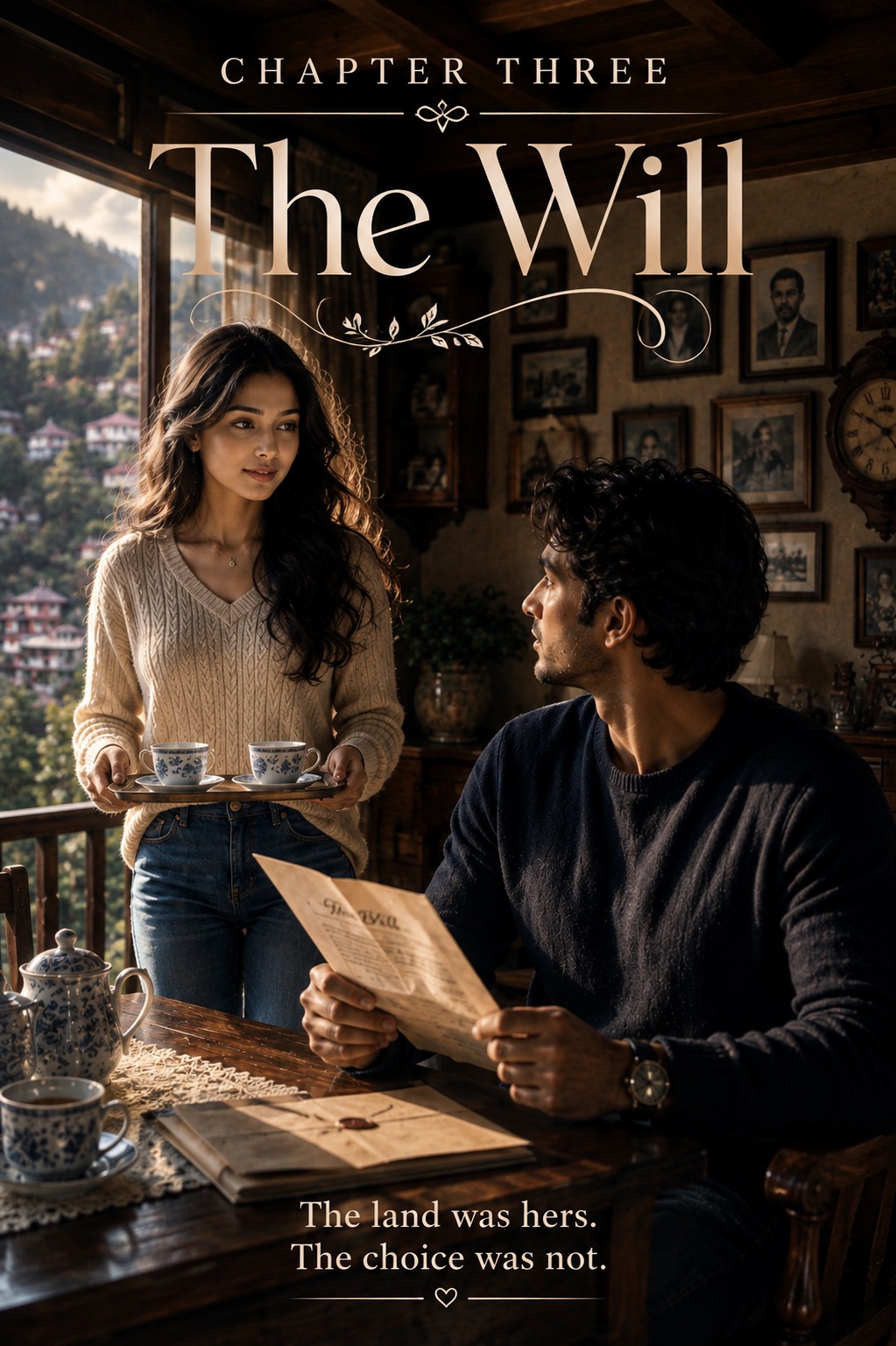
 ## Chapter Three: The Will
Breakfast at the Thakur house was rarely peaceful, and that morning was no exception.
Vikram sat with the newspaper folded beside his plate, pretending to read it. Sunita was complaining that the tea had been made too weak, an accusation she leveled at least twice a week regardless of the tea's actual strength. Mehek ate at the speed of someone who had only just remembered her school bus did not, in fact, wait for anyone, and Mira moved between all three of them with toast and eggs and a fresh pot, the quiet efficiency of someone who had already been awake for hours settling over the table like something no one else in the room noticed.
"Mehek, eat properly."
"I am eating properly."
"You're inhaling it."
"I have four minutes."
"You had twenty."
"I used sixteen of them badly."
Mira set another plate down just as the doorbell rang.
Sunita's head turned toward the hallway, then swung immediately back to Mira, as though the sound itself were something Mira had failed to prevent. "Go see who it is. Who comes to someone's house this early?"
Mira had barely turned when Vikram pushed his chair back. "Let her finish, she's been running since morning. I'll get it."
Sunita made a small, dissatisfied sound and said nothing further. Vikram crossed the sitting room and opened the front door to find two men waiting on the step — one holding a leather folder with the attentive posture of someone accustomed to standing half a step behind another man, the other with his back turned toward the road, looking out over the slope of the hillside.
"Yes?" Vikram asked.
The second man turned, and Vikram recognized him almost immediately — not from any achievement of his own, but from the name alone. The Dutts were the kind of family whose photographs turned up often enough at weddings and inaugurations and charity dinners in the papers that meeting one of them in person produced a strange, slightly dislocating sensation, like encountering someone you already knew.
"Good morning," the man said, with a polite nod. "I'm Kian Dutt. Dutt Global."
Vikram stared for exactly half a second before recovering. "Of course. Of course. Everyone knows who you are." He stepped aside at once, waving them both in. "Please, come in."
The house was modest but well kept, the wooden floors softened by years of use, family photographs lined along one wall, a brass clock ticking above the cabinet. Kian took it in without appearing to, the way he took in most rooms.
"Please, sit," Vikram said. "Tea? Coffee?"
"No, please, we won't take much of your time."
"Nonsense. You've come all this way." Vikram was already turning toward the dining room. "Sunita? We have guests."
Sunita appeared a moment later, her expression of mild irritation dissolving almost instantly at the sight of who was sitting in her drawing room.
"Kian Dutt," Vikram said, with something close to pride, "from Dutt Global."
Sunita's whole manner softened, the transformation so complete and so immediate that Vikram very nearly smiled at it. "Mr. Dutt. Of course. Please, sit — you must have tea."
"Thank you, but really—"
"At least tea."
Kian glanced once at his manager, who studied the floor with great wisdom and offered no assistance whatsoever. "All right. Tea."
Sunita smiled as though he'd personally granted her a favor. Kian had watched this particular transformation take place in countless rooms before. People rarely reacted only to him — they reacted to the Dutt name, to the companies behind it, to a family whose businesses seemed to occupy half the financial pages in any given week. He had stopped taking it personally years ago. It was simply useful to know who changed once they learned his surname.
"I thought perhaps we could discuss the land," he said, once the tea had been promised.
Vikram's expression shifted slightly. "Yes. Your manager spoke to me."
Before he could continue, footsteps came hurrying down the stairs — Mehek, schoolbag half-zipped, one shoelace trailing loose. "Bye, Mom, bye, Dad, I'm going—"
She stopped mid-sentence.
Her gaze had landed on Kian, and Kian watched recognition arrive across her face in real time, the way weather arrives.
"Mehek," Vikram said, "this is Mr. Dutt."
"Hello," Kian said, with a courteous nod.
Mehek stared at him. Then at her father. Then back at him. "You're Kian Dutt."
"So I've been told."
Her eyes went wide. "The same Kian who—"
A horn sounded loudly from the road outside. Sunita spun toward the window. "Your bus!"
Mehek glanced at the door in visible horror, then back at Kian, apparently weighing, for one genuine second, whether her education was worth abandoning the room for. The horn sounded again, longer this time.
"Mehek!"
"I'm going!" She bolted for the door, schoolbag banging against her hip. "Bye!"
The door slammed behind her. Kian looked after it with faint interest. "She seems energetic."
"That is one word for it," Vikram said.
Sunita called toward the kitchen. "Mira! Bring the tea!"
Kian's attention caught on the name before he could stop it, some part of him already turning toward the hallway.
Vikram, oblivious, continued where he'd left off. "As I was saying, there's a complication with the land."
Kian brought his focus back. "What complication?"
"The property isn't actually mine."
His manager shifted almost imperceptibly beside him.
"It belongs to my niece," Vikram said.
At that exact moment, Mira walked in carrying a tray, and Kian looked up and froze — not dramatically, not visibly enough for anyone unfamiliar with him to notice, but for perhaps one full second every thought in his head simply stopped moving in its usual orderly sequence.
Mira.
Of all the houses in Shimla.
And absurdly, before the coincidence had even finished registering, the first thing Kian felt was pleasure. Not strategy. Not the land, not the will, not any of the dozen calculations that would arrive a moment later and crowd the feeling out. Only pleasure, plain and unguarded, at finding her standing in a doorway he hadn't expected her in.
She saw him in the same instant. Her steps slowed. Her eyes widened.
"You."
Kian stood. "Mira."
Vikram looked between them, and Sunita's eyes narrowed by a fraction too small to name.
Mira recovered first. "What are you doing here?"
Kian almost laughed. Of all the houses on this particular hill. Of all the parcels of land in Shimla.
"Business," he said, and then, because that explained nothing at all, "I came to discuss a property."
Mira glanced at her uncle, then back at him. "I see." She set the tray down carefully.
"You two know each other?" Vikram asked.
"Not really," Mira said.
Not really. Kian turned the phrase over with some interest.
"He came into the shop during the storm yesterday," she went on.
"Kian," he said.
She looked at him.
"You called me Kian yesterday."
Sunita was watching the exchange now with an expression Mira knew far too well, and Mira's tone shifted into something noticeably more formal in response. "Yes. Kian came into the shop during the storm."
"By accident," he added.
"Because of the rain."
"I remember."
"Small world," Vikram said, pleased.
"Apparently," said Kian.
Mira poured the tea, and Kian found himself following the movement of her hands without quite meaning to. Yesterday she'd been sitting in candlelight in a half-dark bookshop, laughing at his choice of history book. This morning she stood in a bright dining room, in the same plain, effortless way she seemed to inhabit every room she walked into — no performance, no adjustment in her voice now that she knew exactly who he was. That interested him considerably more than it should have.
Sunita noticed where his attention had settled. Of course she did.
"Mira," she said sharply, "aren't you getting late for college?"
Mira set the teapot down. "Yes." She glanced at her uncle. "I'll go get ready." Then, to Kian and his manager, with perfect politeness, "Excuse me."
She left, and Kian's gaze stayed on the doorway a fraction of a second too long for it to pass unnoticed by anyone paying attention. His manager cleared his throat.
"Sir."
Nothing.
"Sir."
Kian looked at him. The manager glanced meaningfully toward Vikram. Right. Land.
"Sorry," Kian said, leaning back. "Where were we?"
"The property," Vikram said, folding his hands. "The land you're interested in belongs to Mira."
Something in Kian went still again — for an entirely different reason this time. "Mira?"
"My niece. The young woman who was just here."
"I understood that part." His tone had sharpened without his quite intending it to. Business had returned, all at once, displacing whatever had briefly occupied the chair beside it.
Vikram nodded. "Her parents left behind one of the older private landholdings in this part of Shimla. When they died, most of the estate was placed under the terms of their will."
"And those terms are?"
Vikram hesitated, just slightly. "The land passes into Mira's direct control after she marries."
For once, Kian didn't answer immediately.
"Until then," Vikram went on, "it remains tied to the estate. I can't sell it. Mira can't sell it either."
"Who administers it?"
"The trustees, and the family solicitor — but only within the limits the will allows."
"So even if she agreed to sell—"
"It wouldn't matter. Not until she marries."
The word caught somewhere unexpected. Marriage. Kian dismissed the reaction almost as soon as he noticed it and returned his attention to the problem in front of him.
Family wealth had taught him very young that ownership and control were rarely the same thing — he'd grown up around trusts and holding companies and succession clauses the way other people grew up around household chores, and he recognized the shape of Mira's situation almost before Vikram had finished describing it. The estate was hers in every meaningful sense except the one that mattered most: she couldn't control it.
At the center of the complication was Mira Thakur — the twenty-one-year-old biotechnology student he'd met by accident the previous evening, who apparently owned land worth enough to derail one of the most important developments on his desk, and who couldn't legally make a single decision about any of it herself.
The coincidence was almost offensive in its neatness.
"I understand," he said.
Vikram looked visibly relieved. "Thank you. I tried to explain this to your manager, but—"
"No. It's clear now." He turned to his manager. "Go back to the hotel. Take the car."
"But you—"
"I'll come later."
The manager looked at him for a moment, and something passed between them that needed no words at all — the kind of exchange that, translated, amounted roughly to do not make me repeat myself in someone else's living room.
"Of course, sir." The manager rose and let himself out.
Vikram frowned faintly. "You don't need the car?"
"I have legs."
Kian remained seated. Vikram and Sunita exchanged a glance — the discussion, as far as they were concerned, had concluded. Kian appeared not to notice. In truth, he knew exactly what he was doing. Mira had said she was going to college, which meant she would come back down these stairs in a matter of minutes, and Kian had grown up in a family where business was discussed over breakfast, alliances shifted over dinner, and leaving a room before you understood everyone in it was considered amateur behavior. He knew the value of staying five minutes longer.
That was the professional explanation, at least. He was aware it grew less convincing by the second.
Footsteps sounded on the stairs. Mira came down with her college bag over one shoulder, and his mouth curved before he could stop it. There you are.
She stopped when she saw him still sitting there. "You haven't left."
"Observant."
She gave him a look that promised nothing good. "Uncle, Aunt Sunita, I'm leaving."
Kian stood. "So am I."
"You were waiting?" Sunita asked, with obvious interest.
"Not exactly."
Mira's expression turned suspicious, correctly.
"I was thinking," Kian said, hands sliding into his pockets, "that you could show me Shimla."
She stared at him. "Me?"
"Yes."
"Why?"
"Because you live here."
"There are professional guides for that."
"I don't want a professional guide. I want to see the real city — not the Ridge and the Mall and whichever café is listed in every hotel brochure."
"Those places exist for a reason."
"I'm sure they do. I want the places people who actually live here go."
She studied him for a moment. "Why?"
It was a simple question. The real answer wasn't. Because yesterday she'd spoken to him as though he were simply Kian. Because she hadn't wanted anything from him. Because he liked the way her face changed just before she laughed, and he wanted to see it again. He chose the version that required the least unpacking.
"Because it's more interesting."
"Mira has work here after college," Sunita cut in.
"She can do it later," Vikram said, waving the objection away before Mira could speak at all. "Mr. Dutt is a guest in our city. If he's asked her to show him around, why shouldn't she?"
Kian noticed the tension that moved across the room at that, quick and quiet. Mira noticed him noticing it, and her jaw tightened by a degree too small for her aunt and uncle to catch.
"It would be our pleasure," Vikram said warmly, as if the matter were settled.
Mira looked at her uncle, then at Kian. Kian said nothing at all. He could have made it easy for her — withdrawn the invitation, waved it off as unimportant, given her a clean exit. Instead he waited, because silence, in his long experience, made people reveal exactly what they'd do when nobody offered them an easier choice.
Finally, Mira sighed. "I'll see."
"I'll take that."
"That's not a yes."
"It's also not a no."
"It was much closer to no."
"I disagree."
"Of course you do."
She turned for the door. "Goodbye."
Kian followed her out, and she stopped on the step to look back at him. "Why are you following me?"
"I'm leaving too."
"Convenient."
"Extremely."
She started down the road. He fell into step beside her without being invited.
"No," she said, not looking at him.
"No what?"
"No walking me to college."
"I haven't asked."
"You were about to."
"I might simply be walking in the same direction."
"Your hotel is the other way."
He glanced down the road as though this were breaking news. "Is it?"
She gave him a flat look. He smiled.
"Fine. May I walk you to college?"
"No."
"You're very consistent."
"Thank you."
"I admire that about you."
"I'm still saying no."
"Why?"
"Because I don't need half my college watching Kian Dutt arrive with me."
"So you do know who I am now."
"Mehek showed me." She didn't slow down. "Apparently you've been the most important event in Shimla all week."
"I apologize."
"You don't sound sorry."
"I'm not."
She shook her head. "Kian." There was a warning folded into the way she said it, and he enjoyed that considerably more than he should have.
"Fine." He stopped walking.
She took another step before she registered it, then turned back, faintly surprised he'd actually listened.
He lifted both hands. "See? I can take no for an answer."
"Eventually."
"Progress."
She fought a smile and lost, just slightly, and he saw it happen. That was enough.
"Goodbye, Kian."
"Goodbye, Mira."
She walked on without looking back again. Kian stayed where he was until she disappeared around the bend, and then his expression changed as quickly as it had inside the house — the amusement folding away, the problem reasserting itself underneath.
Mira Thakur owned the land. Not yet, technically. But eventually. And the will had made marriage the mechanism.
He walked slowly back toward the main road, turning Vikram's explanation over the way he turned over every contract that had ever been placed in front of him. He didn't believe in impossible deals. He believed in badly understood ones. Every restriction had language, and every piece of language had an interpretation, and every person tied up in it had something they valued more than the thing standing in the way. Sooner or later, if you paid close enough attention, you found the point where circumstances could be moved.
He took out his phone. His manager answered on the first ring.
"Sir?"
"Get me the full title history on the Thakur estate. And the will, if it's accessible."
A pause. "Sir, the family said—"
"I heard what the family said. I want to know exactly what the documents say."
"Yes, sir."
"And don't contact them again."
"Understood."
He ended the call. Ahead of him, the mountains rose pale under the morning light, and somewhere in the opposite direction Mira was walking toward college, probably relieved to have finally shaken him off.
Kian smiled faintly to himself.
She was going to be disappointed. Not because he intended to make himself a nuisance — that would have been crude, and he preferred better methods than that.
There were now two reasons Kian Dutt had no intention of leaving Shimla anytime soon.
One was a piece of land he needed.
The other was Mira Thakur.
He was not yet foolish enough to confuse the two.