
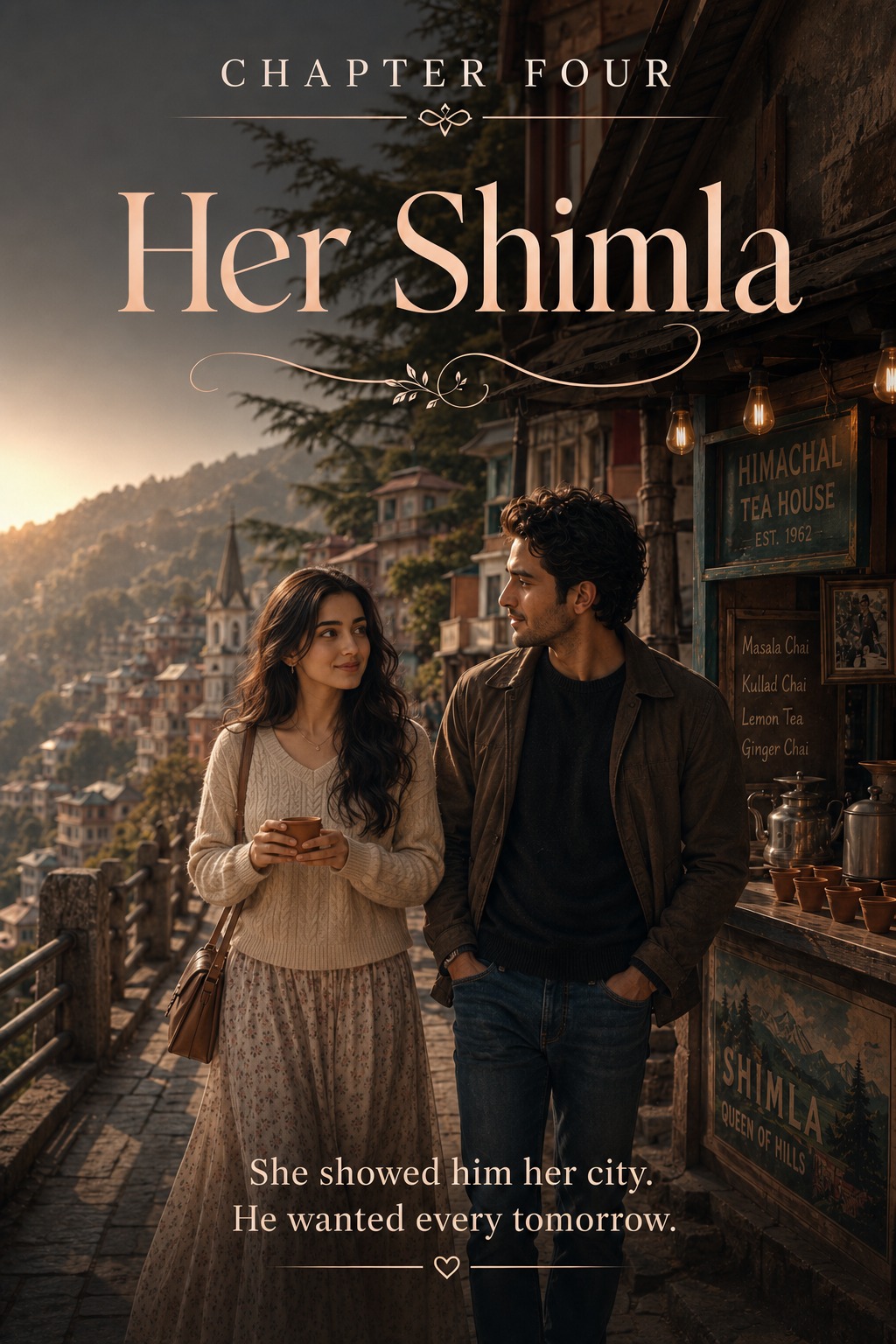
 ## Chapter Four: Her Shimla
He was waiting outside the college gates when Mira came out that afternoon.
Not conspicuously. He'd found a spot beneath a deodar tree at the edge of the road, hands in his pockets, doing a passable impression of a man simply enjoying the view — though the view, as far as Mira could tell, consisted mostly of a parking lot and a cluster of gossiping second-years who had already noticed him and were not being remotely subtle about it.
She stopped a few feet away and folded her arms.
"You actually came."
"You said you'd see."
"I said I'd see. That's not a yes."
"You also didn't say no again, which by our established rules counts as significant progress."
Mira glanced sideways at the second-years, who had abandoned all pretense of conversation and were now simply staring. "You're causing a scene."
"I'm standing under a tree."
"You're standing under a tree and being Kian Dutt while you do it. Those are not the same activity."
"I can't really help the second part."
"You could try harder."
"Duly noted." He fell into step beside her as she started walking, entirely unbothered by the second-years, who had now progressed to whispering with their hands over their mouths. "So. Where does the real Shimla begin?"
Mira considered him for a moment — the expensive, faintly wrong-for-the-terrain shoes, the watch that had probably cost more than her uncle's shop, the general air of a man who had spent his whole life being shown the best version of every place he visited.
"It begins," she said, "by you understanding that I'm not doing this because you asked twice and wore me down."
"Then why are you doing it?"
She considered the question longer than the answer probably deserved. "Because I'm curious what a man like you does with an ordinary afternoon."
"A man like me."
"You know exactly what I mean."
"I don't, actually. Enlighten me."
"Rich. Famous. Photographed. Followed around by a person carrying a folder." She glanced at him. "Where is your folder person, by the way?"
"I sent him back to the hotel."
"Bold."
"I have legs."
"You said that yesterday too."
"It's still true today."
She laughed despite herself, and it occurred to Kian — not for the first time, though this was the first time he let himself properly notice it — that he had spent a fair portion of the last twenty-four hours trying to produce exactly that sound.
She took him first to a tea stall that had no sign, wedged into a gap between two buildings so narrow Kian had to turn sideways to fit through, where an old man in a woolen cap poured tea from a height that seemed designed purely to test the limits of physics.
"This," Mira said, handing him a small clay cup, "is where actual Shimla drinks tea. Not the place with the view and the extortionate prices you're staying fifty meters from."
Kian took a sip. It was, unquestionably, better than anything the hotel had produced in three days.
"This is exceptional."
"I know."
"Why does it taste like this?"
"Because Charan Uncle has been making it exactly the same way for thirty years and refuses all advice, including from his own children." She nodded toward the old man, who was watching Kian with open, unabashed curiosity. "He wants to know if you're the one from television."
"Tell him I'm not."
"He'll know you're lying. Everyone here already knows."
"I gathered."
Mira paid for both cups before Kian could reach for his wallet — a fact he noted with more interest than the two rupees involved should have warranted — and led him back out into the lane.
"You didn't let me pay."
"You'll survive."
"That's not the point."
"The point is that this is my Shimla, and in my Shimla, I don't let a man who's richer than several small nations pay eight rupees for tea while I stand there looking helpless." She glanced at him. "It offends me on principle."
"Noted. Extensively."
They walked on, past a bend where the road opened suddenly onto a view of the valley below — terraced slopes, a scattering of tin roofs catching the afternoon light, the mountains beyond folding into blue haze. Kian stopped without quite meaning to.
"That's not on any brochure."
"No. Tourists don't come this far up. There's nothing to buy here." Mira leaned against the low stone wall bordering the road, looking out at the same view she'd probably seen a thousand times, and something in her posture suggested she still hadn't tired of it. "I used to come here after school. Before the bookshop, before college. I'd sit on this wall and do absolutely nothing for an hour."
"Doing nothing sounds unfamiliar."
"I imagine it does."
"When was the last time you did something purely because you wanted to, with no other reason attached?"
Kian opened his mouth to answer, then found, somewhat to his own surprise, that he didn't have one ready. He thought about it properly — actually thought, instead of reaching for the smooth deflection that usually arrived before anyone finished the question.
"I don't know," he admitted.
"That's a very honest answer for a man who usually has one prepared."
"I'm trying something new."
"How's it going?"
"Uncomfortable. Ask me again in an hour."
She smiled at that, and turned back to the valley, and for a while neither of them said anything at all — which surprised him more than the silence in the bookshop had, because that silence had needed filling and this one didn't.
They walked without any particular destination after that — down through a lane where an old woman sold roasted corn over a coal fire, past a school where the afternoon bell had just released a wave of children in blue uniforms who nearly ran straight into both of them, along a stretch of road where Mira pointed out, with real affection, the exact tree she'd once fallen out of, trying to prove to a much younger Mehek that she wasn't scared of anything.
"Were you scared?"
"Terrified. That's rather the point of proving you're not."
"And the wrist?"
"Worth it. Mehek still believes I'm fearless. I've never corrected her."
Kian glanced at her. "That seems like a great deal of effort to maintain for one nine-year-old's opinion."
"She's not just any nine-year-old. She's the only person in that house who's never once looked at me and seen a burden." Mira said it lightly, the way she said most things that actually mattered, but Kian had learned enough in one day to hear the weight underneath it anyway.
"Your aunt," he said carefully, "seems to see you as one."
Mira's steps slowed, very slightly. "My aunt sees a lot of things. It's not always convenient to correct her either."
"That's not an answer."
"It's the only one you're getting today."
He let it go — filed it away the way he filed most things that didn't add up yet, in the growing folder in his head labeled, unhelpfully, simply Mira — and didn't push further.
They ended up, as the afternoon light began to slant gold across the hillsides, at a church with a red tin roof and a small graveyard behind it, weeds grown up thick between the older stones.
"This is the part where I tell you it's beautiful," Kian said, "and you tell me I've clearly never seen anything beautiful before, given how impressed I am by a church."
"I wasn't going to say that."
"You were thinking it."
"I was thinking that you're not wrong. It is beautiful." She sat down on the low wall, tucking her feet up beside her, entirely unselfconscious in a way Kian had rarely seen in anyone who knew they were being watched. Except she didn't know. That was, he was beginning to understand, the entire difference. "I used to think I'd leave Shimla the moment I could. Go somewhere bigger. Somewhere nobody knew whose niece I was."
"And now?"
"Now I don't know. Sometimes I still want that." She looked out at the mountains, gold-edged and darkening at their peaks. "And sometimes I look at all this and think I'd be an idiot to ever leave it."
Kian sat down beside her, close enough that their shoulders nearly touched, and said nothing for a moment, because he was aware — with the same distant, professional part of his mind that noticed everything — that whatever answer he might reasonably have to that particular tension in her voice, it wasn't one he had any right to offer yet.
"I don't think you're an idiot either way," he said instead.
"That's oddly diplomatic for you."
"I contain multitudes."
She laughed, and the sound carried out over the graveyard and the darkening valley, and Kian thought, with a clarity that startled him slightly, that he would very much like to hear it again tomorrow. And the day after that.
By the time they reached the bend near her house, the sky had gone the deep violet of early evening, and Mira's pace had changed without her seeming to notice it — shorter steps, a straighter spine, something visibly gathering itself in preparation.
Kian noticed. He noticed most things.
"You get quieter the closer we get," he said.
"Do I."
"You do. You've been telling me stories for three hours and you've said four words in the last two minutes."
Mira exhaled, and some of the day's ease visibly left her shoulders. "My aunt will have questions."
"About today?"
"About everything. Where I was, why I was late, who I was with, why I thought it was acceptable to be out until dark." She said it without much inflection, the way a person recites something they've long since stopped being surprised by. "It's easier if I go the rest of the way alone."
"I understand."
"You don't have to look like that."
"Like what?"
"Like you're filing it away for later."
He almost smiled, caught. "I wasn't aware I had a face for that."
"You have several faces. That one's new since this morning." She studied him a moment, and something in her expression softened, just slightly, at whatever she found there. "It's fine, Kian. It's just my life. You don't need to solve it."
Don't I, he thought, and didn't say it, because it was too soon, and too true, and both of those things bothered him more than he wanted to examine standing on a darkening road with her waiting for him to say something ordinary instead.
"Same time tomorrow?" he said.
Mira raised an eyebrow. "You're assuming there's a tomorrow."
"I'm hoping. Very quietly."
"That's new too."
"I'm full of surprises."
She looked at him for a long moment — long enough that he genuinely didn't know which way it would go — and then something in her face gave way, just slightly, into the smile he'd been chasing all afternoon without admitting that was what he was doing.
"Fine," she said. "Tomorrow. But not the bookshop. My uncle asks too many questions when you loiter."
"Where, then?"
"I'll think of somewhere." She started up the lane, then paused and looked back at him, the last of the light catching the edge of her face. "Goodnight, Kian."
"Goodnight, Mira."
He watched her go, the same way he had the first night, until the dark swallowed the shape of her completely — and stood there afterward, on an ordinary road in a town he'd arrived in four days ago meaning to acquire a piece of land and nothing else, entirely unable to remember the last time he had wanted a single ordinary tomorrow this badly.