
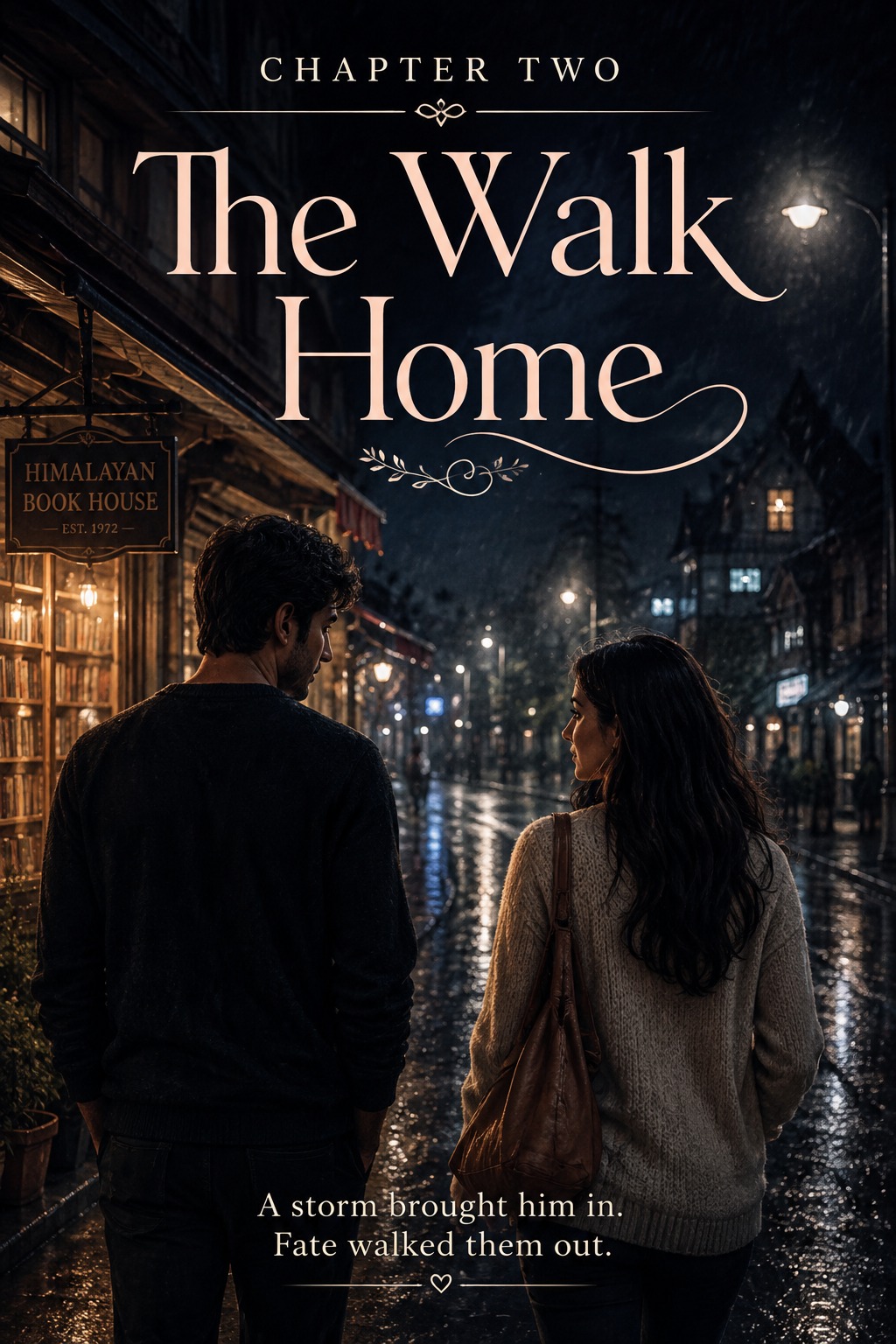
 ## Chapter Two: The Walk Home
"Tell me about this shop," Kian said again, when she didn't immediately answer.
Mira considered him for a moment, as if deciding whether the request was genuine or simply something to fill the silence with. Apparently she decided it was genuine, because she leaned back slightly and let her eyes travel over the shelves the way someone looks at a room they've loved for a long time.
"My grandfather started it. My uncle inherited it, and inherited none of his business sense along with it, which is why it's still standing on charm rather than profit." She said this fondly, not unkindly. "I do the accounts sometimes. Don't tell him I said that."
"Your secret's safe."
"It had better be." She glanced at him. "What about you? What brings a man in a soaked pullover to a bookshop that smells like it hasn't been dusted since the last monarchy?"
"The rain."
"Only the rain?"
"Overwhelmingly the rain."
She smiled at that, and Kian found himself watching the smile a beat longer than the joke warranted.
"I'm Kian," he said.
He was aware, as he said it, that he was giving her exactly enough to seem forthcoming and nothing at all that might mean anything. It was a small, deliberate omission — the kind he made a dozen times a week in boardrooms, without a second thought. He was surprised to find this one required a second thought.
Mira only nodded, unbothered, the way a person nods at any name offered to them in passing. "Mira."
"Mira," he repeated, and something in him noted — carefully, the way he noted most things — that the name had settled into his memory with unusual ease.
"So," he said, before she could ask him anything further about himself, "you happened to be here today, and I happened to get caught in a storm, and—"
"I didn't happen to be here." She said it plainly, without offense. "I come here every day after college."
"Every day?"
"Most days."
"Good," he said — and heard himself say it before he'd quite decided to. Her eyebrows lifted a fraction. He recovered, smooth as water finding its level. "Good for your uncle. Free labor."
"I'm not sure he'd describe it that way."
"No?"
"He pays me in tea."
"Exploitative."
"Completely."
He glanced toward the textbook she'd left near the counter. "You're studying?"
"Biotechnology."
That surprised him — genuinely, not for effect. "Biotechnology."
"Why do you say it like that?"
"I was expecting literature. You looked personally offended when I picked up a history book I had no intention of reading."
"That was professional judgment. Very different."
"What are you planning to do with it? The biotechnology."
The question should have been simple. Mira looked, for a moment, as though it wasn't.
"I don't know yet."
"No plan?"
"I have plans." A pause, and something crossed briefly behind her eyes before she smoothed it away. "Plans just require life to cooperate sometimes."
There was more underneath that sentence than she'd said aloud — Kian had built a career on hearing what people didn't say, and he heard it now, clear as a struck bell. He was on the verge of asking when Mira turned toward the window.
The rain had thinned to a fine, silver drizzle. Somewhere down the road, the streetlamps flickered back to life.
"I think the storm's passed."
He looked, and unfortunately, she was right.
"We can leave now," she said.
"So we can," he said, with none of the enthusiasm the sentence deserved.
By the time they stepped outside, the power had returned to most of the market, and the wet road gleamed black under the lamps. Mira locked the shop door and turned to find Kian still standing there.
"You're waiting?"
"I thought that was obvious."
"For what?"
"For you. I'll drop you home."
"No, thank you. I'm walking."
"Then I'll walk you home."
"Kian." It was the first time she'd used his name, and he felt it more than he expected to. "I can manage."
"I didn't say you couldn't."
"Then why are we arguing?"
"We aren't. You're refusing an extremely reasonable offer."
"And you're refusing an extremely clear answer."
He smiled. She noticed, and narrowed her eyes at him.
"Why are you smiling?"
"No reason."
"That's suspicious."
"Is it?"
"Very." She turned and started walking. He let her get three full steps before he called after her.
"Mira. The roads are empty. It's dark. And you expect me to just watch you walk home alone?"
She stopped. "Let me?"
"Wrong word."
"Very wrong word."
"Fine — watch you walk home alone, and then spend the entire night wondering whether you got there safely." He spread his hands, entirely too pleased with himself. "Do you really want that on your conscience?"
"Nothing is going to happen to me."
"You don't know that."
"Neither do you."
"Exactly," he said, delivering it as though she'd just conceded the whole argument.
Mira stared at him a moment longer, then turned and walked another few steps before stopping to look back over her shoulder.
"Well? Are you coming or not?"
His grin arrived before he could stop it. "Of course."
The rain had settled into a faint, persistent drizzle. Water ran in narrow streams along the edges of the road, and the trees released their held drops whenever the wind moved through them. The air smelled of wet earth and cold stone, and somewhere in the dark hillside, crickets had begun calling to each other as if the storm had never happened.
They walked without speaking for a while — an easier silence than the one in the shop had been.
"Who do you live with?" Kian asked eventually, faintly annoyed at himself for how long it had taken him to land on something as ordinary as a question. He was used to knowing exactly what to say to people within seconds of meeting them. He was less used to wanting to know the answer.
"My uncle. My aunt. My younger cousin, Mehek — she's more like a sister."
"And your parents?"
The change in her was small. Her steps didn't slow and her face didn't fall, but her voice quieted by a degree. "They died when I was little. Car accident."
"I'm sorry." He wished, almost as soon as he'd said it, that he hadn't asked.
"It's all right." The smile she gave him was faint, and old, and practiced — the smile of someone who had learned to carry a thing without showing the weight of it. Kian understood that particular skill better than most people assumed he did.
They walked on. Near a bend where a narrower lane disappeared between trees and low stone houses, Mira stopped.
"This is far enough."
"I'll take you to your door."
"No."
"Mira—"
"Really. I'll go from here."
He studied her face. This refusal was different from the others — not teasing, not stubbornness. Something quieter.
"Why?"
She hesitated. "My aunt. If she sees me coming home with a man—"
"I'm walking you home. That's all."
"I know that."
"So what's the problem?"
"You don't know my aunt." She said it with a certainty that would have made him laugh, if something in her face hadn't stopped him. She glanced toward the dark lane. "She doesn't need much of a reason."
"For what?"
The door closed, the way he was beginning to recognize it did. "No reason. I shouldn't have said anything."
He didn't like that answer — not because it was inadequate, but because it was deliberate. She was protecting something, or someone, or possibly only herself. He filed it away, the way he filed most things that didn't add up yet.
"Any trouble at home?"
"No." Too quick. She heard herself say it too quickly, and said it again, more firmly. "No. Nothing like that."
He let it go. For now.
"I should go," she said, shifting her bag onto her shoulder. "Thank you for walking with me."
"It was a terrible hardship."
She smiled despite herself. "Good night, Kian."
"The pleasure was entirely mine."
Something shifted very slightly in her smile at that — he wasn't sure what — and then she stepped back and turned up the lane. He stayed where he was, listening to her footsteps for longer than he needed to, until the sound of them was gone entirely.
Mira, he thought. Biotechnology student. Works in her uncle's shop every afternoon. Lives beyond that bend with an aunt she'd clearly rather not discuss.
He smiled to himself, once, and turned back toward the main road.
Mira reached home expecting the worst, and found exactly that waiting in the sitting room.
"Where have you been?" Sunita didn't look up from her chair.
"The storm—"
"Of course. The storm. Her Highness finally remembers she has a home to return to."
"Sunita, enough." Vikram lowered his newspaper, his face changing the moment he looked at Mira properly. "Are you all right? You weren't frightened?"
"No, Uncle. I'm fine." That was true, technically. She had been many things that evening — uncomfortable, embarrassed, oddly and constantly aware of a man sitting across a candlelit table from her — but not frightened.
"Go change. You're damp."
She escaped upstairs before Sunita could find a second wind.
She and Mehek shared a room, and Mehek was already in bed, though the book lying open and forgotten on her stomach suggested sleep hadn't been part of the evening's plans. She sat bolt upright the moment Mira came in.
"There you are! I was worried — the power went out everywhere, you were alone in that shop in the dark—"
"I wasn't alone."
Mehek stopped.
Mira began unpacking her bag, as if the sentence hadn't been enormous. "There was a man. He got caught in the storm and came in to wait it out. We talked."
"What man?"
"His name was Kian."
Mehek's expression did nothing dramatic at first — the name meant nothing on its own, and Mira hadn't expected it to. "Was he nice?"
"Surprisingly." Mira pulled off her cardigan. "Irritating. But nice. Insisted on walking me home, wouldn't take no for an answer."
"What's his last name?"
"He never said. Just Kian." Mira paused, folding the cardigan over her arm. "There was a car waiting near the market when we finally said good night. Driver and everything. And someone kept calling his phone — he never answered it, just kept glancing at it like he already knew who it was and didn't care."
Mehek went very still.
"A car. With a driver." She sat up straighter. "Mira. The one everyone's been talking about since Monday — the one arriving in Shimla yesterday — what was his name?"
"Mehek—"
"Kian Dutt." She was already reaching for her phone, thumb moving fast. "Tall. Dark hair. Rich enough that people drive him around and he doesn't even look at his phone." She turned the screen toward Mira before she'd finished speaking. "Look."
Mira looked.
The photograph was clean and professional, the kind taken at some family event rather than a candid — but it was unmistakably him. The same face she'd watched by candlelight two hours earlier, illuminated now by proper lighting and captioned with a family name she recognized from every single conversation she'd successfully ignored that morning.
"Oh," Mira said, very quietly.
Mehek stared at her. "You didn't know."
"No."
"You spent an entire evening with Kian Dutt and you didn't know."
"I didn't ask for a last name. He didn't offer one." Mira sat down slowly on the edge of her bed, turning this new information over as if it might rearrange the evening behind it — the whole conversation replaying itself in a different light, every ordinary question he'd asked her suddenly worth a second look. "He let me think he was just — Kian."
"Why would he do that?"
Mira didn't have an answer for that. She wasn't entirely sure she liked how much she wanted one.
"Mira." Mehek's voice had dropped to something closer to awe. "He walked you home. On purpose. Knowing exactly who he was, and you had no idea."
"It doesn't mean anything."
"It means everything."
"It means he forgot to mention his surname."
"Nobody forgets that they're Kian Dutt."
Mira had no answer for that either, and the absence of one bothered her more than she wanted to admit.
She turned toward the cupboard to end the conversation, and behind her, a voice began, entirely too pleased with itself.
"Mira's wedding is coming—"
"Mehek."
"—Kian Dutt will be waiting—"
A pillow found its target with excellent aim. Mehek dissolved into laughter beneath the blanket.
"Good night," Mira said, in a tone that closed the subject with considerably less success than she'd hoped.
"Good night, future Mrs. Dutt."
A second pillow followed the first.
Elsewhere in Shimla, Kian was no longer smiling.
He stood at the window of his hotel suite, the city scattered in light below him, while his project manager waited a few feet behind with a folder tucked under one arm. Kian didn't offer him a seat.
"Have you found the land?"
"Yes, sir. There's one issue."
"One?"
"The parcel you liked. The owner won't sell."
"You told me negotiations were underway."
"They were."
"And?"
"They refused."
"Increase the offer."
"We did."
"Increase it again."
"Sir—"
"Give them whatever number they want."
The manager hesitated, and Kian caught it instantly. "What?"
"They don't want a higher number."
"Everyone wants a higher number."
"Not these people. They simply don't want to sell."
For several seconds, Kian said nothing. The project mattered more than the people around him fully understood — months of capital, planning, political negotiation, and investor confidence had already been built around this exact stretch of hillside. He did not enjoy obstacles that believed themselves permanent.
"Take me to them."
"Sir?"
"Tomorrow morning."
"You want to speak to them yourself?"
"Apparently I have to." He turned back to the window. "Set it up."
Morning began for Mira exactly as most mornings did — before sunrise, tea, breakfast, lunch preparation, the floors, Mehek complaining about the injustice of consciousness, Sunita finding fault with something before Mira had even finished it. Ordinary life had a remarkable ability to resume itself, as though nothing unusual had happened inside it at all.
A few streets away, a black car stopped at the entrance to a narrow residential road, and Kian looked out the window at it twice before he placed why it seemed familiar.
"We'll need to walk from here," his manager said.
Kian stepped out and recognized the bend immediately — the same one where Mira had turned last night and told him, with absolute finality, that this was far enough. A smile arrived before he could stop it.
"Sir?"
"Nothing."
He glanced up the lane as they passed it, at the stone houses scattered along the slope, at the small balconies and shuttered windows, and told himself he was only curious. It was becoming a suspiciously convenient explanation. Somewhere along this road, Mira Thakur was probably arguing with her cousin over a hairbrush, or tying that plain, unbothered ponytail of hers, entirely unaware that the man from the bookshop was fifty meters from her front door.
He almost laughed at himself. He had come here to negotiate a multimillion-dollar land acquisition and was apparently checking balconies for a woman he'd met the day before.
"Sir." His manager had stopped beside a gate. "This is it."
Kian turned toward the property, and whatever had briefly softened in his expression closed over again, instantly, the way it always did when there was work in front of him.
"Good."
The manager pushed open the gate, and Kian followed him through it, with no idea yet that the land he'd come to acquire and the girl he'd met in a bookshop were about to become the same problem.