
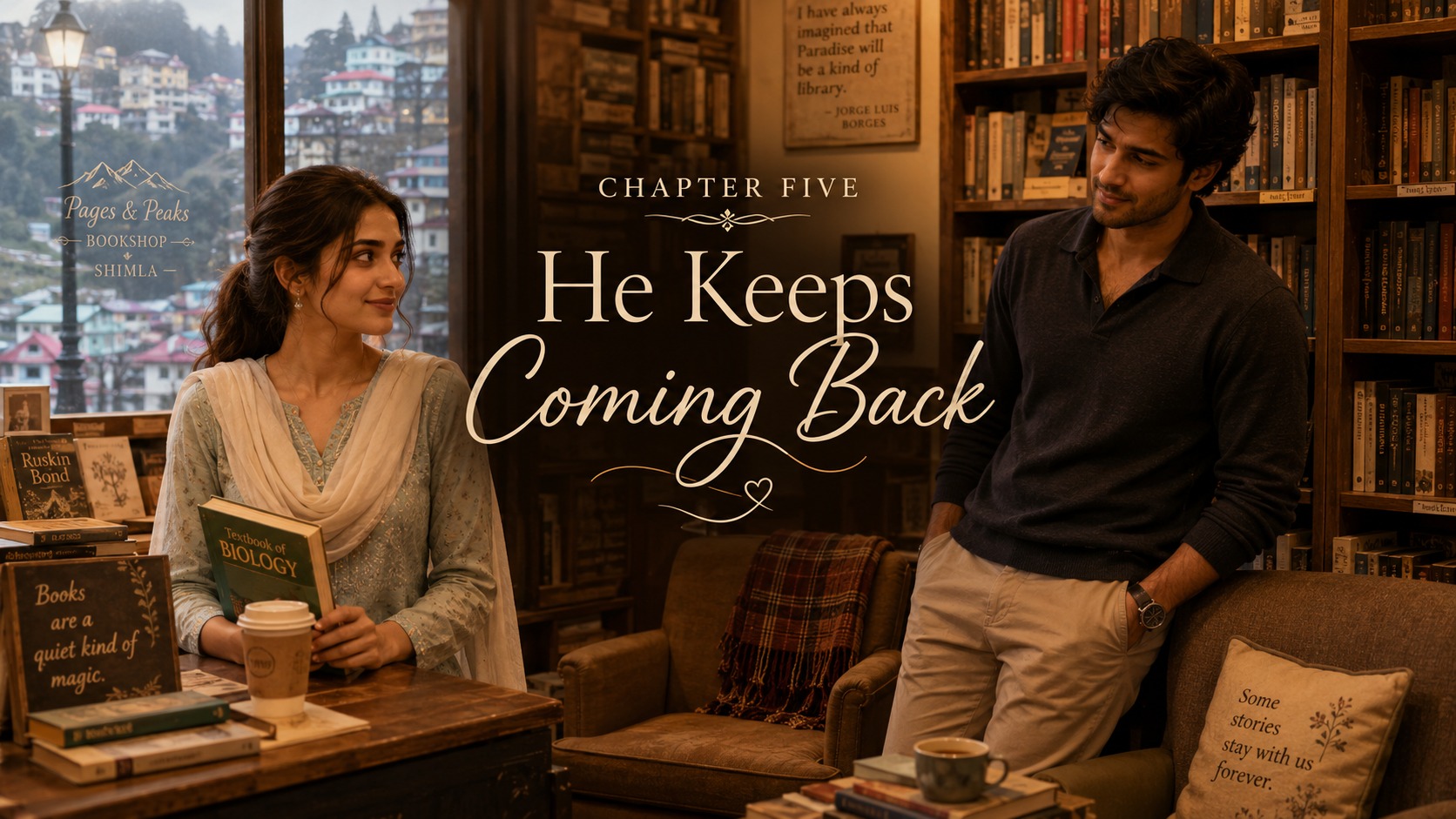
 ## Chapter Five: He Keeps Coming Back
The bell above the door rang at four in the afternoon, and Mira didn't even need to look up to know who it was. Nobody else in Shimla pushed a door open like they were mildly irritated at it for existing.
"We're not doing this again," she said, eyes on her textbook.
"Doing what?"
"You, appearing here with some excuse involving a book you have no intention of buying."
"I might buy a book."
"You might."
"I'm a man of unpredictable literary appetites."
That got her to look up. He was holding out a small paper cup, steam curling from the lid.
"A peace offering," he said, before she could ask.
"We aren't fighting."
"A preventative one, then."
"That sounds suspicious." She eyed it anyway. "What is it?"
"Coffee. From the place near the Ridge with the queue that wraps around the corner."
"You stood in that queue?"
"Absolutely not." He looked faintly offended by the suggestion. "I sent someone."
"Of course you did."
"I'm capable of personal growth. Not unnecessary suffering."
She picked up the cup, mostly so she'd have something to do with her hands. "You remembered I liked their coffee. I said that once. In passing. About something else entirely."
"I have an excellent memory."
"That's slightly alarming."
"It's occasionally useful." He rested one hand on the counter, watching her take the first sip, and when she didn't immediately say anything, added, "Fine. I also needed an excuse to come back."
Something in her chest shifted at how easily he said it — no performance in it at all, which was somehow worse than if there had been. She took another sip to cover the pause.
"You needed an excuse. To come to a bookshop."
"To see you."
She looked up properly then. His mouth curved, unhurried.
"I considered simply saying I missed annoying you, but coffee seemed more dignified."
"You missed annoying me."
"Enormously. It's been almost a full day."
"You've survived worse."
"Debatable."
He pulled the second armchair closer without asking — the one that had, in the space of one storm and one afternoon, quietly become his — and sat.
"That's become your chair very quickly," she said.
"I like it."
"You've sat in it twice."
"Enough for attachment."
"You form attachments quickly."
The words left her before she'd quite decided to say them. For half a second neither of them spoke, his eyes steady on hers, and then he leaned back into the chair.
"Apparently," he said.
Mira looked down at her textbook. The coffee suddenly required her full concentration.
He stayed. That was the strange part — she'd assumed "I wanted to see you" meant another walk, another hour somewhere in the hills, another argument before he vanished back into whatever life Kian Dutt lived when he wasn't in her uncle's shop. Instead he simply stayed, picking up a paperback from the side table, reading the back cover, opening to a page somewhere in the middle, closing it again.
"You're very bad at browsing," she said.
"I'm evaluating."
"You opened one book, in the middle, and gave up."
"It failed the sentence test."
"That may be the single stupidest piece of literary criticism I've ever heard."
"I did warn you my appetites were unpredictable."
She went back to her reading. Or tried to. Five minutes later, without looking up from the diagram in front of her, she became aware that he'd leaned forward to study it too.
"Do cells actually look like that?"
"No."
"Then why draw them like that?"
"Because textbooks enjoy watching students suffer."
"I knew academia had a business model somewhere."
"You're distracting me."
"You haven't turned the page in eight minutes."
She looked down. He was right, which she disliked intensely. "I'm thinking."
"You've been thinking about the same paragraph."
"Were you counting?"
"Approximately." He reached over and turned the book toward himself before she could stop him. "What is it, actually? Cell signalling."
"That sounds threatening."
"It isn't."
"Then what does it do?"
She hesitated, genuinely thrown by the question. "You actually want to know?"
"Yes."
"Why?"
"Because you're studying it."
Something about the plainness of that answer disarmed her more than any of his lines had. She turned the book back around and, against her better judgment, started explaining — cells signalling one another, receptors, the cascade of response that followed, growth or metabolism or movement or, in some cases, a cell's own carefully orchestrated death. He listened properly, not politely — interrupting every few sentences with a question, some sharp, some absurd, until ten minutes had passed and she'd entirely forgotten she was supposed to be irritated with him.
Vikram emerged from the storeroom with a ledger under one arm and stopped at the sight of him.
"Kian."
It was, Mira noted, the first time she'd heard her uncle use his first name so easily.
"Mr. Thakur."
"You're back."
"Mira is attempting to educate me."
"Good luck to her." Vikram glanced at the textbook and disappeared again before Mira could object to the betrayal.
"You've charmed my uncle," she said.
"I said approximately six words to him."
"That might be exactly why."
Somehow the conversation drifted from cell signalling to boarding school, and Mira never quite tracked the route it took to get there — only that one moment he was questioning the number of abbreviations in biology, and the next he was telling her, with total sincerity, about a roommate who had kept a pet iguana under his bed for nearly three months.
"You're lying."
"I wish I were."
"How does one hide an iguana?"
"Badly. It escaped during a morning inspection. Came out from under the wardrobe directly in front of the housemaster, and the boy simply looked at it and claimed he'd never seen the creature in his life."
Mira laughed hard enough that Vikram called out from the back room to check everything was all right.
"Everything's fine, Uncle!" she called back, then, quieter, to Kian, "You're going to get me a reputation — laughing loudly at a man in the bookshop instead of working."
"A man?"
"Yes."
"Yesterday I was apparently a boy who needed feeding."
"You were behaving like one."
"There was an iguana in that story. That doesn't reduce my age."
"It does, slightly."
She was still smiling when she reached across to straighten a stack of books that didn't actually need straightening — she only realized that after her hand was already there. Kian reached for the same book. His fingers stopped an inch from hers.
Neither of them moved.
It was nothing — not even contact, only two hands resting near each other over a worn spine — and yet the whole shop seemed to hold still around it. Mira looked at their hands, then at him. He was already looking at hers, openly, not pretending otherwise.
She withdrew first, unhurried, and picked up her coffee instead.
"You're doing that thing again."
"What thing?"
"Looking at something simple like it requires analysis."
"I don't know what you mean."
"You do."
He considered denying it a second longer, then didn't. "Fine. I was looking at your hand."
"I noticed."
"I assumed you had."
"You're surprisingly honest about being caught."
"Would you prefer a lie?"
"No."
"Excellent."
"That wasn't praise."
"I'll take what I can get." He was quiet for exactly as long as it took her to lift the cup again before adding, "You do realize you're flirting with me."
She nearly choked on the coffee. "I am not."
"You are."
"I was discussing your inability to behave normally around books."
"With unusual warmth."
"You have an extraordinary imagination."
"I've been accused of worse." He nodded at her. "You were the one staring at my hand."
"I was not."
"That part was mine, admittedly. But you were flirting."
She opened her mouth to argue further, thought better of it, and reached instead for her textbook. "Buy a book, Kian."
"Changing the subject."
"Saving myself."
"From?"
"You."
His smile shifted, just slightly, and she heard what she'd said a half-second after she'd said it. "Cell signalling," she added quickly, opening the book with more force than strictly necessary.
He laughed — an easy, unguarded sound — and something in her warmed at having caused it, an ease she refused to examine any further than that.
His phone rang twenty minutes later.
She saw the change arrive before he'd even answered it — his eyes flicking to the screen, and something behind them closing, quiet and immediate, like a door shutting several rooms back in a very large house.
"One minute," he said, already rising, already turned toward the window.
His voice, when it came, belonged to someone else. Sharper. Certain in a way that assumed the world would simply rearrange itself around whatever he decided next. "If the survey team can't access that route, reroute them... I need the eastern elevation data before tomorrow morning, not after the Ashford call... I'm not interested in why the schedule slipped. Fix it."
Mira kept her eyes on her book and listened anyway. This was the Kian Dutt half of Shimla had spent a week gossiping about — not because he'd done anything himself yet worth gossiping about, as far as she could tell, but because of whose son and nephew he was — standing in her uncle's shop with his shoulders set differently, his voice cut down to something clean and absolute.
"Good. Send me the revised report." He ended the call, and for a moment simply stood there at the window. Then she watched him do something she found more interesting than the call itself: put it away. Not forget it — set it down, deliberately, the way a person puts down a tool they're finished with, until his shoulders had eased back into their ordinary shape and the line between his eyebrows had smoothed out entirely.
"Sorry about that," he said, sitting back down.
"Everything all right?"
"Survey issue. For the development."
"The one that involves Uncle's property?"
A beat, half a second too long. "Part of the larger project."
She didn't push further. Not yet. He picked up his coffee instead, gone cold by now, and drank it anyway.
"You do that very smoothly," she said.
"Do what?"
"Change. One second you're telling me about an iguana, and then you're — " she gestured vaguely at him " — that."
"That's very informative."
"You know what I mean. The person who talks like everyone within five miles just became his employee."
"That seems unfair."
"Is it? You even sit differently. Straighter. And you get this line —" she touched her own forehead between her eyebrows without quite meaning to " — right here."
His gaze followed the movement. "That sounds unattractive."
"It is."
"Devastating." But the joke came a beat slower than usual, and she caught something underneath it — the first real hesitation she'd seen in him all week.
"And afterward you just turn it off," she said. "That version of you."
The smile faded, slightly. "It's deliberate, if that's what you're asking."
"Why?"
"Because there's usually no reason to carry one problem into the next room."
"That sounds very organized."
"It is."
"Exhausting."
He glanced up. "Why?"
"Because you're still carrying it. You're just pretending you're not."
That landed somewhere. She saw it — a small pause, there and gone, before he looked around at the shop instead of at her: the mismatched armchairs, the old shelves, the faint rain-marks still visible on the glass from two nights ago.
"I've never thought of it that way," he said finally.
"Maybe you should."
"Dangerous advice. You've already made me think twice this week."
"Terrible experience?"
"Deeply unpleasant." A pause. "It's easier this way. Keeping things separate."
"Business from everything else."
"Mostly."
"Does it work?"
"Usually."
"And when it doesn't?"
He looked at her for a long moment, something unreadable moving behind his eyes. "I haven't decided yet."
She didn't know why that particular answer stayed with her longer than any of his easier ones had. Perhaps because it wasn't a joke. Kian Dutt, she was learning, almost always sounded certain of everything — and this was the first time he hadn't.
"Well," she said, looking away first, "for what it's worth, I prefer this version."
He went very still. "This version."
"The one without survey teams. Or deadlines. Or that face."
"My unattractive business face."
"Exactly that one."
"I'll try not to bring him here."
She laughed, and he watched her do it in a way that made the laughter fade slowly rather than end — not because she was uncomfortable, but because she'd become, all at once, too aware of him: the man in the armchair who'd remembered a coffee order from one offhand sentence, who'd followed her through ordinary streets yesterday for no reason he could easily explain, who apparently preferred this small shop to whatever waited at the other end of his phone.
"I'm making tea," she said, reaching for the kettle mostly to have something to do with her hands.
"You have coffee."
"For Uncle."
Behind her, quietly: "Mira?"
"What?"
"I prefer this version too."
She looked over her shoulder. He wasn't smiling now, and she understood exactly what he meant — not the shop. Not the afternoon. Her. The answer rose in her before she could stop it, so she did the only thing she knew how to do when something started mattering more than she was ready for.
She made it smaller.
"The other version seems exhausting to be around."
He laughed. "There you are."
"What?"
"I was worried sincerity had killed you."
"You survived yours."
"Barely."
By six he still hadn't bought anything, and Mira finally set both hands on the counter.
"You've been here two hours."
"Correct."
"You've had coffee. Tea. Half of Uncle's biscuits."
"That accusation lacks evidence."
"And purchased nothing."
"I was considering it."
"For two hours?"
"Literature requires care."
She came around the counter, pulled a paperback off the nearest shelf, and held it out. "Here."
"What is it?"
"A novel. You wanted one."
"Did I?"
"You claimed you might."
"That was before I discovered conversation was free." He turned it over anyway. "Why this one?"
"Because I like it."
That seemed to settle something for him instantly. He opened to the first page, read a single line, and closed it again. "I'll take it."
"That fast?"
"You recommended it."
"I handed it to you because you needed to buy something."
"A very compelling recommendation, all the same."
She rang it up. He handed over a note far larger than necessary, and when she went to make change, their fingers actually touched this time — brief, ordinary, the kind of contact that happens a hundred times a day between two people exchanging money. Neither of them moved quite as quickly as the moment required. She felt it travel the length of her arm regardless, and said nothing, and neither did he.
Vikram reappeared long enough to see him to the door. "You're leaving?"
"Apparently Mira's decided I've loitered long enough."
"You have."
"Thank you for tolerating me, Mr. Thakur."
"Anytime," Vikram said, entirely too warmly, and vanished again before Mira could object to the betrayal a second time.
She followed him to the door — to lock it behind him, she told herself, and nothing more than that. Evening had settled cool and blue over the street, shop lights beginning to glow along the road.
He turned back. "Tomorrow?"
"You came today without asking."
"You told me yesterday."
"I said tomorrow, yesterday. That only covered today."
"So I'm asking now." He waited, unhurried, while she attempted to look as though she were seriously weighing it.
"You're very persistent."
"Yes."
"At least you admit it."
"I've been told honesty is attractive."
"By whom?"
"Currently hoping it's you."
She laughed despite herself, and there it was again — the small, alarming pleasure of watching him pleased because of her.
"I have college," she said. "And the shop. And studying."
"I know all three."
"You know everything, apparently."
"Not everything."
"Progress."
"Tomorrow?"
She should have said no. Whether she wanted to was, increasingly, beside the point. "Maybe."
His smile widened. "That's practically enthusiastic."
"It means maybe."
"I've learned your language."
"You have not."
"Goodnight, Mira."
She began closing the door. He put one hand lightly against its edge — not stopping it, only keeping it from shutting for one extra second — and when she looked at his hand and then at him, he removed it at once.
"Goodnight."
Something in her softened despite every intention not to let it. "Goodnight, Kian."
The bell gave its small chime as the door shut. Through the glass she watched him walk off down the road with the book tucked under his arm. He didn't look back. She stood there a moment longer than she meant to before returning to the counter, where her textbook sat open to the same page she'd abandoned two hours earlier. She read the first sentence. Read it again. Realized she had no idea what it said, and lowered her forehead gently onto the book.
"Studying?" Vikram called from the back.
"Yes!"
A pause. "Very hard?"
She closed her eyes. "Extremely."
Kian's phone was buzzing again before he'd reached the end of the street. He ignored it until he was inside the car, where his manager was already waiting in the front seat with a folder on his lap.
"You're in my car."
"You stopped answering your phone."
"That was deliberate."
"I gathered." His manager's eyes moved to the paperback tucked under Kian's arm, then back to his face. "You bought a book."
"Yes."
"I've worked for you three years. I've never seen you voluntarily purchase fiction."
"It was recommended."
Understanding arrived on the man's face with visible speed, and Kian regretted the sentence the moment it left him.
"Don't," he said.
"I said nothing."
"Your silence is doing quite a lot of work."
The folder came over the seat instead, mercifully changing the subject. "More of the estate documentation came through. Enough to confirm yesterday's read — the full instrument should be complete by tomorrow."
Kian opened it. Trustees. Restrictions. Beneficial interest. Parcel references, page after page of legal architecture built around land he now knew belonged, on paper if not yet in practice, to a woman who'd handed him a paperback an hour ago because she liked it.
"The parcel's central to the current configuration," his manager went on. "We can redesign around it, but the numbers get considerably worse."
"How much worse?"
"You'll have a figure tomorrow. You won't like it."
Kian scanned another page without absorbing a word of it, and set the folder down on his knee, the paperback resting beside it on the seat. Two objects, side by side, belonging to two entirely separate parts of his life.
He had met her before he knew the land was hers. He'd gone back today because he'd wanted to, not because of any parcel or configuration or number his manager was about to hand him tomorrow. Whatever happened with the estate would be handled on its own terms, the way everything else was — one problem in one room, kept carefully apart from the next.
That was how he did things. It had never once failed him before.
"Get me every alternative configuration," he said. "All of them. Even the expensive ones."
"And the estate?"
"Keep working on it."
The car pulled away from the curb. Kian opened the folder again, read three pages, and realized afterward that he could not have repeated a single word of them. He looked instead at the paperback beside him, picked it up, opened it to the first page, and began, for the first time in longer than he could easily remember, to read something with absolutely no practical use to him at all.