
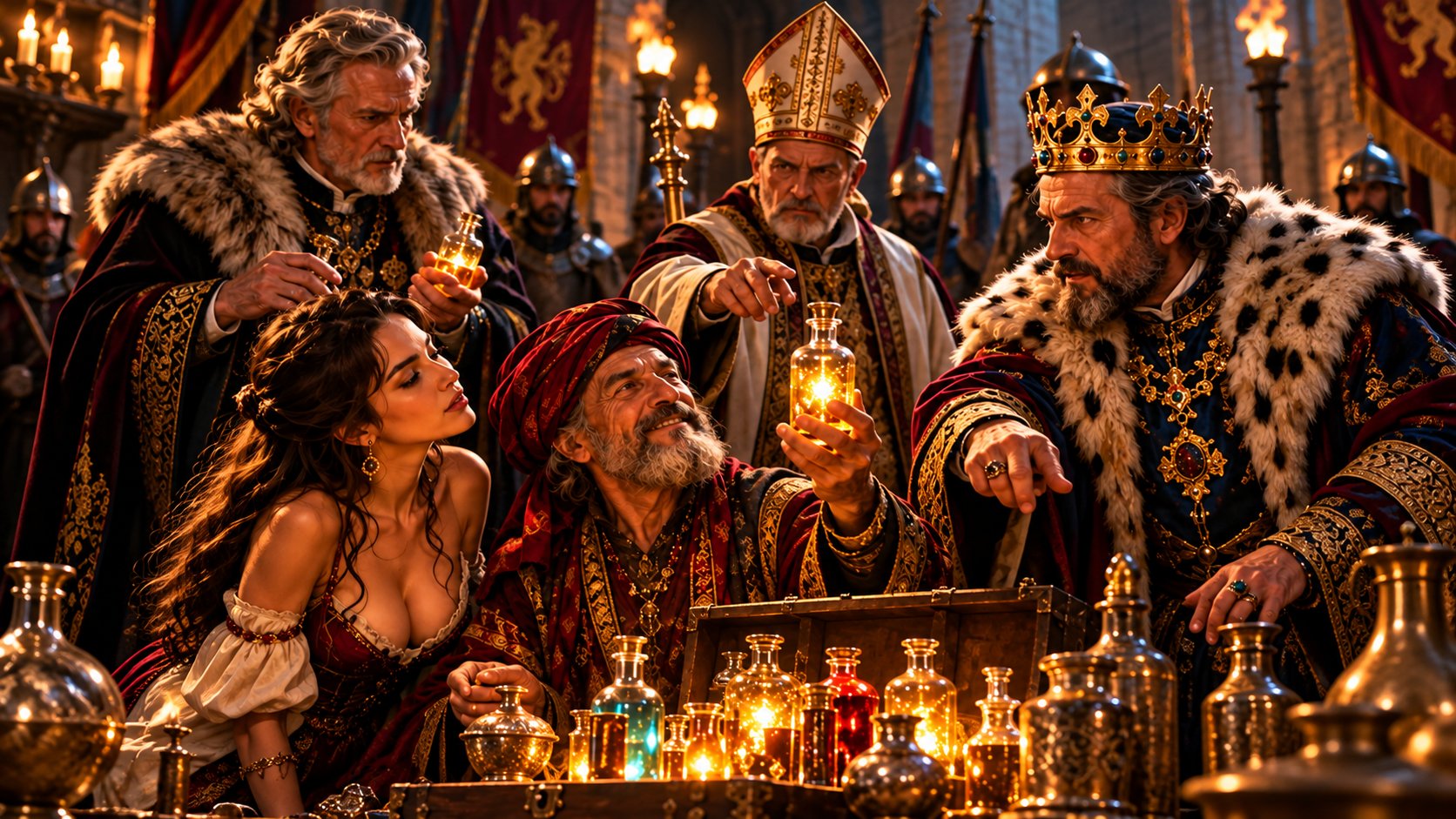
The merchant arrived on a Tuesday, although some later insisted it had been a Sunday.
I remember it was Tuesday because the market was open, the church bells were silent, and the executioner was having his boots repaired.
He came without guards, servants, or a caravan. Just a small wooden cart, a gray horse, and a sign painted in gold letters:
ETERNAL LIFE FOR SALE.
By noon, half the town had gathered around him.
The merchant was an ordinary-looking man, perhaps fifty years old, with tired eyes and the patient expression of someone who had spent too many years explaining simple things to people determined not to understand them.
He stood beside his cart, smiling.
"Come closer," he announced. "I offer something that kings have sought, philosophers have imagined, and priests have promised since the beginning of time."
A wealthy merchant pushed through the crowd.
"How much?"
"That depends," replied the stranger.
"On what?"
"On how much you fear dying."
The man hesitated.
"Everyone fears death."
"Not everyone," said the stranger.
I was standing beneath the awning of a tavern, enjoying a glass of wine and the spectacle of human stupidity, which has always provided me with inexpensive entertainment.
The wealthy man produced a purse of gold.
"I'll take one."
The merchant accepted the purse and handed him a small wooden box.
The buyer opened it immediately.
It was empty.
"What's this?"
"Your eternity."
"There's nothing inside!"
"Precisely."
The crowd murmured. The buyer looked furious, but he closed the box and hurried away. Perhaps he feared that admitting he had been cheated would make him appear foolish.
By evening, every wealthy family in town had purchased at least one box.
Some bought several, presumably to ensure that their children and grandchildren would never have to suffer the inconvenience of dying.
Others locked their boxes in iron chests, hired guards, and refused to let anyone approach them.
The poor watched with resentment.
The rich watched one another with suspicion.
And the merchant continued smiling.
The following morning, three priests arrived.
Their spokesman was a large man whose magnificent robes suggested that poverty was a virtue best practiced by others.
"We have been informed," he declared, "that you are selling eternal life."
"That is correct."
"Eternal life belongs to God."
"I have never claimed otherwise."
"Then you must cease your activities immediately."
"Why?"
"Because salvation cannot be sold!"
The merchant looked genuinely surprised.
"An interesting objection, coming from you."
The crowd fell silent.
I nearly choked on my wine.
The priest turned crimson.
"You are mocking the Church!"
"Not at all," replied the merchant. "I am merely admiring your concern for commercial competition."
That afternoon, the priests demanded exclusive control of the boxes.
By sunset, the king had heard about the affair.
And kings, as history repeatedly demonstrates, cannot tolerate the existence of anything valuable that does not already belong to them.
Royal soldiers arrived the next morning.
Their captain read a proclamation announcing that eternal life was henceforth a matter of national security.
All remaining boxes were to be confiscated.
The merchant offered no resistance.
The soldiers loaded his cart onto a wagon and marched toward the palace.
I found him later, sitting alone outside the tavern.
For the first time, he appeared tired.
"Tell me something," I said.
He looked up.
"How much does eternity cost?"
"Nothing," he replied.
I waited.
"Eternity is free. What I sell is the fear of losing it."
I considered his answer.
"And people pay for that?"
"They always have."
He looked toward the palace, where the king's soldiers were carrying the confiscated boxes through the gates.
"Some pay with gold. Others with obedience. Many surrender their entire lives."
"And the priests?"
"They sell reassurance."
"The king?"
"Control."
"And you?"
He smiled faintly.
"I sell empty boxes."
I laughed.
It was not a polite laugh.
It was the sort of laughter that begins somewhere deep inside a man who has spent too many years watching humanity repeat the same absurdities.
The merchant did not join me.
Instead, he studied my face with an expression I could not interpret.
"Be careful," he said.
"Of what?"
"Of laughing at people who believe their fear is sacred."
They arrested him that night.
The charges included fraud, blasphemy, sedition, and attempting to interfere with the royal monopoly on eternal life.
His trial lasted less than an hour.
The wealthy demanded their money back.
The priests demanded repentance.
The king demanded to know whether the boxes actually worked.
The merchant answered every question with the same quiet smile.
No one ever discovered what became of him.
Some claimed he was executed.
Others said he escaped.
A few insisted that he had never existed.
As for the boxes, they remained in the royal treasury for many years. No one dared open them again.
And me?
They banished me for laughing.
I left the town at dawn, carrying little more than my coat, my traveling bag, and a bottle of wine.
At the crossroads, I found a small wooden box beside a milestone.
There was no inscription.
No lock.
No explanation.
I picked it up and shook it.
Nothing moved inside.
I thought about opening it.
Then I remembered the merchant's words.
Eternity is free.
I placed the box in my bag and continued walking.
I have carried it with me ever since.
And although many years have passed, I have never opened it.
Perhaps because I know what is inside.
Or perhaps because, after all this time, I am not entirely certain I want to find out.
— THE OUTCAST