
It was a miserable evening, the kind that makes a man question the wisdom of leaving his house.
Rain battered the windows of the tavern, the fire was struggling against the damp, and the wine was considerably better than the company.
I had come to meet a bookseller who owed me money. He never appeared.
Instead, I met the strangest man I have ever known.
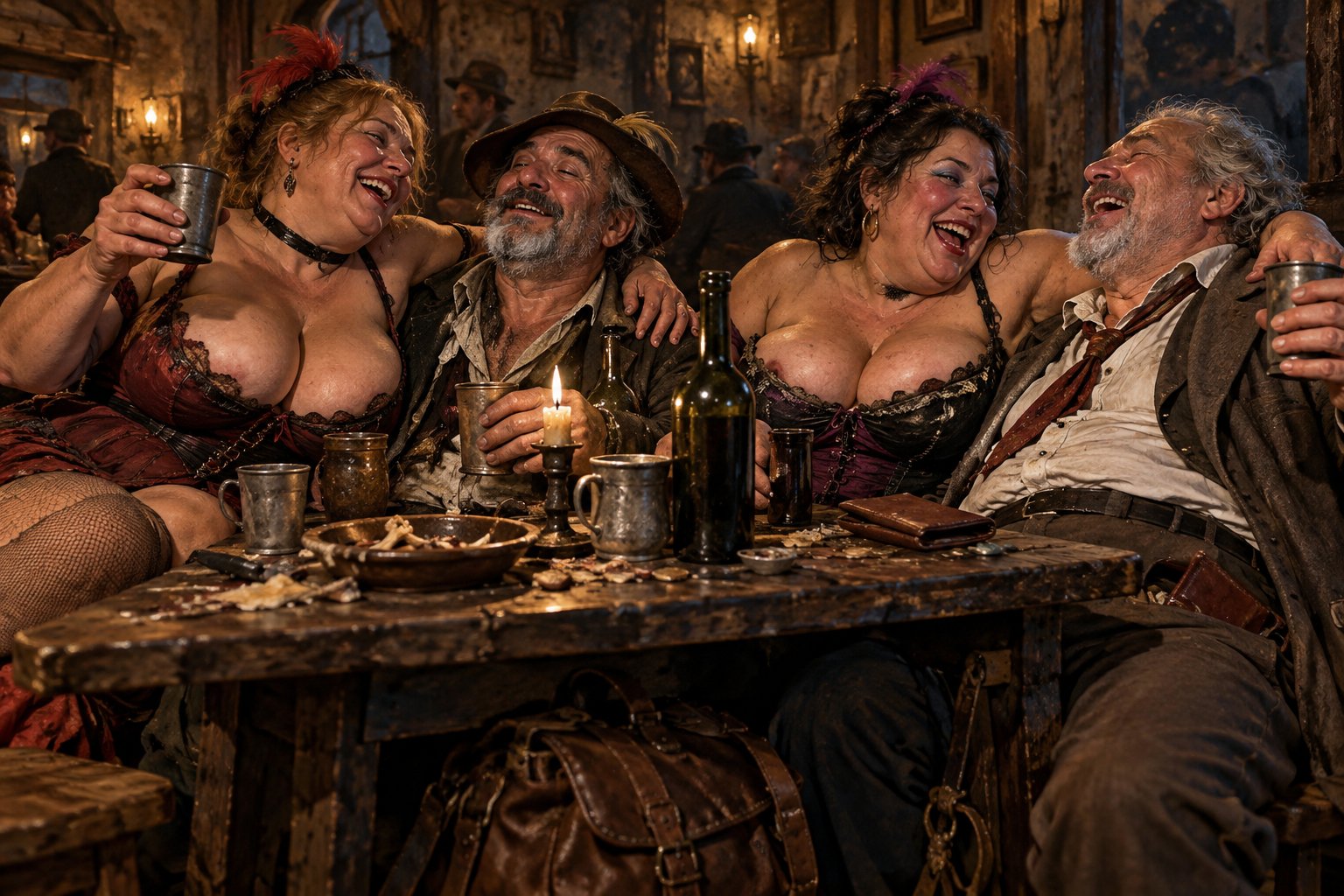
He was sitting alone at a table near the fireplace, wearing a weathered coat and a wide-brimmed hat. His gray beard was untidy, his eyes remarkably clear, and his expression suggested that he found the entire human race mildly amusing.
He had a bottle of wine before him and a traveling bag at his feet.
I might never have spoken to him had he not interrupted a conversation between two soldiers at the neighboring table.
"The emperor was a fool," he remarked.
One of the soldiers turned.
"Which emperor?"
"Most of them. But I was referring to the Roman one."
"And what would you know about Roman emperors?"
"Enough to avoid becoming one."
The soldiers laughed. I did not.
There was something peculiar about the way he spoke. He did not sound like a scholar repeating something he had read. He sounded like a man recalling an unpleasant acquaintance.
I approached his table.
"May I join you?"
"That depends," he replied.
"On what?"
"Whether you intend to improve the conversation or merely increase its volume."
I sat down.
My name is of little importance. I am an editor by profession, which means that I spend my days correcting the mistakes of men who consider themselves intellectually superior to everyone else.
It is a profession that encourages cynicism.
The stranger, however, appeared to have been born with it.
We began with the Romans.
From there, we moved to kings, wars, priests, philosophers, and women.
He had an opinion about everything, and almost none of his opinions were suitable for polite society.
"Religion," he declared, "is a remarkable enterprise. It persuades men to surrender the only life they know in exchange for another that no one can demonstrate."
"You are an atheist, then?"
"Certainly not."
"A believer?"
"That depends on what you wish me to believe."
"Do you believe in God?"
He considered the question.
"I have met too many people who claim to speak for Him. It has made me reluctant to join the conversation."
I laughed.
He raised his glass.
"To ignorance," he said. "The most widely distributed treasure in the world."
We drank.
Later, the conversation turned to war.
"Have you ever been a soldier?" I asked.
"Unfortunately."
"For which country?"
"Several."
"That sounds rather disloyal."
"On the contrary. I was consistently loyal to the same cause."
"Which was?"
"Survival."
I began to suspect that the man was either a liar of extraordinary talent or someone whose life had been considerably more interesting than mine.
Possibly both.
By midnight, we had consumed enough wine to make the distinction irrelevant.
By then, we were no longer alone. Two women had joined our table, both blessed with generous figures, infectious laughter, and a remarkable capacity for wine.
One had settled beside the stranger, her arm resting comfortably across his shoulders. The other had taken possession of the seat next to mine and seemed determined to discover whether an editor could drink as much as he talked.
The Outcast was in magnificent spirits. He told outrageous stories, flirted shamelessly with both women, and laughed so loudly that the innkeeper repeatedly threatened to throw us out.
At one point, the four of us raised our cups in a toast to something I can no longer remember.
I do remember the stranger leaning toward me and saying:
"Never trust a man who refuses wine, a woman who never laughs, or a king who promises justice."
"Is that wisdom?" I asked.
"No," he replied. "Experience. Wisdom would have prevented me from acquiring it."
The women roared with laughter, and I ordered another bottle.
He told stories about distant ports, forgotten cities, battles fought for reasons no one remembered, and women whose names he pronounced with an unexpected tenderness.
Occasionally, he mentioned events that had occurred centuries before his birth.
At least, before the birth he should have had.
I assumed he was inventing them.
But the details troubled me.
He described the smell of a burning city, the weight of an ancient sword, and the peculiar silence that follows a massacre.
Not like a historian.
Like a witness.
"Who are you?" I finally asked.
He smiled.
"A man who has been called many things."
"Such as?"
"Heretic. Traitor. Wanderer. Madman."
"And which do you prefer?"
He finished his wine.
"The Outcast."
"That is hardly a name."
"Neither are most of the titles men give themselves."
He reached for the bottle, discovered it was empty, and looked genuinely disappointed.
"Another?" I suggested.
"An excellent idea. You may yet become a respectable companion."
I remember very little of what happened afterward.
There was singing.
Someone broke a chair.
The innkeeper threatened to throw us into the street.
At some point, the stranger began arguing with a priest about whether heaven would be tolerable if it were populated exclusively by people who expected to go there.
The priest left.
We ordered another bottle.
Then darkness.
I awoke the following morning with my head resting on the table and a pain behind my eyes that suggested someone had attempted to split my skull with an axe.
The tavern was nearly empty.
The fire had died.
The stranger was gone.
So was my wallet.
I searched my pockets, then the floor, then beneath the table.
Nothing.
The innkeeper watched me with undisguised satisfaction.
"Your friend left before dawn," he said.
"He was not my friend."
"He said you would pay for everything."
"Of course he did."
I cursed the stranger, his ancestors, his descendants, and the entire institution of human companionship.
Then I noticed the bag.
It was still beneath the chair where he had been sitting.
A heavy leather traveling bag, worn at the corners and secured by a brass clasp.
I stared at it.
The thief had taken my wallet.
But he had forgotten his own belongings.
For the first time that morning, I smiled.
I carried the bag home.
Inside, I discovered a collection of objects that made very little sense.
An old knife, its blade stained with rust.
Three coins bearing symbols I did not recognize.
A small portrait of a woman whose expression was both beautiful and strangely sorrowful.
And a thick manuscript bound in dark leather.
On its first page, written in a firm but irregular hand, were the words:
MEMOIRS OF AN OUTCAST
Beneath the title, someone had added a note:
If you find this manuscript, have the decency not to publish it.
I read the sentence twice.
Then I began to laugh.
The scoundrel had stolen my wallet, left me with the tavern bill, and now expected me to respect his literary privacy.
I opened the manuscript.
The first pages described a journey through a country whose name I had never encountered.
The next recounted a conversation with a man who, according to every historical account available to me, had been dead for more than a thousand years.
I read until evening.
Then through the night.
By dawn, I had reached a conclusion.
Either the stranger was the greatest liar who had ever lived, or I was holding a document that could overturn much of what we believed about history.
There was, of course, a third possibility.
That I had gone mad.
As an editor, I considered all three equally plausible.
I never recovered my wallet.
Nor did I find the stranger.
But I kept his manuscript.
And after considerable reflection, I decided to publish it.
Not because I believed every word.
Not because I considered it my duty to enlighten humanity.
And certainly not because I wished to make the world a better place.
I published it because the bastard owed me money.
Besides, I suspected he would be furious.
That alone made the enterprise worthwhile.
And so began my association with the man who called himself the Outcast.
A man whose stories I would spend years trying to verify.
A man who had apparently witnessed things no living person could have seen.
And a man who, despite everything, I would eventually come to regard as something resembling a friend.
But that, as they say, is another story.
— THE EDITOR