
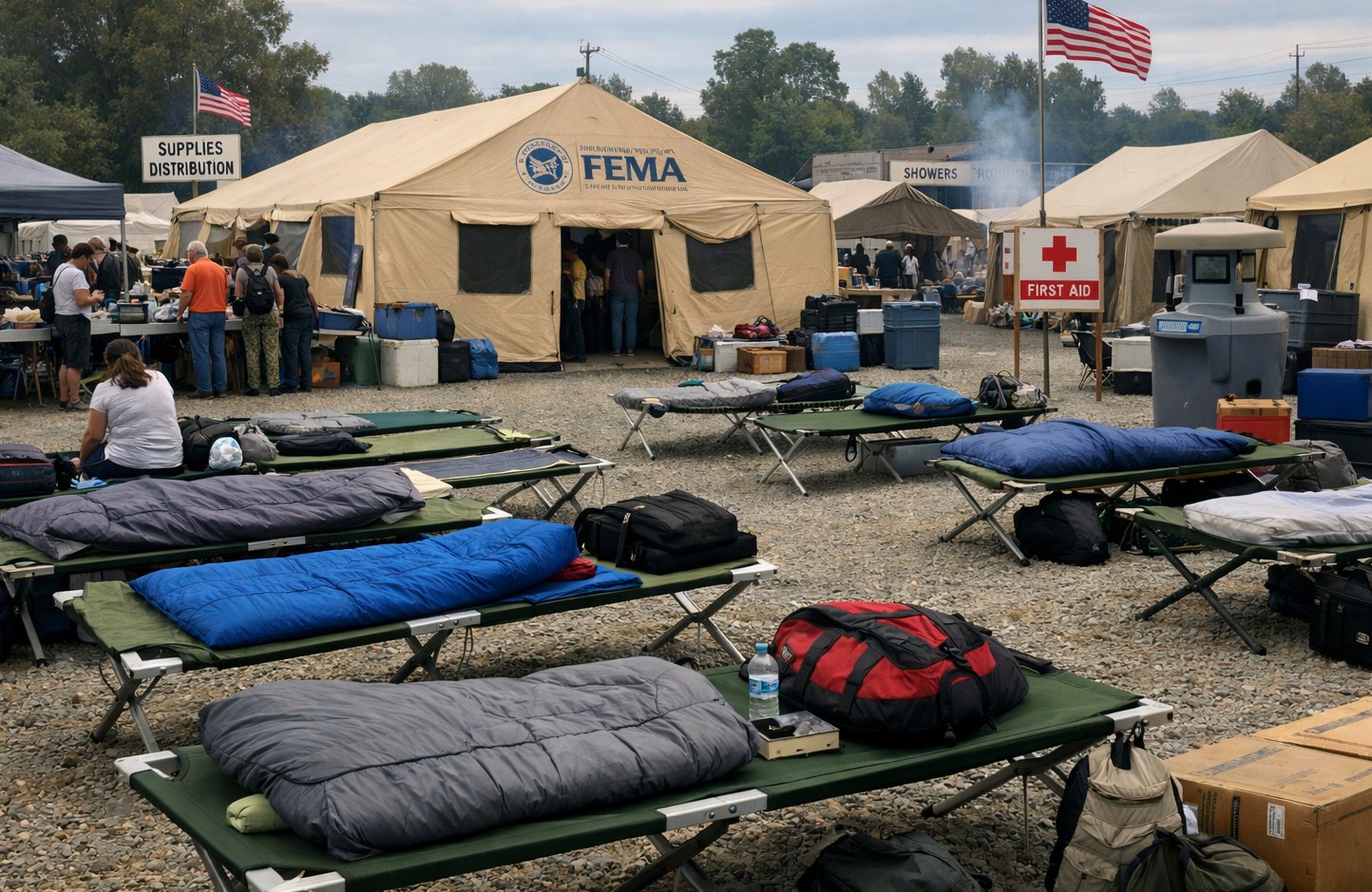
 The tents had started sagging.
No one could say when exactly. It wasn’t sudden. Just a slow surrender. The fabric stretched, ropes frayed, stakes loosened in soil that had been churned too many times by too many restless feet.
By morning, the camp looked tired.
Smoke from cooking fires hung low in the damp February air. It carried the smell of powdered eggs and desperation. Generators coughed unevenly. Somewhere in the distance, a child was crying — not the sharp cry of injury, but the thin, exhausted cry of someone who had learned hunger too young.
Rose stood in the ration line with her hood up and her hands buried in the pockets of her coat. She watched everything.
Two rows ahead, a fight almost broke out over canned beans. Behind her, a woman whispered rumors about the “Announcement.” At the perimeter fence, three men were arguing with a FEMA officer about reentry privileges.
The camp had rules. The camp had curfews.
But the camp no longer had order.
Maurice wasn’t in line.
He hadn’t stood in a ration line in three days.
He was near the south barricade, where the tents thinned and the lighting grew unreliable at night. The unofficial section. The place where the skeptical gathered. The ones who talked quietly about supply runs and perimeter blind spots.
He crouched over a crate with two others — Caleb and Rina — studying a hand-drawn map of nearby warehouses.
“They’ll cut the food soon,” Caleb muttered.
“They can’t,” Rina replied. “They’ll have riots nationwide.”
Maurice said nothing.
He had learned that the absence of reassurance was louder than fear.
By noon, the rumor became official.
Every camp loudspeaker across the country crackled to life at once.
The feedback whine silenced conversations mid-sentence.
Then the voice came.
Measured. Calm. Confident.
“The President of the United States will address the nation at 0800 tomorrow morning.”
A pause.
“This address concerns the national stabilization plan and the future of housing, employment, and civil governance.”
A longer pause.
“Attendance is mandatory.”
The speakers cut out.
Silence lingered longer than the announcement.
Rose exhaled slowly.
She didn’t need to look at Maurice to know what he was thinking.
That night, the gangs moved earlier than usual.
Three tents were raided before midnight. A crate of antibiotics disappeared from the medical trailer. A FEMA worker was struck in the head trying to intervene.
The security lights flickered twice.
Rose lay awake staring at the tent ceiling, listening to the fabric snap in the wind.
“Just finish your paperwork,” she whispered into the darkness, though Maurice wasn’t there.
Morning arrived gray and brittle.
The entire camp gathered around mounted screens bolted to mobile trailers. The signal glitched twice before stabilizing.
The President looked smaller than Rose remembered.
Older.
Tired in a way that sleep doesn’t fix.
He spoke for exactly four minutes.
Spoke of strain. Spoke of division. Spoke of unsustainable emergency measures.
Then he said the sentence that fractured history.
“Effective immediately, executive authority will transition to the Office of the Supreme Director of the Continuem.”
A new emblem replaced the Presidential seal.
An eagle. One star. Nine stripes.
“The United States, in its current form, will dissolve into nine administrative districts under Continuem governance. Construction of public housing units is complete. Registered residents will begin relocation immediately.”
The camera shifted.
The Supreme Director did not smile.
She spoke like a surgeon describing a procedure.
“Within three months, food instability will end. Medical supply chains will normalize. Employment will be district-assigned. Civil unrest will be resolved.”
A pause.
“Support for temporary encampments will conclude in thirty days.”
The words landed heavier than anything else.
“Residents who have not completed registration, orientation, and background clearance have thirty days to comply.”
The screen went black.
The wind moved through the tents.
No one clapped.
Rose turned slowly toward Maurice.
He wasn’t looking at the screen anymore.
He was looking at the fence.
By afternoon, transport trucks were arriving.
Names were called through megaphones. Families split themselves along paperwork lines. Some cried. Some celebrated. Some pretended not to notice.
Rose’s name was called in the first wave.
She found Maurice near the south barricade again.
“You can still finish,” she said quietly.
He didn’t answer.
“You heard him. Thirty days and the food stops.”
“That’s the point,” Maurice replied.
She searched his face.
“You think this is rescue?”
“I think it’s better than this,” she said, gesturing to the camp.
“And what’s the cost?”
She didn’t have an answer she trusted.
“I’ll come back,” she said instead. “They said visits are allowed once we’re settled.”
He studied her.
“You believe that?”
“I have to.”
He smiled faintly. Not mocking. Just tired.
“You’ve always been better at surviving than me.”
“And you’ve always been better at questioning everything.”
She reached for his hand.
“Don’t make this harder than it already is.”
“I’m not.”
But they both knew he was.
The transport convoy left at dusk.
Rose didn’t look back until the camp was a cluster of dim lights shrinking in the distance.
She told herself she wasn’t abandoning him.
She told herself this was strategy.
District housing was orderly.
Rows of identical structures. Clean sidewalks. Working streetlights.
Her unit was smaller than she imagined.
Stuffy. Plain. White walls.
But it had running water.
It had a locking door.
She placed her hand against the wall and let out a breath she didn’t know she’d been holding for months.
Maybe this works.
Maybe this ends the chaos.
The next morning, she requested a visitation pass.
Denied.
“Processing times are several weeks,” the officer said without looking up.
“You told me visits were open.”
“Requests are subject to approval.”
She felt something tighten in her chest.
Forms were filed. Voices raised. Escalations requested.
By evening, she was granted a twelve-hour furlough.
“Early-stage optics,” one supervisor muttered.
When she returned to the camp, it felt smaller.
Hungrier.
Maurice saw her before she called his name.
For a moment, they were just siblings again.
They hugged like survivors who hadn’t yet admitted they were on opposite sides of something irreversible.
“How is it?” he asked.
“It’s solid,” she said. “It’s safe.”
“And?”
She hesitated.
“And quiet.”
He nodded.
“That’s how it starts.”
She frowned.
“What are you planning?”
He didn’t answer directly.
“Food deliveries already slowed this afternoon.”
Her stomach dropped.
“Thirty days,” she whispered.
He shook his head.
“Try seven.”
The sun was lowering again.
The loudspeakers crackled.
A new message this time.
“All remaining encampments will enter supply taper protocol effective immediately.”
Murmurs spread.
Rose felt the ground tilt beneath her.
Maurice looked at her.
Not angry. Not vindicated.
Just certain.
“You should go back before curfew,” he said softly.
She grabbed his sleeve.
“Come with me.”
“I can’t.”
“Why?”
“Because if everyone goes… there’s nothing left outside it.”
The first generator shut off.
Then another.
The camp darkened in sections.
Rose felt, for the first time, that her solid new walls might not be protection —
but distance.
Distance from her brother. Distance from something forming. Distance from truth.
The wind moved through the sagging tents again.
And somewhere beyond the perimeter lights, unseen machinery had already begun rearranging the country.