
 The first night outside the perimeter had not felt like freedom.
It felt like exposure.
The sky was too wide. The dark too complete. Inside the District there had always been light — sterile, humming, artificial. Out here the night swallowed everything whole. The only illumination came in fractured pieces: a dying billboard flickering somewhere in the distance, a vehicle fire long burned out but still faintly glowing beneath twisted metal, the pale wash of moonlight across empty parking lots.
A few
Maurice didn’t sleep much.
None of them did.
Caleb had taken the first watch without being asked. Rina the second. Maurice pretended to rest, but every sound reorganized his nerves — shifting metal, wind through broken windows, something collapsing far off in the city’s skeletal remains.
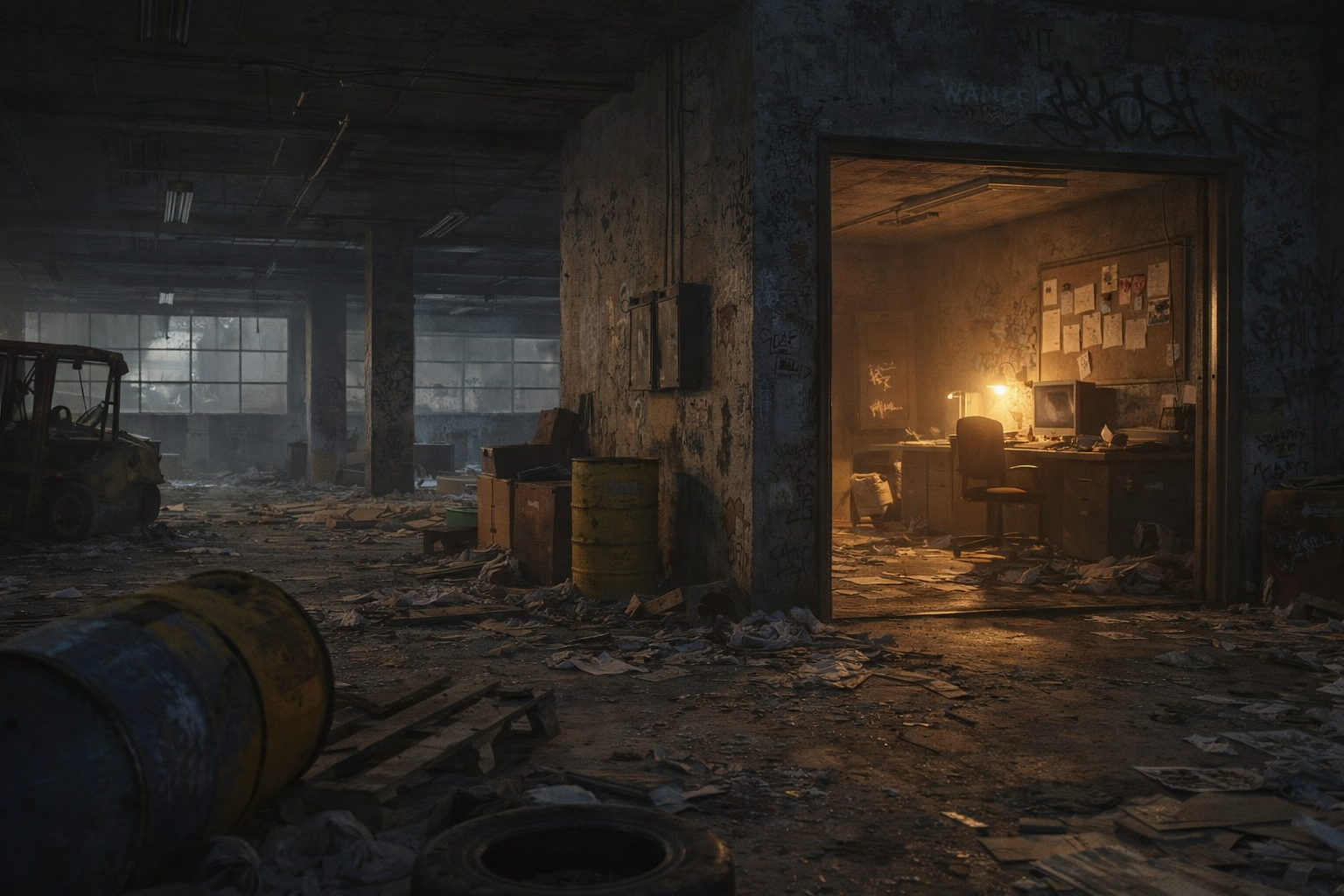
The warehouse they chose was less shelter than compromise. Concrete walls. No doors. A back office with a rusted filing cabinet and a collapsed desk. It was dry. That was enough for now.
The next morning, reality set in.
Food.
They started with the obvious places.
A gas station less than half a mile away. Shelves stripped clean except for expired protein bars and dented cans with labels half torn off. Someone had already swept through hard weeks ago — maybe months. The coolers were empty. The power long gone.
A grocery store farther out yielded worse. The front had been smashed. Rot had once lived there. Now it was just dust and flies.
A superstore off the main road had been picked to the bone. Abandoned carts lay scattered like fossils. Entire aisles stripped down to metal framing.
What remained wasn’t food.
It was evidence.
Evidence that they were late.
By the third day, their movements became quieter. More economical. Less hopeful.
They learned quickly that wandering without transport was wasteful. Every mile burned energy they could not replace. Every open parking lot was exposure. Every long road meant being seen before seeing.
Hunger thinned conversation.
Rina rationed without asking permission. Caleb counted supplies twice each night. Maurice began noticing patterns.
Wind direction.
Broken glass that had shifted recently.
Footprints in soft dirt that did not belong to them.
On the fourth morning, they heard it before they saw it.
Low engines.
Not civilian. Not improvised.
Mechanical. Controlled.
Maurice raised a hand and they dropped instinctively behind a collapsed concrete barrier near what had once been a hardware store.
The vehicles rolled into view minutes later.
Armored all-terrain transports — black, angular, elevated. Windows narrow. Tires thick and knuckled for terrain. Painted insignia on the doors: the eagle and shield of the Continuem.
Not Officers.
Guards.
They moved differently.
Inside the District, Officers wore pressed uniforms, carried tablets, issued citations with steady voices. They enforced compliance.
These men were something else.
Full body armor. Tactical vests. Faces half-covered. Machine guns mounted at the ready.
One vehicle slowed.
A loudspeaker crackled to life, the voice metallic and rehearsed.
“You are in direct violation. All citizens must submit and register with the Continuem. Food, clothing, and shelter will be provided upon completion of the registration process. Effective immediately, anyone that has not been registered is subject to harsh penalties including imprisonment up to death. Per Continuem Statute 1.09.”
The words echoed off dead buildings.
Maurice watched through a crack in concrete.
There was no panic in the patrol. No urgency.
They weren’t searching.
They were reminding.
The vehicles continued through the autonomous zone, methodical and unhurried.
Caleb exhaled only after the sound faded.
“They’ll sweep back,” Rina whispered.
Maurice nodded.
He understood something then.
The wasteland wasn’t freedom.
It was containment.
A pressure field around the District. Hunger and exposure driving people back toward registration. Toward the fence. Toward the promise of shelter.
The Guards didn’t need to chase everyone.
They just had to wait.
That night in the warehouse, Maurice lay awake staring at the ceiling beams.
Caleb and Rina hadn't known Maurice that long.
But they were looking at him now when decisions needed to be made.
He hadn’t asked for that.
He felt it anyway.
He studied the map he had drawn in charcoal on the back of a torn shipping label — supply locations already exhausted, patrol direction, sightlines, distances between cover.
Random scavenging was unsustainable.
They needed a concentrated source.
And there was one.
The District.
He had decided before he spoke.
“I’m going back inside,” he said quietly.
Caleb looked up first. No surprise. Just calculation.
“For supplies?” Caleb asked.
Maurice held his gaze.
“And Rose.”
Rina didn’t argue. She just nodded once, as if confirming something already understood.
“You won’t get far alone,” Caleb said.
“I’m not going far,” Maurice replied. “Just recon. Layout. Entry points. Patrol timing. I’ll come back. Then we plan extraction.”
Extraction.
The word felt heavier than he intended.
“You don’t have to do this,” Rina said.
He did.
Not because of pride.
Not because of ideology.
Because he hadn’t heard his sister say his name in days.
The next afternoon he moved alone.
He traveled light. No pack. No metal that could reflect light. Only a small blade and one ration bar.
He approached the District from the west side where the terrain dipped slightly before rising toward the perimeter fence. Dead grass. Sparse tree cover. Enough to crawl unseen if careful.
He learned quickly that stillness mattered more than speed.
Spotlights rotated in steady arcs. Guard towers spaced evenly along the fence line. Officers inside the inner checkpoint — formal uniforms, controlled posture. Guards on the outer patrol loop — armored, mobile.
Two arms of the same body.
He flattened himself when a spotlight swept too close. Counted the seconds between passes.
Eight.
Pause.
Eight.
The fence hummed faintly — electrified.
Beyond it, rows of housing units glowed in organized symmetry.
From the outside, the District looked orderly.
Not comforting.
Fortified.
Maurice pressed his chest into the cold earth and watched.
He didn’t feel anger.
He felt distance.
She’s in there.
I’m out here.
He studied the patrol vehicle that paused near the south gate. Noted the blind space between two floodlights where shadows held longer than they should.
He memorized guard rotations.
Counted breaths.
Tracked timing.
This wasn’t rebellion.
It was anatomy.
He shifted slightly, lowering himself further into the dirt as another spotlight passed overhead.
Somewhere beyond the housing rows, beyond administrative buildings and ration depots, Rose was moving through her assigned corridors.
He wondered if she moved differently now.
If she spoke carefully.
If she had already begun to belong to something he refused.
The spotlight swept again.
Eight seconds.
He pressed his face closer to the ground.
Survival wasn’t the hardest part.
Staying connected was.
And he would not let distance decide for him.
He waited for the next rotation.
And kept counting.