
 INSIDE THE VEIL
The special aired on a Friday night in late April 1988.
ABC had preempted its regular programming for two full hours of prime time, something that had never been done in the history of television, promoted for three weeks with full-page newspaper ads and hourly radio spots. By Friday evening, an estimated one hundred and twelve million Americans had indicated they intended to watch.
The screen held on ABC's circular logo, the lowercase "abc" white against black, for three seconds in silence, the way it always did before something the network considered important. Then an announcer's voice came in over the logo, measured and grave in the way network announcers had perfected for exactly this kind of evening.
"ABC News presents a special report. Inside the Veil: The Brotherhood of Aelin, with Barbara Walters."
The title card held for a beat, then dissolved.
It opened with Battle Cry on stage.
Who They Were
The concert footage was archival, multiple tours, multiple venues, multiple years, cut together with the kind of editorial precision that only became possible when an ABC producer had sat in a room for three weeks with every piece of Battle Cry footage the network could legally acquire. The result was four minutes of some of the most kinetic concert footage ever assembled for a television broadcast.
[ABC News archival footage — Battle Cry, various tours 1983–1987]
Barbara's narration ran under the footage from the first frame.
"In 1979, five young musicians in Reno, Nevada, were calling themselves Garage Disaster, which was accurate," she said, as the footage opened on Connor Braydee owning the front of the stage the way certain people own rooms, dark curling hair moving when he moved, green eyes that could hold a crowd of twenty thousand with the same intensity as a single person across a dinner table. When he worked the crowd, he wasn't performing. He was hunting. And the crowd was always, without exception, delighted to be caught.
"The sound was alive, but broken," Barbara continued, as the footage cut to Ricky Strathan, all restless auburn-haired energy, stepping into a solo with a grin that suggested he was enjoying himself slightly more than the situation required. "The drummer was the problem."
Erik Hahn filled the frame next, broad through the shoulders in a way that made other large men look underbuilt by comparison, headbanging through a bridge with quiet, contained authority.
"And then, one afternoon that summer," Barbara said, "a twenty-one-year-old from the nearby Paiute reservation walked past an open garage door, heard something in the music that stopped him in his tracks, stepped inside, sat down behind an unfamiliar kit, and played."
Jason Elias appeared behind the kit, the still point at the center of the storm, the focused calm of a man who had long since stopped needing to prove anything to anyone in the room.
"The song snapped into place," Barbara said. "The drummer who had been the problem walked out and didn't come back. The young man from the reservation stayed."
And then the footage held on Jace, elevated on the riser behind the kit, hands moving with a certainty that was not aggression and not restraint but something between them. Even in archival footage where the editors' intentions lay elsewhere, the eye pulled toward him with a gravity that had nothing to do with the cut.
"They renamed themselves Battle Cry that same night," Barbara said. "Within a few years, they had found a manager named John Kavanaugh who believed in what he was hearing. Within a decade, they were one of the most successful hard rock bands in the world."
The footage lingered on Jace a moment longer, the camera doing what cameras always seemed to do around him without quite meaning to.
"What none of them knew," Barbara said, her voice dropping into something quieter, more deliberate, "and what the young man from the Paiute reservation did not yet know about himself, was that the afternoon he walked through that garage door, he was not simply joining a band. He was becoming the High King of a sovereign island nation that the rest of the world would not learn about for another eight years, and inheriting a war against a thousand-year-old sorcerer named Aldus the Conqueror that had been waiting for him since before he was born."
The concert footage cut to black.
"This is what happened next."
What Was Lost
ABC handled the harder material before the portal. It was the right editorial decision.
"What Was Lost" is, in the end, about more than one night. [ABC News — Viewer discretion is advised]
"On May 22, 1983, outside a venue in San Diego, an old man approached Jason Elias after a show. His name was Seamus Greene, and he was Aelin's sixth Guardian. He gave Jace the amulet he himself had worn for decades, and a wooden box holding four more, sapphire, onyx, emerald, and garnet, meant for the four men Jace would soon bring into a war none of them had chosen. Jace's heart stopped during the bonding and started again only because it had to. In some sense, that alley is where their innocence first began to erode, months and years before anyone ever laid a hand on any of them. Being chosen is not the same as being asked."
"In 1984, Connor Braydee was abducted by a disciple of Aldus the Conqueror named Sorienne, acting on Aldus's own orders. He was twenty-two years old. He survived it, and by the end of that ordeal, Sorienne did not. He did not speak publicly about any of it for years."
When Barbara asked him about it directly, later, Connor answered without flinching. "She was a sorceress. She seemed obsessed with me, in her own way, but she took me on Aldus's orders, to get inside my mind and violate what she found there. That was the actual assignment. I was just the means of carrying it out."
"In 1986, all five members of Battle Cry were taken by two individuals, Lillian and Harvey Marks, who acted independently of Aldus, though they were funded by him. Connor was twenty-four that time. Jace was twenty-eight. Ricky was twenty-three. Nathan, the eldest of the five, was still only in his early thirties. These were young men."
"What was done to them in 1986 has mostly been made public, though each man carries his own particular account of it, some of which you'll hear in their own words in the hours ahead. Jace and Connor were subjected to terrifying abuse, both physical and sexual, and for Connor, it was the second time in two years."
"An event of this kind would be more than enough to break most people. But the men of Battle Cry are not most people. They were not broken. They survived. And survival, as anyone who has lived through sustained harm understands, is not the same as being undamaged."
"What was actually lost across those two nights was never simply dignity. It was trust. It was safety. It was the carefree twenties that most young men take for granted and these five did not get to keep. Connor lost it first, alone, in 1984. The other four lost it together two years later. None of it was ever fully returned."
"Aelin's enemy does not fight clean," Barbara said. "He never has. And the Brotherhood has paid a price for being what they are that the world is only now beginning to understand."
There was one more loss from that period the special addressed only briefly: Dave Gipsen, who had driven their bus since the beginning and was, by every account of the people who knew him, family, died in September 1985 clearing an airstrip runway so the band's plane could escape Aldus's forces. He was forty-seven. "The Brotherhood knows what he did," Barbara said simply. "That will have to be enough."
Then: the interior of ABC Studios in New York.
The Portal
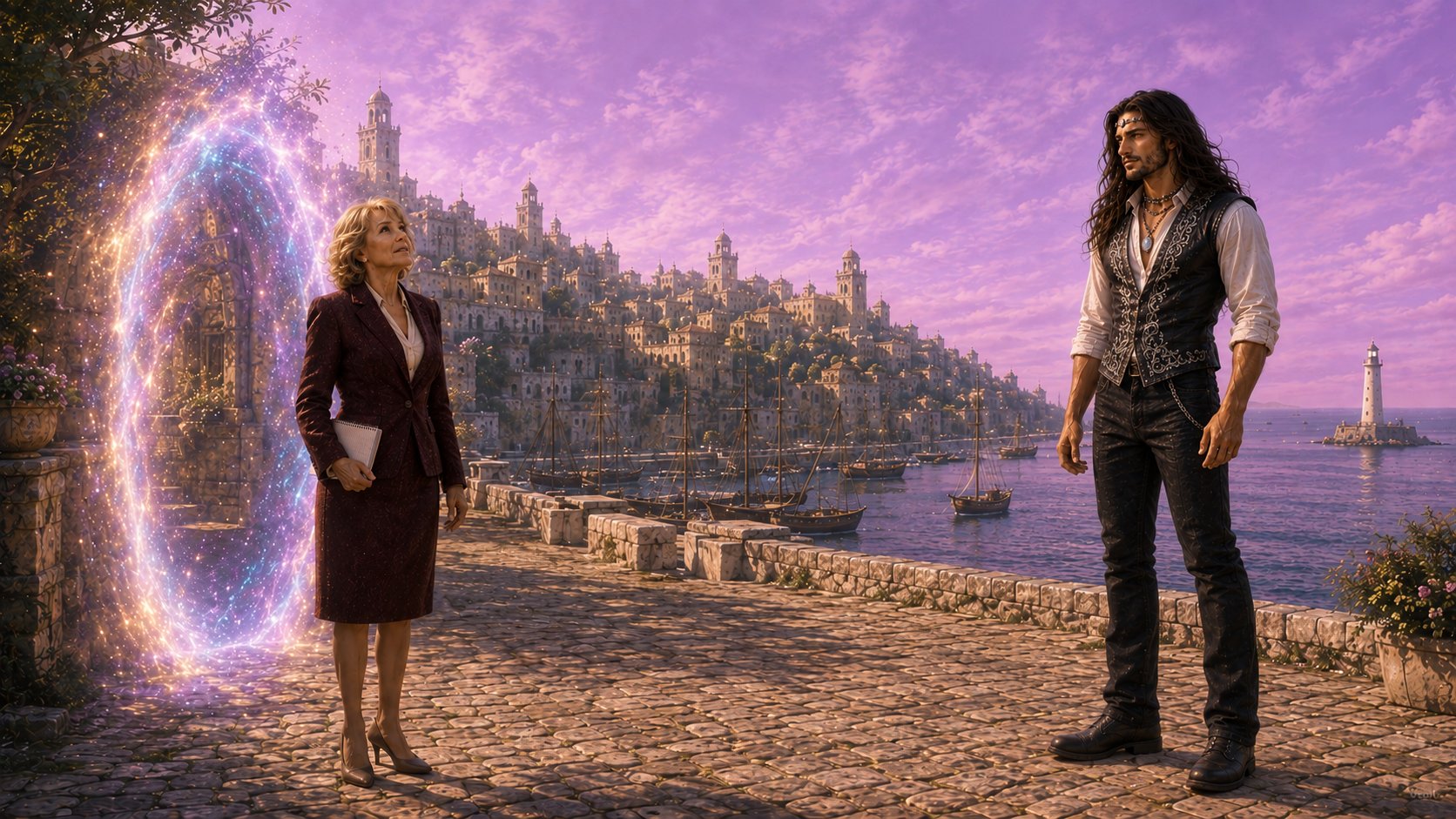
The shot was wide, a large open space cleared of its usual equipment, lighting rigs overhead, a production crew of eight standing to one side. Barbara Walters stood in the center of the frame, dressed in a deep burgundy blazer, her expression composed and expectant. She spoke directly to camera.
"What you are about to see has never been filmed before. In a few moments, I will step through a portal, a doorway created using a device Nathan Dallenger calls a portal key, and I will walk out the other side on an island that the rest of the world did not know existed until 1986. My camera crew will film me going in. An Aelin Broadcasting crew will film me coming out. And for the next two hours, you will see what I saw."
She paused.
"I've been doing this job for a long time," she said. "I have interviewed heads of state, survivors of disasters, people at the highest and lowest points of their lives. I have very rarely been nervous before a story."
She smiled slightly. "I was nervous before this one."
The camera held on her. Then, in the cleared space behind her, the air began to change.
There was no sound. No crack of energy, no mechanical hum. The portal simply opened, a vertical ellipse of shimmering light, its edges rippling with a luminescence that the camera struggled to render accurately, cycling through colors that had no precise names. It was roughly eight feet tall and wide enough for two people to walk through side by side.
The ABC crew stepped back involuntarily. One of them could be heard on the audio track saying something under his breath that the network would later choose not to bleep.
Barbara Walters picked up her notepad, straightened her blazer, and walked through.
[ABC News / Aelin Broadcasting — April 1988]
The cut was instantaneous.
One frame: the interior of ABC Studios in New York, the portal's shimmering edge filling the screen.
Next frame: daylight. Open sky. And the sky was lavender.
Not the grey-purple of early morning or the faint rose of a certain kind of sunset. A full, clear, soft lavender, a color the sky simply was not, rendered in the honest light of a late-April morning. The Aelin Broadcasting camera had been positioned low and wide, so the first image the viewer at home received was Barbara Walters stepping out of nothing. The portal had no visible presence on the Aelin side. She simply appeared from the air and stopped dead.
She did not look at the camera. She did not look at the Aelin Broadcasting crew waiting to receive her.
She breathed in.
The air on Aelin carried no exhaust, no industrial haze, no city weight. It was simply air, clean in a way that took a moment to process because the frame of reference for clean air did not prepare you for this. It smelled of the sea, of grass coming in after a long winter, of something faintly floral that had no name in English. Barbara Walters, who had been a professional for thirty years and prided herself on her composure, stood on the Aelinian coast in the April morning light and breathed.
Then she looked up at the sky.
She stood there for four full seconds, looking at the lavender sky above an island that should not exist.
Then she turned to the Aelin Broadcasting camera.
"Oh," she said quietly. "Oh, it's real."
Aelin
[Narrated by Barbara Walters]
"Aelin is an island nation that has maintained anonymity for nearly a millennium. Its coordinates do not appear on any publicly available map. It cannot be seen from the sea via ship. It cannot be seen by land. It cannot be seen via satellite. It has been protected for eight hundred and thirty years by something called the Veil, a cloaking mechanism created by the island's second Conjurer, Daerdon, in 1155 AD, in response to a warlord named Aldus who had been attacking the island for decades and showed no intention of stopping. The Veil did not just defend Aelin. It made it unfindable. Aldus's ships sailed past it. His scouts found nothing. An entire sovereign nation, home to nine hundred and fifty-four thousand people, vanished from the world's knowledge."
"For eight hundred and thirty years, it stayed that way."
"The island I walked out onto this April morning is not a primitive place preserved in amber. It is not a medieval settlement that time forgot. It is a functioning modern nation that has made deliberate, democratic choices about what kind of modernity it wanted, and what kind it did not. Aelin has electricity, medicine, engineering that in some areas exceeds what the outside world has yet developed. It also has open carriages and horses on cobblestone streets, bakeries that have been in the same family for six generations, and air so clean it takes your breath away in a different sense than you're used to."
"Nothing new was industrialized here without presenting the pros and cons to the people of Aelin first. The Congress voted. And the result is a place that feels ancient and functions with quiet modern competence, simultaneously, on its own terms."
"I spent two days here. I rode through five counties in an open carriage under a lavender sky. And I came home changed in a way I am still working out how to describe."
Behind her, the ABC camera crew stepped through the portal one by one, the operator first, then the sound engineer, then the producer, each of them stopping in the same involuntary way, each of them looking up. The ABC camera began rolling from the moment it cleared the portal. Now there were two cameras on the same piece of coast: one from Aelin Broadcasting, one from ABC News. Both of them were pointed at the same thing.
[ABC News / Aelin Broadcasting — footage shared with mutual editorial approval — April 1988]
Both organizations had agreed in advance: footage from either camera could be used by the other, subject to approval. It was a practical necessity, neither crew could be everywhere simultaneously, and it meant the special carried images no single team could have captured alone.
Barbara was still looking at the sky when the Aelin Broadcasting camera shifted its angle and caught what was standing thirty feet behind her.
[Narrated by Barbara Walters]
"I should tell you about the sky. I had been told about it. I had been warned, in the careful way people warn you about things they know you cannot adequately prepare for, that the sky on Aelin is not the sky anywhere else. That the lavender is real and full and present in ordinary daylight, not a trick of dawn or dusk. I had filed this information away and told myself I was ready."
"I was not ready."
"But I should also tell you, because the Aelin Broadcasting camera caught it, and because it is true, that the sky was not the only sight on the coast that morning that was incredible to see."
Standing with the crew, easy and unhurried in the April light, was a man Barbara had not yet noticed.
Barbara turned.
Her breath caught, audibly, before she had any chance to control it.
The ABC camera operator swung to follow her line of sight and found him.
Standing before her was the King of Aelin, Jason Elias, drummer of Battle Cry, and nothing about the title had prepared her for the man wearing it. He was not in court clothes. He wore an Aelinian linen shirt, crisp white, sleeves rolled to the elbows, moving slightly in the sea wind, a leather vest over it with opaline Celtic scrollwork catching the light when he shifted his weight. Black trousers, black boots, the opaline amulet burning quietly at his chest even in daylight, and above it all a crown of silver set with all five stones, sapphire, garnet, opal, emerald, onyx, the opal largest and centered, resting over amber eyes that found her and held there with the kind of unhurried, complete attention most people never receive from anyone in their entire lives.
He was six feet four inches, twenty-nine years old, and he was, without exaggeration or performance, one of the most beautiful men Barbara Walters had ever stood in front of in a career that had put her in rooms with some of the most photographed people alive. It was not simply the bone structure, though the bone structure alone would have stopped traffic. It was that nothing about him seemed built for a camera and yet the camera could not look away, that whatever made him beautiful seemed to come from several layers deeper than his face, and that looking at him produced the disorienting, almost embarrassing sensation of being caught staring at something you had not been warned was possible to see in a living person.
For a moment she simply stood there, one hand still half-raised from whatever gesture she'd been making toward the sky, and did not move at all. It was not the practiced pause of someone composing herself for camera. Something in her had actually caught, visibly, the way people's faces do for half a second before they remember they're being watched. She had interviewed presidents and kings and men who had ordered terrible things, and she found, standing on a strange coastline under a lavender sky, that she needed a full breath before she trusted her own voice.
Later, in her memoir, she would try to explain it and settle for calling it presence, the sense that whatever she was looking at was not simply handsome but somehow whole, kind and steady and lit from some source she couldn't name, and that being looked back at by it felt like being seen rather than merely noticed. She was not the first person it would happen to, and she would not be the last.
Then the moment passed, a smile broke across her face, unforced and a little rueful, as if she'd caught herself at something, and she crossed the last few feet toward him, and the two cameras, Aelin Broadcasting and ABC News, both rolling, caught the meeting from opposite angles.
"Ms. Walters," Jace said. "Welcome to Aelin." He extended his hand and she shook it, and then he smiled, brief, genuine, the smile of someone who is glad something is finally happening, and said, "Come with me. I want to show you something before the carriage leaves."
He led her to where a low table had been set up near the tree line, and on it lay a map.
It was a clean, detailed rendering of Aelin, the five counties clearly delineated, the county seats marked, the roads shown, the coastline accurate. Castle of Elders at the southeastern peninsula tip. Daerdon University on the high ground of Dráíocht to the northwest. The wooded interior of Léirstinach sweeping across the central and southwestern reaches. The broad expanse of Neart to the north. Ainmhithe in the center-eastern counties between them.
What the map did not show: coordinates. No latitude, no longitude, no bearing marks, no distance scale referencing any external landmark. A map that could tell you everything about how to move within it and nothing about where it was.
"This is what ABC will use to show the carriage route during the special," Jace said. "You're welcome to keep it. It's accurate in every detail that matters." He looked at it. "The details that don't matter, for your purposes, aren't on it."
Barbara looked at the map. Then at him. "The location stays classified."
"The location stays classified," Jace confirmed. It was not an apology. It was a fact, stated with the same quiet finality he appeared to bring to most facts. "Nine hundred and fifty-four thousand people live here. We have an enemy who has been trying to find this island for eight hundred and thirty years. We went public with who we are. We did not go public with where we are." A brief pause. "Those are two different decisions."
Barbara nodded once. "Understood."
[Jason Beannú Elias (Jace) — Guardian of the Brotherhood, High King of Aelin and Governor of Harmonytis]
Jace handed the folded map to the producer and turned back toward the coast road. "There's time yet before the carriage leaves," he said. "And you're standing in my county. A host who lets a guest leave without showing her around isn't much of a host. Walk with me a while. Harmonytis is small. We can see the heart of it before the horses get restless."
Jace offered his arm to Barbara, a gesture Barbara found very endearing.
She looked at her producer, who was nodding before she had finished turning her head, and took Jace's arm with a smile, walking with him. The two cameras fell in behind them.
The road from the arrival point climbed in an easy grade toward the capital, and the capital, Barbara told the camera later, looked like the inside of a shell. Every wall, every step, every cobble had been cut from the same pale stone, and the stone did not simply catch the morning light. It held it. A faint silver shimmer rose off the buildings as though they were lit from somewhere under their own surfaces, and the lavender sky pressed down over all of it, soft and total.
"Cloch Lonrach," Jace told her when she stopped to lay her hand flat against a wall, "We also call it Shimmer-Stone. It quarries soft and hardens in the air. There are two kinds, white and black. Most of the island is built from it. The white is quarried here in Harmonytis while the black is found in Dráíocht. Nathan's county. You'll see that one this afternoon."
The wall was warm under her palm and faintly granular. The shimmer moved as she shifted her hand, following her like water under ice.
"Magnificent," she said.
The market filled a broad square at the center of the town. There were carts and awnings and trestle tables, baskets of bread still steaming in the cool air, silver fish laid in rows on beds of crushed ice, cut flowers in colors Barbara did not have names for. The air carried salt and yeast and something green and floral underneath it. What it did not carry was exhaust. The only engine in sight was a single battered moped leaning against a doorway, and it was not running. She hadn't seen an automobile anywhere.
Jace seemed to sense the question before she spoke it, and explained, "Aelin has no cars or trucks. No large combustion engines that create exhaust. That was by choice, voted as law by Congress and the Aelinian people in 1926 by my predecessor, Seamus Greene."
"But," Barbara asked, "with the mining, building...how do you transport it?"
Jace smiled and pointed to a large metal flat-bed carriage being pulled by 8 large Belgian Draft horses. Pallets of Aelinian berries and apples were being unloaded at a large produce stand.
"It's how this island has moved things for centuries," Jace said. "Not likely to change any time soon, either. Motorized hauling would be faster, but we care about keeping emissions to the barest minimums. For the sake of the people, and also our Veil."
"Aelin has managed to solve a problem many countries never will... and all by the will of the people!"
[Narrated by Barbara Walters]
"I have spent my career learning to read the distance between powerful people and ordinary ones. It is a real distance, and it is almost always there, even when both parties are pretending it is not. I walked into that market watching for it. I did not find it. The High King of Aelin moved through his own capital and his people did not bow and they did not flinch. A woman selling bread argued with him about whether he was eating enough. A man mending a net asked how Jace's brother in America was. A child held up a drawing, and he went down on one knee to study it as though nothing in the world were more pressing. I have met a great many heads of state. I have never seen one who was loved quite like an ordinary neighbor."
The bread woman pressed a roll into his hand and waved his coin away, and Jace thanked her by name and ate it as they walked, and Barbara filed the whole exchange away.
"They aren't afraid of you," she observed.
"Why would they be?" Jace asked. "I grew up a continent from here, but this is theirs as much as it's mine. More, maybe. They were on this island before I came along. They'll be here long after. I answer to them. That isn't a humble thing to say. It's just how the place works."
Cardinal Point sat at the eastern edge of the town, a long stone headland that ran out into the water with the harbor curled in its lee. The fishing fleet was in, dozens of low boats with their dark sails furled, hulls knocking gently against the quay. Men and women worked the lines and the nets and the sorting tables. Gulls wheeled and complained overhead. The sea beyond the point lay flat and bright and ran on until it simply stopped being visible, with no horizon line that Barbara could fix her eye on.
Jace nodded toward the fleet. "Harmonytis feeds a good part of the island. We're a fishing county before we're anything else. The seat of power happens to sit on top of a working port, and I think that keeps everyone honest. It's hard to be full of yourself when the man you passed a law beside in the morning is gutting cod by the afternoon."
A weathered older fisherman straightened at one of the sorting tables, recognized the king, and raised a gloved hand with no ceremony in it at all. Jace raised his in return.
"Why is Aelin's sky so...purple?" she asked.
"That's the Veil," Jace said, simply. "The structure of it is something Nathan is better equipped to explain, but the alchemic properties that make up the Veil are also the same properties that make our sky appear the lavender color you saw the moment you stepped through the portal. From out there a ship sails straight through where we're standing and sees nothing but open water. Eight hundred and thirty years, and not one of Aldus's vessels has ever found this harbor. No one has."
The Aelinian Congress building stood back from the harbor on higher ground, a wide round structure of the same shimmer-stone, and when Jace led her in, the chamber opened above them in tiers of curved seating that ringed an open floor. High on the far wall hung five crests in a single row, each set with one great stone: sapphire blue, then garnet red, then a white opal at the center, then emerald green, then onyx black. The seats were empty. The light came down soft and even through the high windows.
"This is where it actually happens," Jace told her. "People think a king decides things. On Aelin the king proposes, and argues, and listens, and then the Congress votes. Nothing new gets built here, not a road, not a power line, not a single factory, until the people who would have to live with it have heard the case for and the case against and made the call themselves."
He looked up at the empty tiers. "I'll be standing on that floor within the hour, hearing grievances and chairing a county meeting. It's slower than ruling by decree. It's better."
"You sound like a man who has thought hard about the difference," Barbara remarked.
"I'm the seventh Guardian," Jace said. "Six men carried this before me. The first of them held it for the better part of three centuries. The guardian lifespan is long, but has been getting shorter with each generation. You learn from all who ruled before you. Mostly you learn that the island outlasts you, and you had better leave it in good hands." He turned from the chamber and tilted his head toward the door.
"Speaking of which. Indira is waiting, and your horses really are getting restless."
They came back down toward the arrival road in the lengthening morning, the sea wind off Cardinal Point following them the whole way.
The open carriage was waiting on the road above the arrival point, dark wood, brass fittings, two matched bays with the easy temperament of horses that had been doing this route for years. Jace walked with her up the graded path toward it, hands easy at his sides, the sea wind moving across the coast behind them, blowing his long hair lazily around as they walked.
"The carriage will take you through the other four counties today," he said. "Each governor will meet you in his county. You'll find them in their natural environment, not staged for you. What they're doing when you arrive is what they actually do."
"How do you do all of it and still have time for music?" Barbara asked.
Jace smiled easily and replied, "I make time for it. We all do. This is home for us and it's our responsibility to care for this island and its people, but we started off as a rock band. We'll always be that band underneath all the pomp and circumstance."
"How do you separate them?" Barbara asked, genuinely curious about how this man and his brothers kept everything in order but still embraced the chaos of being a band, "I can't imagine you take the rock star into Congress with you."
Jace laughed kindly and told her, "There's a time to be the goofy rock stars we still are, and time to be the leaders we need to be for the people of Aelin. You learn what's the most important thing, and to us…that's Aelin."
"I am so eager to see it all, Your Majesty," Barbara said, placing her hand on Jace's arm warmly.
"Barbara," Jace replied with a charming grin, "Call me Jace. My subjects go with "Your Majesty" most of the time…. friends can just call me Jace."
"So, I am a friend?" Barbara asked.
"I'd like to think so unless you know something I don't," Jace joked.
Barbara laughed and quickly said, "If I wasn't I likely would not be here!"
Jace chuckled and walked Barbara up to the beautiful open carriage with an equally as beautiful woman sitting in it.
"Indira Saatva will ride with you throughout. She was born here. She knows this island better than most people alive. She'll be good company and she'll answer things the governors won't think to mention."
"And now you go attend to Aelin business?" Barbara asked.
"Yes, and I'll see you at Castle of Elders when you get back," he said. "We'll have a lot more to talk about by then." He stopped at the carriage door and opened it himself. Inside, a woman was waiting, dark-haired, composed, a wreath of glowing flowers resting in her lap. "Ms. Walters, this is Indira Saatva."
He said it the way you introduce someone you trust completely. Then he stepped back.
Barbara climbed in. Jace closed the door.
"Enjoy the tour of Aelin, Barbara. I look forward to hearing what you think of it." He said. Taking Barbara's hand in his, he kissed the top of it, and nodded as he released it.
Barbara, surprised, but impressed, thanked him and smiled. She'd received a kiss on the hand from a king…who was also a rock star. The look on her face seemed to convey the incredulous wonder of that fact.
Jace stayed where he was and nodded to the driver, who touched his cap and the carriage began to move. The ABC camera caught him from behind, standing on the road in the April light, watching the carriage go, the opaline amulet catching the sun as he turned away.
From somewhere not far off, carried on the sea wind, came the sound of Aelinian music, something with the warm, lifted quality of the island's Irish roots, strings and a low drum, moving through the morning air as the carriage rolled down the stone road into the interior of the island.
[Indira Saatva — Léirstinach Resident, Master Gardener]
The roads were stone-paved in the villages and well-graded packed earth between them. The lavender sky sat above the open top of the carriage, unhurried and absolute, and Indira watched it the way someone watches a thing they have known their entire life and have not yet stopped finding beautiful.
"What is this?" Barbara asked, pointing to the wreath in Indira's lap.
"It's for you, Barbara," Indira told her warmly, "To welcome you to my country. Aelin is happy you have come."
Barbara smiled and allowed Indira to place the wreath over her head, resting it on her shoulders. Barbara touched the wreath with wonder, the vibrant, glowing colors of blue, violet, pink, and yellow woven through it and asked, "What are these?"
"Lantern vines," Indira said. "They only grow on Aelin. We've tried to cultivate them outside the Veil, they don't take. The glow stops within a day."
She looked at it with the quiet satisfaction of someone whose life's work is the stubbornness of growing things.
"What does it mean?" Barbara asked. "The wreath."
Indira considered how to say it. "You know what a lei is? In Hawaii, the flower garland given as a greeting, as a farewell, as an act of welcome?"
"I do."
"It is like that," Indira said. "The same idea, though we arrived at it separately. On Aelin the wreath is made by hand, from plants you have grown yourself, and given to someone whose arrival matters to you. It is not ceremony. It is personal."
She looked down at her hands, which still carried faint traces of pollen from the morning's work.
"I have been growing flowers and plants since I was very small. My grandmother taught me to make them, she made woven wreaths in India, before Partition, before she came here. That skill was one of the things she carried with her when she left. You cannot carry much when you are fleeing. But you carry what is in your hands."
Indira looked at the wreath on Barbara's shoulders with the quiet expression of someone seeing more than one thing at once. "She taught me on Aelin, with Aelinian plants. The form came from her. The flowers came from this soil. I have been growing them and making these since I was small enough that the wreaths were larger than my head."
"I chose the lantern vine for you because it is native to Aelin and nowhere else. It seemed like the right thing to give someone seeing this island for the first time."
"You made wreaths for the Brotherhood," Barbara said. "When they first arrived."
"Yes, in 1983," Indira said. "Five men from the mainland, arriving for the first time, trying to understand what this island was and what it was asking of them. I brought wreaths because that is what I do when someone arrives somewhere that matters."
A slight pause, something private moving behind her eyes.
"When I placed Connor's over his shoulders, his amulet flickered. Quick and bright, startled, almost. Like it recognized something before he did."
She looked out at the road ahead.
"I have thought about that moment many times since."
"You were born here," Barbara said.
"I was," Indira said. "First generation. My grandparents came during Partition, 1947. They were brought to Aelin through channels that took considerable courage on everyone's part, including theirs."
She looked at the fields moving past the window. "They never went back. There was nothing to go back to. Aelin became home in the way that places become home when there is no other option, completely, and permanently."
"And you grew up on this island."
"In Léirstinach," Indira said. "Among the gardens and the forest paths and the conservatory students who wandered out of their practice rooms at odd hours." A brief pause, warm without being sentimental. "It is a good place to grow up."
"You are the master gardener," Barbara said. "What does that mean in practice?"
Indira considered the question with care.
"Léirstinach has some of the oldest cultivated land on Aelin," she said. "The soil composition is unique, influenced by the county's elevation, the mineral content of the bedrock, the way the Veil interacts with growing things over centuries. What I do is understand that system well enough to work with it rather than against it."
She paused.
"Plants grown on Aelin do not behave like plants grown elsewhere. The conditions here cannot be replicated outside the Veil. Part of my work is documenting exactly why, so that knowledge is not lost if anything changes."
The carriage moved through a village, stone buildings, window boxes just beginning to show their first spring color, a blacksmith's yard with the day's first smoke rising from the forge. A woman hanging laundry waved without looking up. Two children chased each other across a courtyard and stopped to stare with open curiosity at the unfamiliar vehicle and the camera following behind it.
"How long have you known the Brotherhood?" Barbara asked.
"The Brotherhood as they are now, five years," Indira said. "They came to Aelin in 1983. I was twenty-two. Aelin is not a large island, the governors are not distant figures here, they're people you see at the market. Five years on this island is not a short acquaintance." She paused. "And I have known some of them considerably better than others." She turned to look at the road ahead. That was all.
Léirstinach — Indira and the Gardens
Léirstinach was the island's southwest, mountainous and heavily wooded, still holding remnant snow on the higher elevations while the lower ground greened and wildflowers pushed through the clearings.
"Where's Governor Braydee this morning?" Barbara asked. "I'd assumed he'd be meeting us here."
"Ainmhithe," Indira said. "There's a shipment of wool coming out of the stables county that Léirstinach's weavers have been waiting on, and he went to see about moving it along himself. He does that more than a governor strictly needs to." A small, private smile. "You'll meet him. He won't be able to help himself once he hears you were through."
The carriage slowed as it came into a village at the edge of the county seat, and a small girl broke away from a knot of children by the roadside and ran alongside it, waving something over her head.
"Indira! Indira, look!"
Indira had the driver stop before Barbara could even ask. She climbed down and crouched to the girl's height, and the girl held up a wreath of woven wildflowers, a little lopsided, clearly handmade, clearly proud of it.
"I did the joining myself this time," the girl said. "Nobody helped."
Indira turned it over in her hands with real attention, not the performance of attention adults sometimes give children, the actual thing. "You did," she said. "Look at that binding. That's better than mine was at your age." She set the wreath gently back into the girl's hands. "Keep at the outer petals, they're still a little loose, but this is good work."
The girl beamed and ran back to the other children, wreath held high.
Barbara watched the whole exchange with open interest. "You're well known here."
"I'm the county's master gardener," Indira said, climbing back into the carriage. "Have been for six years now. It's not a governor's title, but people here tend to know who tends what."
[Indira — Master Gardener of Léirstinach]
The carriage carried them up through the terraced hillside toward a cluster of pale stone buildings, flowering vines climbing the walls, the air thick with the scent of things in bloom.
"Léirstinach is known for four things," Indira said, as they walked the Gardens and then into the Conservatory beyond it, practice rooms lining a long stone corridor, the sound of a cello somewhere behind a closed door. "Music, flowers, tailoring, and weaving, both rugs and garments. My family's been part of the last for three generations. The Conservatory's been here even longer than that." She glanced toward the practice rooms. "I grew up close enough to hear it from my grandmother's garden. Late evenings, mostly. Someone always stayed past closing."
"Léirstinach means vision in the old language," she said. "The county was named for the power that governs it, and for the man who governs it now. I've always thought that was fitting. A place should know what it is."
Dráíocht — Nathan and the University
Daerdon University occupied the high ground of Dráíocht County, a cluster of pale stone buildings maintained over centuries, the library alone running seven stories with windows facing the sea, the coastal light making the stone look like it had been there forever, which it had.
When the carriage reached Daerdon University, Indira led Barbara into the main building and pointed her toward a corridor on the second floor. "Third door on the left," she said. "He's finishing a class."
She said it in the tone of someone who had learned not to interrupt him herself, which suggested she had tried at least once.
Through the narrow window in the door, the last freshmen could be seen gathering their notebooks, several doing a visible double-take at the sight of Barbara and a full ABC camera crew in the corridor.
The classroom was clearing. And at the front of the room, his back to the door, Nathan Dallenger was still at the board.
He was writing a physics equation, later identified by the ABC science consultant as a derivation of spatial correspondence theory that did not exist in any published literature she could find, with the focused, slightly oblivious quality of a man for whom the problem in front of him took precedence over everything else.
Barbara watched through the window.
The last student slipped out past her. The room was empty now, and Nathan still had not turned around.
He finished the equation, set the chalk down, looked at it, and added one more line.
Then he turned and saw Barbara Walters and a camera crew standing in the doorway of his freshman physics classroom.
Brief and composed, his was the expression of a man recalibrating from one mode to another without embarrassment. He picked up a cloth and wiped chalk dust from his hands.
"Ms. Walters," he said. "Come in."
He wore a black vest with deep garnet brocade embroidery, the large garnet amulet prominent on its silver chain at his chest, the silver half-circlet resting in his sandy hair, the garnet center stone flanked by two small round opals. He was the most precisely assembled of the five in his appearance, the composed manner of someone whose intelligence was the first thing you noticed and whose warmth was the second. He looked, one of the ABC producers noted in her log, like a medieval scholar who had been given a rock star's wardrobe and found it entirely appropriate. The chalk dust on his fingers did not undermine this impression. It confirmed it.
[Nathan Dallenger — Conjurer of the Brotherhood, Governor of Dráíocht]
He took her hand and kissed the back of it, brief and unremarkable, the way another man might shake hands, a courtesy performed without any particular ceremony because it had simply always been the correct thing to do.
Barbara looked at the equation still on the board behind him. "What were you teaching?"
"Spatial correspondence theory," Nathan said. "First-year students. It's the foundational concept behind portal technology. I like them to understand the principle before they encounter the application."
"The Conjurer," Barbara said. "What does that mean, in practical terms?"
"The four elements answer to me. Earth, water, air, fire. I can call them, shape them, in most cases change them into something else entirely, within limits." He held out his open palm, and a small, steady flame kindled above it, orange-blue at the base, entirely contained, not spreading to his skin or the air around it. "It doesn't burn me. I've never entirely worked out why, only that it doesn't." He closed his hand and the flame went out, no smoke, no smell of anything having burned at all. "The portal key and the Veil work are applications of the same underlying principle. The power came first. Everything I've built is just me finding out what else it's good for."
"They teach portal theory to freshmen here."
"We teach it the way other universities teach calculus," Nathan said. "As a tool. One you need to understand before you can use properly."
Barbara looked at him with the attention she brought to moments that genuinely interested her. "You skipped grades as a child," she said. "Several of them."
"Three years," Nathan said, settling against the edge of the desk. "I was reading at two, doing mathematics at four. My parents found a school that could keep up. It managed for a while. Then I went to university at fifteen, studied music composition and chemistry simultaneously, and finished both doctorates at the same time." He considered. "Efficient."
"You did two doctorates simultaneously."
"I find I think better when I have more than one problem running," Nathan said. It was not immodest. It was accurate.
"Is that where you met Connor Braydee?"
"After," Nathan said. "I'd already finished both degrees. Connor was studying there. We discovered we shared a fairly specific set of musical sensibilities and a tendency to stay in the practice rooms past the point where anyone else remained." A slight pause. "He was better at the violin than I expected. I was better at rock than he expected. We got along."
"You were building things, even then," Barbara said.
"Always," Nathan said. "My doctorates are in chemistry and quantum physics, and I'm currently studying medicine at Daerdon as well." A slight pause. "There always seems to be another gap worth closing."
"There's a through line," Barbara said, "from a chemistry doctorate to a physics doctorate to medicine now."
Nathan looked at the equation on the board, then back at her. "There's a kind of problem that exists in the gap between what is theoretically possible and what anyone has yet made work. The portal key came out of one of those gaps. So did the Veil modifications I've made these past five years. Medicine has its own version of the same gap."
"You created the portal key," Barbara said.
"I did," Nathan said. "Portal technology has existed in Aelin's history for centuries. The portal key is the current iteration, more precise, more stable, lower energy cost than its predecessors."
"How does it work?"
"Space isn't as fixed as it appears," Nathan said. "There are points of natural correspondence between locations, closer to each other than a standard map would suggest. The portal key identifies those correspondences and creates a stable bridge between them. What you experienced was the transition between two corresponding points: ABC Studios in New York, and a specific coastal location here in Aelin."
"And no one can trace it."
"No coordinates were transmitted, no signal sent. The portal opens, is used, and closes. There's nothing to trace." He paused. "Aelin's location remains classified. It's not a restriction against you specifically. It's a condition of our survival. We don't dismantle the Veil because we've started giving interviews."
Barbara let a beat pass before the next question, gentler in tone than the ones before it. "In 1986, you were the one who took the ransom call."
"I was." Nathan's composure didn't slip, exactly, but something behind it went still. "Lillian Marks made the call herself. She was... focused on me specifically, in a way that had nothing to do with the ransom. I won't go further into what that looked like. It wasn't about money for her, not entirely." He was quiet a moment. "I couldn't see the other three. I could hear enough to know things were bad. Knowing and not being able to do anything about it is its own particular kind of helpless."
Barbara didn't ask him to say more than that. She let the silence hold for a moment instead, the same courtesy she'd extended to Ricky, then moved them both gently forward.
A dull boom rattled the classroom window, distant, muffled by two floors and a corridor, but distinct. Barbara startled visibly. Nathan looked up too, then chuckled.
"Sorry, that's one of our chemistry labs down there," he said. "Somebody just sparked a reaction they weren't quite ready for."
"That happens a lot?"
"More than you'd think." He leaned back against the desk, grinning now. "When I first got here, the students used to set their watches by my lab. Ten-fifteen most mornings, like clockwork. You have no idea how many things blew up before I finally figured out what I was doing wrong." He shook his head. "I've gotten a lot better since. Mostly. Every once in a while I still manage to blow something up." A beat. "At my own coronation, actually. Set off what half the island still calls the best fireworks display Aelin's ever seen. Wasn't on purpose. Nobody's ever quite let me live that one down."
Barbara laughed, and something in her posture eased, the first fully unguarded moment of the interview.
"Tell me about the Veil itself," Barbara said. "How does it hold?"
"The Veil draws on the Conjurer's power," Nathan said. "Each generation's Conjurer maintains it. If something happened to me, the responsibility would fall to Jace, who has access to all the amulets' powers through the Guardian bond, but a Guardian maintaining the Veil alone would be stretched in ways that would benefit our enemy. Protecting the Conjurer isn't just personal loyalty. It's strategic necessity." He said it plainly, as someone states a fact they have long since made peace with.
"Does the Conjurer's power change how you think about physics?" Barbara asked.
"It confirmed things I already suspected," he said. "The gap between what classical physics describes and what I could feel was possible, the amulet closed. It didn't rewrite my understanding. It validated it." He paused. "Either very reassuring or very alarming, depending on how you look at it."
"Tell me about the university," Barbara said.
Nathan looked at the room around him with the expression of a man who had found something remarkable and intended to stay inside it. "Daerdon University was founded by the second Brotherhood," he said. "The principle was that a nation this isolated had to be extraordinary in its learning, or it would atrophy. We've had no gaps in the student body since the twelfth century. Our medical research, our engineering, our agricultural science, all of it developed in complete isolation from the outside world, which means we've arrived at some things independently that the outside world is still working toward."
"Such as?"
Nathan smiled. It was a quiet, composed smile. "That's a longer conversation than we have tonight," he said. "But I'd genuinely enjoy having it sometime."
Neart — Erik and Rebekah
Neart occupied the island's northern reaches, its landscape a broad rolling expanse of farmland coming in green after the long winter.
Erik Hahn was waiting at the edge of the first field, and he was not in court clothes.
He wore a sleeveless black vest with sapphire Celtic knotwork across the chest, the sapphire amulet at his chest, the half-circlet at his brow, the sapphire center stone flanked by two small round opals, assessing the camera crew with the calm of someone who had assessed more genuinely dangerous things and found this manageable.
He was, simply stated, enormous, with the broad, unhurried physicality of a man who had never needed to assert his size because his size asserted itself. The farm workers moving through the field behind him were not small men, and they looked small.
He took her hand and bowed over it, formal and unhurried, the kiss brief and correct, the way a man performs a thing he considers genuinely owed rather than merely polite. Barbara would mention it later.
[Erik Hahn — Warrior of the Brotherhood, Governor of Neart]
"You're working the fields," Barbara said.
"Neart is a farming county," Erik replied with a shy smile, his voice a low, measured baritone. "If I'm going to govern it well, I should understand it. You can read reports and look at numbers. You can also put your hands in the soil and understand it differently."
"Do you enjoy it?"
He thought about this with the same seriousness he appeared to bring to most questions. "I enjoy things that are physical and have a clear result," he said. "You put work in, something grows. It's honest."
"That's an interesting perspective from someone who is also a professional musician and a supernatural warrior."
A slow smile, patient and genuine. "Those things are also honest," he said. "Just differently."
"The Warrior," Barbara said. "What does that give you, in practical terms?"
Erik considered this, then walked to the edge of the field where a loaded stone cart sat, the kind that normally needed two draft horses to move. He set both hands against it and pushed, and it rolled forward through the mud as easily as if it had been empty. "Strength, mostly. Battle sense. My sword and ring carry lightning when I need them to." He let the cart settle again. "I don't reach for that often. Most days, the strength is enough."
Barbara's next question came quieter. "In 1986, you were held as well."
Erik went very quiet before he answered, quieter than his usual stillness, and something changed in his eyes, a tightness at the corners, a flatness that hadn't been there a moment before. He didn't cry. He didn't look away from her either, but the effort of holding steady while something clearly moved underneath was written plainly across his face, and the ABC camera caught every second of it.
"I was," he said finally, his voice lower than before. "I couldn't see what was happening to the others. I could hear enough of it. There's a particular kind of helplessness in being strong enough to break down a door and knowing that doing it would only make things worse for the people you're trying to protect." A long pause, his jaw working once before he continued. "I've made my peace with it, mostly. Some nights more than others."
Barbara didn't push further. She let the quiet sit a moment before she spoke again, gentler, giving him the time to come back from wherever the question had taken him.
The carriage continued into the county seat, where Rebekah Gahliki's bakery occupied a low stone building, the morning's loaves visible through a wide front window, the street outside smelling of fresh bread and early spring.
Rebekah was behind the counter when Barbara arrived, a woman in her early thirties with long dark hair and warm olive complexion, brown eyes that held a quiet knowing intelligence. She wore a small sapphire pendant at her throat, to honor Erik. She handed Barbara a slice of honey bread before Barbara had finished sitting down.
[Rebekah Gahliki — Neart County Resident]
Barbara took a bite. The camera held on her face.
"Oh," Barbara said, in almost exactly the tone she had used stepping out of the portal. "That's extraordinary."
"Aelinian grain," Rebekah said, with simple satisfaction. "The soil here is different. The sky is different. Everything grows differently. You can't replicate it outside the Veil."
"How long has your family been on Aelin?"
Rebekah's expression settled into something that carried both weight and warmth. "My grandparents came here during the Second World War," she said. "They were in Europe. They were Jewish. They were in danger. Seamus Greene, the sixth Guardian of Aelin, who preceded Jason, found them and brought the whole family here. He gave them safety when the world was not offering it." She was quiet. "I was born here. My children will be born here. This is home."
"And now the world knows Aelin exists," Barbara said. "How does that feel?"
Rebekah looked at the bread rack. "Honest answer? Complicated. We hid for good reasons. But hiding has a cost. It makes you small in ways you don't always notice." She looked back at Barbara. "I'd rather be known."
Ainmhithe — Ricky and the Stables
Ricky Strathan was already on horseback when the carriage arrived at Ainmhithe's main stable yard.
He was on his beautiful black stallion, Shadow, and he rode with the casual authority of someone who had been doing this since before he could explain why. He was grinning as he grinned on stage when a solo was going well, bright and sharp and aimed, in this case, at Barbara's carriage as it came through the stable gate.
He wore his casual Ainmhithe clothes, a black sleeveless vest with silver scrollwork at the chest, the onyx amulet on its chain, black trousers, black boots. The half-circlet sat in his thick auburn hair, the onyx center stone flanked by two small round opals. He was kinetic energy that apparently did not require a stage to fully express itself, with the kind of easy physical confidence that came from a body that had been asked to do difficult things and had always said yes.
He had the horse moving toward the carriage before it fully stopped, swinging down before it had properly halted at all.
[Ricky Strathan — Sentinel of the Brotherhood, Governor of Ainmhithe]
He took Barbara's hand, swept into a bow deep enough to be faintly ridiculous, and kissed the back of it with a flourish, a little spin of his wrist on the release, the whole thing performed with the unmistakable relish of a man who had learned the gesture from someone who loved doing it and had never once considered toning it down.
"You ride?" he asked Barbara, by way of greeting.
"I have," Barbara said carefully. "Some years ago."
"We'll get you back on," he said, with the confidence of someone who considered this already settled. "But first, come on, there's something I want you to see before we do anything else."
What he wanted her to see was the Aelinian Panthers.
The Ainmhithe preserve occupied a stretch of the county's wooded interior, and the carriage followed a narrow track through trees that were just beginning to leaf out in the April air, the silver-barked species unique to Aelin catching the morning light in a way that made the forest floor shimmer. Ricky rode alongside, pointing out things as they passed with the enthusiasm of a man who had lived here long enough to know where everything was and had not lost the pleasure of showing it to someone seeing it for the first time.
The Panthers were in the lower clearing.
There were three of them, large cats, built along the lines of a panther but with something subtly different in the structure of the shoulders and the length of the tail. Their fur was white, but in the dappled morning light it caught the color and shifted, running through blue and green and red in a slow iridescent movement that the cameras caught and that the ABC producers would later describe as the single most arresting footage of the entire special. The Aelinian Panthers, called the Guardian Panthers by the island's people, simply existed in the clearing and let the light move through their coats, and the ABC camera operator forgot to breathe for approximately forty-five seconds.
Barbara forgot to speak, which was even more rare.
"They're native to Aelin," Ricky said quietly, from beside her. "Only place in the world they exist. The fur does that in natural light, the iridescence. They're not dangerous to us. They know us." He paused. "I've spent a lot of time out here with them. They have opinions about people."
"What do they think of me?" Barbara asked.
Ricky watched the nearest cat. It had raised its head and was regarding Barbara with slow, gold-eyed consideration.
"You're being evaluated," he said. "Sitting still is the right move."
Barbara sat still. The Panther held her in its gaze. Then it lowered its head and went back to whatever it had been doing.
"Verdict?" Barbara asked.
"You passed," Ricky said. He sounded genuinely pleased.
They sat down properly then, on a fallen log at the clearing's edge, the Panthers still moving lazily through the grass nearby, close enough to stay in frame.
"The Sentinel," Barbara said. "What does that actually mean, day to day?"
"Portals, mostly. I can open one anywhere I've been, or anywhere I can see clearly enough to picture." He glanced at the nearest Panther. "And I can become one of them, if I need to. Or most things, really, if I've got a reason and a little time to concentrate."
"You can shapeshift."
"Since I was seventeen." He said it lightly, like it was the least interesting fact about himself, which Barbara's expression suggested she did not agree with. "Want to see?"
He didn't wait for an answer. He was already moving, and where Ricky Strathan had been crouched a moment before, a fourth Panther now sat, white coat catching the same slow iridescence as the other three, gold eyes fixed on Barbara with an expression that was, unmistakably, still faintly smug.
The ABC camera operator made a sound that did not make it into the final broadcast audio.
The Panther-shaped Ricky held the form for perhaps ten seconds, long enough for the real Panthers to glance over with what looked, to Barbara, like mild professional interest, and then he was a man again, grinning, entirely unbothered by having just proven something most of the world would spend the rest of its life refusing to believe.
"Show-off," Barbara said, once she'd recovered her voice.
"Every time," Ricky agreed cheerfully. "Why be subtle when the option's right there?"
Barbara let the moment settle before she asked the next question, and something in how she asked it told Ricky exactly what was coming before she finished the sentence.
"In 1986," she said, "you were held for several days. I understand you were quite ill at the time, on top of everything else that happened."
The grin didn't disappear so much as change register, still present, but no longer the thing carrying the moment. "I was," Ricky said. "Some kind of virus, on top of it. There were a couple of nights I genuinely thought that was going to be how it ended for me, and not from anything anyone was doing to me on purpose. Just my own body, giving up before anyone else had the chance to finish the job." He looked at the Panther nearest him, not at Barbara. "I don't mind saying that part out loud. People should know it wasn't just the obvious stuff that nearly got me."
Barbara asked it gently, but she asked it. "You were also whipped, while you were that sick."
"Yeah." Just that, for a moment. Then, quieter, "Being that sick and being handled that roughly at the same time, I'm not sure I've got the right words for what that does to a body. I mostly remember being cold. And being aware of the other three somewhere in the same building, and not being able to do anything about that either."
Barbara didn't push further. She let a small silence sit there instead, the kind she was known for, giving him the room to fill it or not, and only asked her next question once his shoulders had come down slightly.
"Do you think about it often?"
"Less than I used to. Not never." He looked back at her, steady now. "I'm not going to pretend I've got it all figured out just because I can turn into a cat on command. Those are two different things."
They did get Barbara on a horse before the carriage left Ainmhithe. Ricky rode alongside her on the chestnut, guiding a grey mare through a gentle circuit while keeping up a running commentary on Ainmhithe's history that managed to be informative and funny simultaneously.
The ABC camera caught the moment Barbara started laughing at something he said and forgot to be nervous about the horse, and that image would be one of the most reproduced of the entire special.
The carriage left Ainmhithe in the early afternoon, following the coast road east toward Harmonytis, the castle still just a pale shape on the horizon. Indira had gone quiet, watching the hills go by, that small private smile from earlier tucked away somewhere Barbara suspected she wasn't meant to notice.
They were maybe twenty minutes out when Barbara heard it: hoof beats, fast and closing.
The ABC camera operator turned first. A rider was cutting across the open pasture at a dead gallop, low over the horse's neck, closing the gap like he'd done it before and knew exactly how much horse he had left.
“That’ll be Connor,” Indira said, without turning around. Unhurried. Not even a little surprised.
The carriage slowed to a stop. The rider came in fast and reined up hard alongside the door, both horse and rider blowing and clearly pleased with themselves.
Connor Braydee stayed in the saddle, dark curling hair wind-tossed and half out of whatever it had started the day in, shirt open at the collar, sleeves shoved up, dust and hay still on him from wherever the wool had been loaded. The emerald amulet swung loose on its chain. He looked like a guy who'd made up his mind about something ten minutes ago and hadn't slowed down since.
[Connor Braydee — Visionary of the Brotherhood, Governor of Léirstinach]
He leaned down from the saddle, took Barbara's hand, and kissed the back of it. No flourish, no ceremony. Just easy, like he'd been looking forward to it all day.
"Ms. Walters. I'm so sorry I missed you this morning."
"You didn't know I was coming?"
"I knew you were coming to Aelin. Didn't know you were coming to Ainmhithe while I was forty minutes down the road arguing about wool."
"How'd you find out?" Barbara asked.
"Ricky sent a runner out to the stockyard once the shipment was settled. Mostly to gloat that he got to meet you first."
He shook his head and added, "I left the guy I was negotiating with mid-sentence. I owe him an apology. And probably a better price."
Barbara laughed.
"You rode after me?"
"I did!" Connor chuckled, "I couldn't let Ricky have all the fun."
Barbara chuckled delightedly.
The carriage started forward again at a walk, and he came with it, easy in the saddle now that he'd caught up.
"Ricky's gonna be smug about this for years. That he got to meet you before I did."
Barbara laughed.
"Did you enjoy your time in Léirstinach?" Connor asked.
Barbara nodded and told him, "Very much, and Indira showed me her gardens, and the Conservatory."
"Good," Connor enthused, "My county, aside from being one of the most lush and green, is a musical one. Not only in the Conservatory...but in the wind, the people…"
"And in its governor, too!" Barbara said with a smile.
"Definitely in its governor," Connor chuckled.
"You're the Visionary," she said. "What does that actually mean?"
"Most people think mind reading. It's not just that, not really," Connor explained, "I see stuff before it happens, sometimes on command, and sometimes completely out of the blue. Kind of like weather, I feel it coming before anybody else notices the sky's changed. Clairvoyance, telepathy, telekinesis… a handful of other stuff too."
He glanced at her.
"For what it's worth, I'm not in your head right now. I don't do that without asking first. Figured that was worth saying, given where we are."
They were coming up on the boundary stones marking the edge of Harmonytis when Connor suddenly stopped talking mid-word.
The emerald amulet at his chest flared once, deep green light rising under the surface of the stone. His eyes went the same color, brighter and brighter green, glowing faintly, like the amulet had reached straight up into his face.
Barbara stared. "Your eyes."
"Yeah..." He didn't seem bothered by it, but suddenly his expression changed to one of concern, "Give me one second."
"Is something wrong?"
Connor nodded slowly, his eyes and amulet blazing now. He sighed heavily and replied, "That's Jace. There's a congressional problem."
He was already gathering the reins, his brows furrowing in disapproval.
"There's a fight in the Congressional chamber. My own senators are tearing each other apart over something I already had settled with them a week ago. They're going at each other, and the Prime Minister cannot get them to stop. Jace tried to calm them, but says it's ugly and wants me in the room before it gets uglier."
"The King's talking to you? Right now, from here?" Barbara asked.
"He does that." Connor confirmed.
Something more had just come into him, and it did not look as if it were a good thing. He sighed and shook his head in slight frustration.
"I'm sorry, Ms. Walters, I need to ride to the Congressional chamber before my Senators start throwing things at each other," Connor said with a frown, "I'll see you tonight, and I look forward to talking with you more."
With a respectful nod to Barbara and Indira, he turned the horse, and was moving at the same full gallop he'd arrived in, cutting away toward the castle.
Barbara watched him go. Then she looked at Indira.
Indira wasn't looking at Barbara. She was watching Connor's shrinking shape on the horizon, a fond smile crossing her face for a few seconds before she caught herself and turned back to the road, composed again.
Barbara filed it away.
Castle of Elders
Castle of Elders sat at the southeastern tip of the island, where the land narrowed to a long peninsula that reached out into open water. It had been built by the first Brotherhood in the eleventh century and added to by every generation since, the pale stone maintained with the consistent care of people who understood that they were living inside history and had a responsibility to keep it standing.
From the approach road, it was visible for miles, towers catching the late-afternoon April light, ivy climbing the lower walls in the early-season green of new growth, the sky above it doing what the Aelinian sky always did.
Barbara arrived at the Castle of Elders in the early evening of her first day, the carriage tour complete, the island seen, the lavender sky deepening toward gold above the peninsula as the horses came up the approach road.
She would stay the night as a guest of the Brotherhood. The room she was given faced the sea, with the lavender sky visible through a tall window until the light finally failed and the stars came out, different stars, she would note in her journal, arranged in a configuration she did not recognize, which was the detail that finally made the reality of where she was fully land.
Dinner that first night was in the Great Hall, at a table too grand for the three people using it, though nobody seemed bothered by the mismatch. Jace and Samantha joined her, informal in a way the day's formal interviews hadn't allowed, and the castle's head chef, a broad, quietly intense man named Matthias Meinschoen, personally saw the first course to the table himself, watching Barbara's face for her reaction with the barely concealed anxiety of an artist unveiling new work.
[Matthias Meinschoen — Head Chef, Castle of Elders]
He needn't have worried. There was fish that morning's boats had pulled from the water around the peninsula, prepared so simply and so well that Barbara found herself asking what had been done to it and getting, in return, a look that suggested the question was slightly insulting. Vegetables that tasted the way vegetables were supposed to taste and rarely did anymore. Fruit and berries in colors she didn't have names for, the way so much on this island seemed to be. The bread came from Neart, dense and faintly sweet, and she thought of Rebekah pressing a roll into her hands that morning and finally understood what had been meant by it.
Jace noticed, halfway through the first course, that the producer had taken a chair near the wall rather than the table, and that the cameraman hadn't sat down at all, still braced behind his tripod, recording the meal the way he'd recorded everything else that day.
"Come sit with us," Jace said to the producer, warm, like it was already settled. "Please. There's plenty."
She hesitated, glancing toward her cameraman, who was still upright behind the camera, dutiful, plainly not planning to move until someone told him the day was over.
Jace got up instead of pressing the point. He crossed to the tripod, studied it for a second with the interest of a man who liked understanding how things worked, and pressed the record button himself. "It's rolling," he said. "Go eat something. I've got it for a minute."
The cameraman looked briefly, genuinely startled, at the King of Aelin standing behind his own equipment, then looked at Barbara, who only smiled and gestured at the empty seat beside her. He sat. Jace stayed at the tripod a moment longer than strictly necessary, watching the frame with the same unhurried attention he gave most things, before returning to his own chair once both of them were settled and eating.
Dessert arrived last and very nearly undid her composure, something layered and dark and finished with berries Matthias would only call "a Neart specialty," delivered with the quiet satisfaction of a man who knew exactly what he'd built.
"I am going to need to walk considerably more than I have been," Barbara told Jace, "or none of my clothes will fit by the time I leave this island."
Jace laughed, unhurried and genuine. "Matthias would consider that a personal victory."
It became the shape of both days she spent there, interviews and travel by daylight, the Great Hall and Jace and Samantha and Matthias's cooking each evening, the crew always waved into the same table by the second night without needing to be asked twice. More than one of them would later admit, off the record, that leaving Aelin's kitchen behind was nearly as hard as leaving Aelin itself.
Galena
Prime Minister Galena Dallenger received Barbara in the formal sitting room of the Prime Minister's residence in Harmonytis on the morning of her second day on Aelin, before Samantha, and before the private, closing interview Barbara had arranged with Jace and Connor for that evening.
She was a striking woman, tall and slender, classically Slavic in her features, with long golden-blonde hair worn loose past her shoulders and grey-green eyes that held both warmth and precision simultaneously. She wore deep crimson, Nathan's county color, worn as his wife, which suited her completely, with the garnet pendant at her throat to match. She had the bearing of someone who was accustomed to being the most prepared person in any given room and had long since stopped needing to demonstrate it.
She had served as Prime Minister for thirteen years, governing alongside this Brotherhood since 1984.
[Prime Minister Galena Dallenger — Harmonytis]
"Your husband is Nathan Dallenger," Barbara said. "The Conjurer. Does that ever complicate things?"
Galena smiled. It was a precise smile, warm enough to be genuine and contained enough to be entirely deliberate.
"It's occasionally interesting," she said. "Nathan and I both think carefully before we act. We disagree on policy from time to time. We do so respectfully, because we've had practice."
"When the Brotherhood was abducted in 1986," Barbara said, "you went to the White House."
Galena's expression did not change, but her posture shifted, fractionally, almost imperceptibly. "I did," she said. "I appeared in the Oval Office without warning. President Reagan and Vice President Bush were gracious. They deployed every resource I asked for. The United States has been a reliable ally to Aelin, and that alliance held when it mattered most."
"Was it difficult to walk in there as a Prime Minister and not as a wife?"
A silence, longer than the others.
"I was both," Galena said quietly. "I could not afford to be only one. Nathan needed his Prime Minister. He also needed his wife to come home." She straightened almost imperceptibly. "I managed both."
"When Battle Cry made the announcement in Dallas," Barbara said, "was that your decision?"
"It was collective," Galena said. "The Brotherhood voted. I was consulted extensively. The Aelinian Congress was consulted. The citizens were consulted through a formal referendum. The vote to go public was not unanimous. But it was clear."
"What was the argument against?"
"Safety," Galena said simply. "We have an enemy. He has been our enemy for the entirety of Aelin's existence as a protected nation. Visibility makes certain things easier for him." She paused. "But invisibility was costing us things we could no longer afford to lose. And the Brotherhood made the judgment that the time had come."
"Are you at peace with that judgment?"
Galena was quiet. Not uncertain, considering.
"I am," she said. "Aelin has always been worth protecting. I believe it is also worth knowing."
Samantha
Samantha's interview came in the golden hour before dinner, the light going long and warm through the castle's east-facing windows.
Samantha sat alone in one of the castle's smaller receiving rooms, warmer than the throne room, a fireplace lit against the evening chill, two chairs angled for conversation though only one of them was occupied. She wore Aelinian fashion, a deep violet gown with silver embroidery at the hem and cuffs, her auburn-red hair down in waves past her shoulders, her hazel-green eyes steady and clear. An amethyst pendant sat at her throat, her own stone, chosen before she knew the island, fitting in the way the right things always seemed to fit around these people. She was not yet the High Votaress, that would come with the wedding, but she wore the island's aesthetic with the ease of someone who had been coming here long enough to feel at home in it.
[Samantha Wallace — Future High Votaress of Aelin]
"He proposed in Hawaii," Barbara said.
"He did," Samantha said, and something in her whole posture softened at the memory. "Around ten-thirty at night. He didn't have a ring on him, it wasn't planned that carefully. The proposal just happened. The ring I wear now was his mother's, an opal, passed to me through his aunt afterward."
"You're a drum technician," Barbara said.
"I am." She said it without qualifying weight, no apology for being a thing that people found surprising given the context.
"Did you have any idea, when you took the job, what you were getting into?"
Samantha thought about it. "No," she said. "And yes. I knew Jace before I knew what Jace was. The person was the same. The context was… larger than expected."
"Larger than expected," Barbara repeated. "You're going to be the High Votaress of a nation with nine hundred years of history."
"I am," Samantha said again, in the same tone.
Barbara looked at her. "You're not intimidated."
"I'm a lot of things," Samantha said. "Intimidated is in there. But I've been doing a job that requires you to set up and break down a world-class drum kit on a tight schedule with very little margin for error, for years. I've learned to do what's in front of me." A small, private smile. "This is what's in front of me now."
"The wedding is planned for May 12, 1990," Barbara said.
"It is," Samantha said.
Barbara looked at her for a moment, something gentler entering her tone. "You've been through a great deal. Both of you, together and separately."
Samantha was quiet for a moment, her hands folding in her lap. "We have," she said finally. "I won't pretend it's been simple. But he's still here. I'm still here." She looked directly at the camera then, not away from it. "That's the whole answer, really. Everything else is just the details of how we got there."
Jace and Connor
Barbara's last request of the day came after Samantha, and it came with a condition already agreed to in advance: no crew moving through the room, one fixed camera, and just the two of them, Guardian and Visionary, no one else.
They met her in a smaller sitting room off the east wing, a fire already lit against the evening chill. Jace set his crown on the table by the door on the way in, an unthinking motion, the way a man sets down something heavy without commenting on the weight of it. Connor did the same a moment later.
"Before we get to the harder part of tonight," Barbara said, once they'd settled, "I want to ask about something you've mentioned publicly before, but never at length. The bonding. Your heart stopped."
Jace nodded slowly. "It did. Seamus warned me it would be difficult. He didn't mention it would kill me first and ask permission after." A dry note, not quite a joke. "The Guardian amulet doesn't ease into a person. It arrives. My heart stopped long enough that Nathan started compressions on the ground outside a venue in San Diego, in front of maybe thirty strangers who had no idea what they were looking at."
"What was it like, coming back?"
"Like being handed something enormous and told it was already mine," Jace said. "I didn't get a say in wanting it. I got a say in what I did with it after."
Barbara let a moment pass. "I want to ask about 1986 now. Your brothers have already told me some of what happened, in their own words, in their own segments. I wanted to give the two of you a chance to say what you needed to, without an audience of your own family in the room."
"Appreciate that," Jace said.
"Tell me about that house," Barbara said. "What it was, for you specifically."
Jace was quiet for a moment.
"I'm angry about it," he said finally. "I want to say that first, because people expect something else from me. Strength. Some lesson about surviving. Maybe some of that's true too. But mostly, when I think about that house, I'm angry. I don't cry about what happened to me in there. None of us do, on camera, and I've stopped pretending that's some kind of virtue. It's just where the feeling goes instead."
"Angry at whom?"
"At Aldus, for funding it. At the two people who ran that house, because what they did wasn't following his orders. It was something they wanted. They enjoyed it. That's not public record, and I want it to be, because people have spent two years imagining hired hands doing a monster's dirty work, and that's not what happened. Two people built that whole night for themselves." He said it flatly, each word placed like he'd rehearsed containing it.
Barbara didn't fill the silence that followed.
"And at myself," she said finally, gently, when he didn't go on.
Jace looked at her.
"Yeah," he said. "At myself. I offered myself to them first. Told myself if I took it, they'd leave Connor alone." He glanced at his brother, just briefly. "It didn't work. They took him anyway. I spent two years telling myself if I'd fought harder, or been faster—" He stopped. "I know how that sounds. I know there was nothing I could have done that would have changed it. Connor's told me that himself. More than once. I believe him most days. Some days I still don't."
Connor's hands stayed still in his lap. When he spoke, his voice had changed, dropped, gone rougher than it had been a moment before, though his face gave away almost nothing.
"He's said this to me before," Connor said. "I'll say it back to him the same way I said it the first time, in case it helps someone else hear it. Nothing he did changed what happened to me. They were always going to take me. I knew it before he ever offered himself. Jace traded himself for me and it still happened, and if he's carried that as failure for two years, then I've failed just as badly by not making it land the first ten times I told him otherwise."
Jace's jaw worked. He didn't say anything.
"That's the part I actually want people to hear," Connor said, still to Barbara, quieter now. "Not the details of what was done to either of us. The fact that we walked out of that house, and one of us has spent two years blaming himself for something he had no power to stop, and the other one has never once blamed him for it and still can't make it stick." He looked at Jace. "I don't know how to fix that from here. I just wanted to say it somewhere it might finally count."
Barbara let the silence hold before she spoke again.
"Does it count?" she asked. "Hearing it here?"
Jace looked at Connor for a long moment.
"Working on it," he said.
Something in Connor's face loosened, not quite a smile, but close to one.
"We're still here," Jace said, turning back to Barbara. "Both of us. That's the end of the story I'd want people to take from tonight. Not the middle of it."
Barbara nodded slowly. She didn't ask another question. She let the fire hold the silence the way she'd learned to let hard moments breathe, and when she finally spoke again, it was only to thank them, and let it end there.
The Portal Home
The portal opened in the courtyard where the horses were kept during the day, cleared now, torches lit against the full dark. Nathan stood near the shimmering seam of light he'd called into being only a few minutes before, checking it with the same unhurried attention he gave any piece of his own work.
The whole household had gathered. Erik and Ricky stood together near the wall. Galena had come down from the residence still in her evening dress, Samantha beside her. Jace and Connor came out last, from the direction of the east wing, the fire-warmth of the room they'd just left still visible in both their faces.
The ABC crew stood off to one side with their own gear already broken down, the faces of people who had spent two days somewhere they weren't sure they'd be able to properly describe once they got home.
Barbara looked at all of them for a moment before she spoke.
"I don't have adequate words for this," she said. "I've said goodbye to a great many people in my career. I don't think I've ever meant it quite like this."
"You'll be back," Ricky said. It wasn't a question.
"I hope so."
Ricky reached her first, less performance in it than the first time, though the flourish stayed, a small spin on the release out of habit more than showmanship. "Try not to miss us too much," he said.
"I'll manage," Barbara said, smiling.
Erik came next, the same unhurried formality as their first meeting, a courtesy that clearly meant just as much the second time. "Safe travels, Ms. Walters."
Nathan's version was brisk and precise, though something in his eyes suggested he'd have said more if he were built that way. "It was a genuine pleasure," he said. "I mean that with more precision than people usually intend when they say it."
Connor took her hand next, unhurried the same way he'd been on the road, though something steadier had settled into it since. "Come back," he said. "Not for the story. Just come back."
Galena took Barbara's hands the way one professional acknowledges another, warm but precise. "Come back for a Congress session sometime," she said. "You will find it very entertaining. Or infuriating. Possibly both."
"I may take you up on that."
Samantha hugged her, simple and unguarded. "Thank you for being kind to him," she said quietly. She didn't say which one of them she meant, and didn't need to.
Then Jace.
He didn't kiss her hand this time. He took both of her hands in his and held them a moment, looking at her with the same complete, unhurried attention she'd first noticed on the coast two mornings before.
"Thank you for how you told this," he said. "All of it. Not just the easy parts."
"Thank you for trusting me with it."
"You gave us something we didn't know we needed," Jace said. "Two days of being seen as exactly what we are, no more and no less, by someone who actually looked." He smiled, and it reached every part of his face the way it had that first morning on the coast. "Come back and eat more of Matthias's cooking. He'll never forgive me if you don't."
Barbara laughed, unsteady, and found she had to blink hard before she answered. "I intend to."
He let her hands go, slowly, and stepped back to stand with his brothers.
Barbara looked at all of them once more. Then, behind her, at the crew who had watched every second of it: the sound engineer wiping his eyes without apology, the producer not even pretending she wasn't doing the same.
"Two days," Barbara said, mostly to herself. "It shouldn't be possible to love a place this much in two days."
She stepped through.
The Closing
One frame: the lavender dark of the Aelinian courtyard.
Next frame: the interior of ABC Studios in New York, fluorescent hum and hard right angles, a world that had, only two days before, felt entirely normal to her.
Barbara stood still a moment, letting her eyes adjust, letting the crew's applause, quiet, genuine, wash past her before she turned to the studio's fixed camera.
[Narrated by Barbara Walters — ABC Studios, New York]
"I have been asked, since returning, what surprised me most about Aelin. People expect me to say the sky, or the portal, or the five most formidable men I have ever been in a room with, standing inside an ancient castle that predates the Magna Carta. Though they did surprise me with their warmth, intelligence, and presence. Make no mistake… The Brotherhood of Aelin is made up of five men who are all quite handsome and strong. Five rock stars who have now proven that they can be that and more."
"No, what surprised me most was the bread. Not because it was remarkable, though it was. But because of what Rebekah Gahliki said when she handed it to me. That Aelinian grain grows differently because the sky is different and the soil is different. That you cannot replicate it outside the Veil."
"Aelin has been hidden for eight hundred and thirty years. It has survived a thousand-year-old enemy, the isolation of invisibility, the weight of being a secret that nine hundred and fifty-four thousand people had to keep. And in that time, it built universities and music conservatories and farms and bakeries. It grew a grain that produces bread unlike anything you have ever tasted. It produced five men who are simultaneously one of the most successful rock bands in the world and the governing body of a sovereign nation, and who carry that combination with a matter-of-factness that takes several days to fully absorb."
"It also produced Guardian Panthers with iridescent fur, which I was not prepared for and which I am still not entirely over."
"I sat with men who have been through things no camera will ever fully document. I watched them govern. I watched them teach children. I watched one of them get me on a horse. I watched their king sit in a courtyard and talk to a small boy with the same attention he gave a head of state."
"The Brotherhood of Aelin chose to let the world know them. After two days on this island, I believe they were right to do it."
"Aelin is real. It is remarkable. And it has been waiting a very long time."
The studio held on her a long moment after she stopped speaking, the control room silent in her earpiece, no one quite ready to call it.
ABC ran the special four minutes over schedule. The network did not cut it.
One hundred and fourteen million Americans watched it to the end.
On Aelin, Samantha Wallace watched the special from the sitting room of their quarters in the Castle of Elders, a mug of tea going cold on the table beside her.
Aelin Broadcasting was carrying it live, the full ABC feed, shared by agreement, the signal coming through clean. The lavender sky outside the window had gone deep indigo by now, the same sky she was watching on screen rendered in the honest light of a late-April morning.
She had been there for most of the filming. She knew what was coming in each segment, knew what had been cut and what had stayed. But watching it the way the rest of the world was watching it, cut and narrated and scored with the quiet instrumental ABC had licensed for the interstitials, was a different thing from being there.
She watched herself on screen. The violet gown. The castle fireplace. Her own voice saying this is what's in front of me.
She watched Jace on his throne. The way the torchlight caught his eyes. The way he had looked at her in that last interview, the look the camera had almost caught and almost hadn't.
She watched Connor say it happened twice in a steady voice to a hundred and fourteen million people, and she pressed her hand against her mouth and held it there until the segment was done.
She picked up the tea. It was completely cold.
She drank it anyway.
Her phone rang at eleven-fifteen. Her mother, calling from Salem, Oregon. "You looked beautiful," she said, and then, quieter, "You live there, Sam. You actually live there."
"Yeah," Samantha said, looking out at the real sky over the real castle. "I do."
After she hung up, she sat with the last of her cold tea and thought about Dave Gipsen, who had told her to keep her drum boy on the one and three.
Make this worth it, he'd said.
She intended to.