
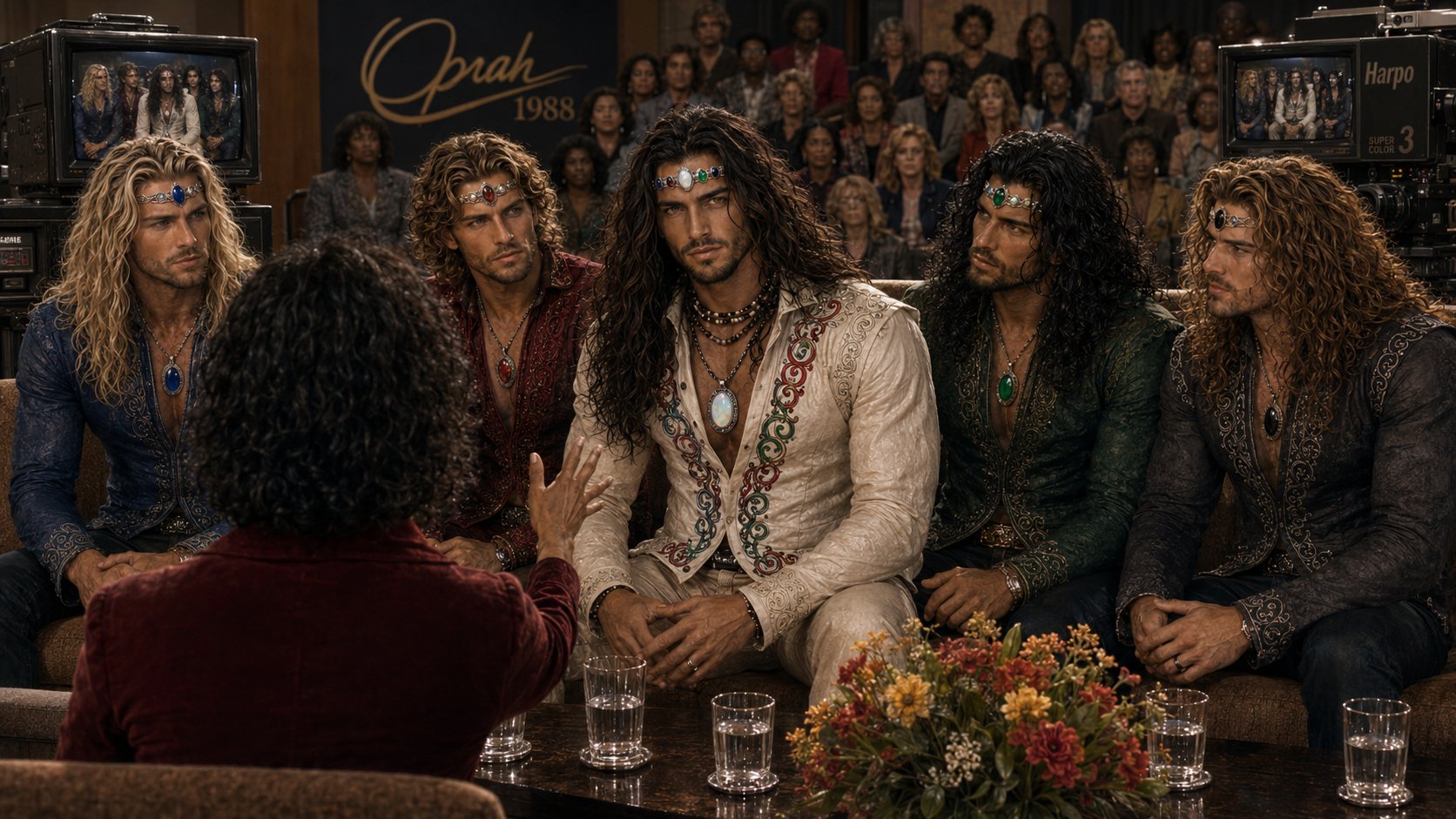
 THE YEAR THE WORLD KEPT TURNING
Castle of Elders — Harmonytis, Aelin / Various Mainland Locations
The world did not move on.
This was the thing nobody had told them… or perhaps they had been told, and in the exhaustion of the first week after the special, the information had not fully landed. The Barbara Walters interview had aired on a Friday night in late April. By the following Friday, the coverage had not slowed. It had deepened. The initial wave…the diplomatic statements, the tabloids, the morning shows clearing their full broadcast hours… that had been the surface. What came beneath it was the sustained, relentless attention of a world that had been given something extraordinary to think about and intended to keep thinking about it.
Kavanaugh said it plainly on the first Monday of May, setting his briefcase on the great hall table with the weight of a man who had been managing something larger than himself for several consecutive days and intended to keep managing it.
"This does not go away quickly," he said. "I want to be clear about that so that nobody is surprised. We are not going to wake up one morning and find the requests have stopped. What we are doing is managing the volume and choosing the direction."
Jace had a mug of coffee going warm in his hand. Samantha was beside him, her own tea cooling. The rest of the Brotherhood was distributed around the table in the various stages of having-been-awake-since-dawn that had become the default state of the Castle of Elders.
"How many requests as of this morning," Jace said.
Kavanaugh opened the folder. "Interview requests: two hundred and fourteen. Print, radio, television, and international. Publication requests, profiles, cover features, extended pieces; sixty-seven. That number includes Rolling Stone, who have called three times, and Time magazine, who have called twice."
"Time magazine," Ricky said from the floor where he was sitting with his back against the wall.
"Time magazine," Kavanaugh confirmed. "They want a cover."
The great hall absorbed this.
"Which ones do we take," Connor said. He was at the table with his second cup of tea, the emerald amulet catching the morning light from the window behind him.
"That is what I'd like to determine today," Kavanaugh said. He looked at Jace.
"There is one in particular I want to flag before the rest. Tom Brokaw followed up."
"He said five minutes twice," Connor said, recalling the last time Brokaw had called.
"He said it again in the follow-up," Kavanaugh said, with the expression of a man who found this professionally endearing. "Still twice. Still with the pause between them."
"He means it," Connor said. The slight nod that meant he had read the contact through the ambient field and found it genuine, "He is not performing the request. He only wants five minutes."
"Schedule him," Jace said. "This week if possible. He gets his five minutes. If it runs longer, it runs longer."
Kavanaugh made a note. "Rolling Stone."
"Yes," Jace said.
"Time."
Jace looked at Connor. Connor considered, then nodded once.
"Yes. But we set the terms for the photography," Jace told John.
"I'll handle the terms," Kavanaugh said. He made another note. "There is one other contact I want to flag separately, because it is not a media request."
He set a card on the table.
Connor was already looking at it before Kavanaugh said the name.
"Oprah Winfrey," Kavanaugh said. "Her production company called. She wants to meet first, not an interview request, a meeting. She said, and I am quoting directly: 'I am not interested in the same conversation everyone else is having. I want to understand what they carry.'"
The table was quiet.
"She watched the special," Connor said. "She watched it in her own living room, alone, twice. The second time she made notes."
"When does she want to meet," Jace said.
"She suggested Chicago. The show's studio. Whenever is convenient for the Brotherhood." Kavanaugh paused. "She used that word. Brotherhood. Not 'the band.'"
Jace looked at the card. Then he looked at Samantha, who was watching him with the expression she had when she was letting him make the decision without influencing it, which was itself a form of influence and they both knew it.
"Set it up," Jace said. "Chicago. We'll go to her."
Connor called Theresa Saldana before attending to other calls.
He did it early in the morning, from the window of his residence in Léirstinach, the day after the Brotherhood meeting. The lavender sky was still pale, the sun not yet fully up, and the island was in that pre-morning quiet that felt like the world holding its breath.
Theresa Saldana had founded Victims for Victims in 1982. She had built it from nothing, from the knowledge of what it meant to survive something the world wanted to look away from, and the conviction that survivors deserved a structure, a voice, and each other. Connor had read everything about her before he made the call. He knew who he was calling.
She picked up on the second ring.
"Ms. Saldana," Connor said. "This is Connor Braydee. I understand you called."
There was a brief silence. She had been waiting for this call, and sounded pleased to hear his voice.
"I watched the special," she said. "Both nights. The first time, I had to stop and walk around my kitchen for about ten minutes before I could sit back down. That is not something I do."
Connor looked at the sea. At the pale morning light on the water.
"The words you used," she said. "Not the interview words. The other ones, when you were talking about what he did to you and your brothers. 'He uses fear and the violation of the body as weapons. He used them against us. We recovered.'"
Another pause, shorter.
"I've been doing this work for six years and I've sat across from hundreds of people who needed to hear exactly that sentence, and not one of them had ever heard a public figure say it out loud. Without softening it. Without making it smaller than it was." Her voice was level, but underneath it was something he recognized, the steadiness of someone who had learned to speak clearly about the thing that had happened to them because the alternative was letting it be unspeakable. I needed to call you. Not through Kavanaugh, not in a letter. I needed to call."
"I'm glad you did," Connor said.
"I also wanted to say…" She stopped. Started again. "I know what it costs to say those things publicly. I know what it costs to sit in a room with a camera on you and not flinch from it. I wanted you to know that someone who has been there heard you, and it mattered."
Connor was quiet. Outside, the lavender sky was beginning to catch the first edge of light. He was thinking about what it was to be heard by someone who understood exactly what the words meant. Not as a viewer or a journalist, but from the inside of it.
"Thank you," he said. "For calling. And for saying it directly."
"I find that directness is usually better," she said, with a note in her voice that was not quite humor but carried the warmth of someone who had made peace with difficult things. "I think you may share that view."
"I do," he said.
They talked for nearly an hour. The call moved easily between things, what she had built with Victims for Victims and how it worked, what the Brigade letters had told him about what the special had opened up, the practical shape of what a partnership between the two organizations might look like. She asked about the other four, not as a researcher collecting data, but the way someone asks when they actually want to know: how they were doing, what kind of support they had around them, whether any of them had been able to access anything useful in the years since. Connor told her what he could. She listened the way people listened when they understood what was being said under the words.
"I want to meet them," she said, near the end. "Not as an interview or as a panel… just to sit in a room with them. All five of you. I want to be able to look at all of you and know that you're okay. Or that you're working toward it. I know that's a lot to ask."
"It isn't," Connor said. "We'll make it happen. Let me talk to Kavanaugh about scheduling. I want it to be soon."
"So do I," she said.
After they hung up, Connor stayed at the window for a long time. He was thinking about the 1,640 letters that had arrived overnight through the Brigade. He was thinking about what Alen had told him in the Visionary Realm, the shard, and what could remove it, and the word Votaress, and Indira's name said quietly in the firelight of a room in another era. He was thinking about five men in a room with Theresa Saldana, and what that conversation was going to be, and that he wanted it to happen.
Galena brought it up on a Thursday morning. Thursday was the Brotherhood's administrative meeting day, which meant all five of them were in the great hall, seated, already in the frame of mind for things that needed to be decided. She waited until the end of the agenda and then set a folder on the table.
Not a large folder. A thin one. This was, if anything, more concerning than a thick one.
"The hair," she said.
The great hall was quiet.
"What about the hair," Ricky said.
"You are now recognized world leaders," Galena said, with the composed directness she brought to everything that needed to be said plainly. "You will be sitting across from Oprah Winfrey. You will be on the cover of Time magazine. You will be shooting two music videos that will be seen by tens of millions of people. I am not asking you to look like other world leaders." She paused. "I am asking you to look like what you are. Tighter. More regal. Still yourselves, but the version of yourselves that the world is now looking at as leaders of a sovereign nation."
She opened the folder. There were photographs inside. Tasteful reference images showing various ways that long hair could be shaped and cleaned up without being surrendered.
She slid it to the center of the table.
Nobody moved toward it immediately.
"How much," Nathan said.
"Enough to make the difference," Galena said. "Not enough to change who you are."
Nathan looked at the photographs. "Reasonable," he said. He looked at Galena. "I'll go first."
Connor leaned over and looked at the photographs. He had been thinking about it already, if he was honest. His hair had reached a length at which the post-show inventory had become genuinely alarming. A pen two weeks ago. Three straws from a hospitality table, somehow braided together, discovered at midnight. A pencil stub last Tuesday that he was fairly certain had been used. He had not mentioned the pencil.
"I'm up for something," Connor said. "It's been getting out of hand."
"The pencil," Jace said.
"I don't know what you're talking about," Connor said, with perfect dignity.
"He found a pencil in his hair," Jace told the table.
"A used one," Ricky added, "A little bitty pencil!"
"It came flying out of his hair when he turned his head," Erik inserted quickly.
"Struck one of our fans in the arm, I heard…" Nathan chimed.
"Okay…I will not be confirming or denying anything," Connor said. "But yes. Something needs to happen."
Erik had been looking at the photographs with the expression of a man conducting a careful private assessment. He was not opposed to his hair, which had been long since his Minnesota high school years and which he had always worn as a matter of preference rather than performance. It was his. He had opinions about it.
"How much off," he said.
"Shaped," Galena said. "Not shortened substantially. Cleaned up at the ends. Layered so it moves well rather than hanging flat."
Erik looked at the photographs for another moment. "Show me the end result first," he said. "I'll decide after I see it."
She turned to the last page of the folder, which contained a photograph considerably closer to what they all actually looked like, long-haired and leather-vested, simply cleaned up.
Erik looked at it. "Fine," he said.
Jace had not said anything.
He was looking at the folder without looking at it, which was the quality he had when something was sitting across from him that had more dimensions than it appeared to. Long hair was not just preference for him. It was not image. It was Thomas Elias, who had worn his hair the same way, and his father before him, and the line of men before that going back further than Jace could trace it. It was the reservation and the language and the things that had been his before the amulet and before the castle and before any of this.
Galena looked at him. She understood exactly what she was looking at.
"Jace," she said. She said it quietly. "I am not asking you to cut it."
"I know," he said.
"I am asking you to shape it. The length stays."
He was quiet for another moment. Then Samantha, who had been sitting beside him throughout with the quality she had when she was letting him arrive somewhere in his own time, said: "I have an idea of what would look right."
He looked at her.
"For you and for Connor," she said. "If you'll let me tell the stylist what I'm thinking."
He held her gaze.
"Okay," he said.
Connor looked at her. "What are you thinking for me."
"Something with more shape through the top," she said. "The curls are staying. We're just giving them somewhere to be."
Connor considered this. He glanced at his reflection in the dark window glass of the great hall, then back at Samantha. "Do it," he said.
"Ricky," Samantha said.
Ricky had been watching all of this with the relaxed expression of a man who was not especially worried about his own situation.
"Yeah, I'm fine with a trim," he said.
"Buzz cut," Samantha said.
Ricky went very still.
The great hall was completely silent.
"I'm sorry," Ricky asked, "What?"
"I'm just saying it would suit you," Samantha said, with perfect innocence.
"It would absolutely not suit me," Ricky said, with considerable feeling. "I would look like… I don't even know what I would look like. I would look wrong. I would look like a different person. I would look like someone who does not play guitar. Samantha. No."
Conner and Jace both tried very hard not to snicker. Nathan and Erik played it cool, but each were biting their lips.
"I'm just exploring the options…" Samantha started, trying not to laugh now.
"The option is no," Ricky said. "Firmly and with great conviction, no. Not a buzz cut. Not even a little buzz cut. Not a buzz cut on one side. No buzz cut anywhere on my head."
"Okay," Samantha said, mildly, "No buzz cut."
"I want that on the record," Ricky said. "Categorically. No buzz cut."
"Noted," Galena said, and made a note, which caused Ricky to look at her with mild alarm.
"She's not actually writing buzz cut, Ricky…" Connor said, noting Ricky's paranoid attempt to see what Galena wrote.
"She wrote something," Ricky said.
"She wrote no buzz cut," Nathan said. "Which is the same information."
Ricky looked at Nathan. Nathan looked back at him with the expression of a man who had found the last two minutes genuinely entertaining and was not going to say so.
The stylist Galena had brought over from the mainland arrived the next morning. She was a woman named Petra who had worked with several European royals, which Galena considered an appropriate credential, and who looked at the five of them in the castle sitting room with the professional assessment of someone who had been given an interesting problem and intended to solve it well.
Nathan sat down first.
He came out of the chair twenty minutes later looking, as Galena had promised, like himself but the version the world was now looking at. The sandy brown was shaped; the waves settled into something that had direction rather than simply length. The garnet amulet sat better against his collar. He looked at the mirror, turned his head slightly, and nodded once with the satisfaction of someone whose expectations had been met.
"Good," he said, and went back to his notes.
Connor went next, with Samantha giving Petra the brief she had described. Petra worked for thirty-five minutes, and when Connor stood up the dark curls had been given, as Samantha had put it, somewhere to be. The shape through the top was clean, the length preserved, the emerald amulet framed rather than buried. He looked in the mirror and was quiet.
"Right," he said. "Yes. That's right."
"The pencils will still find a way in," Ricky said, from the couch where he was waiting.
"I am choosing not to hear that," Connor said.
Jace went third, with Samantha beside Petra the entire time, occasionally saying a word or two, mostly just watching with the quality of someone who had a clear picture in their mind and was watching it arrive. The Paiute length stayed. The dark waves were shaped and cleaned at the ends, layered so they moved rather than hung. When Jace stood up he looked in the mirror for a longer moment than the others had.
He thought about his father.
The length was there. The waves were there. Thomas Elias had worn his hair exactly this long. This was not a departure. This was just Thomas Elias's hair with better maintenance.
"Good," he said. He looked at Samantha. "Thank you."
She touched his arm briefly. That was all.
Erik went fourth. Petra worked on the blonde with the approach Galena had described… shaped at the ends, layered, cleaned up without being reduced. Erik watched the mirror throughout with the careful attention of a man monitoring a situation. When it was done, he turned his head, assessed, and said: "That works."
This was high praise from Erik.
Ricky sat down last, in the manner of a man approaching something he had fully accepted and intended to face with dignity.
"No buzz cut," he said to Petra.
"No buzz cut," Petra confirmed.
"I want to be very clear…"
"Ricky…" Samantha said, "You're not getting a buzz cut."
"I think you traumatized the poor guy, Sam," Connor chuckled.
"No buzz cut," Ricky said, one final time, to the room generally, and then sat back and allowed Petra to work.
He came out of the chair twenty minutes later looking, as everyone immediately agreed, extremely good. The auburn curls were shaped and cleaned the length intact, the onyx amulet sitting exactly where it had always sat.
He looked in the mirror.
"Okay," he said, after a moment. "Okay, yes. Fine. That's good."
"It's very good," Connor said.
"You look like a man who governs a county," Nathan said.
"I do govern a county," Ricky replied.
"You look like it now," Nathan said pleasantly, and returned to his notes.
Galena looked at the five of them when it was done…standing in the castle sitting room in the morning light, the same five men they had always been, just the version the world was about to see on Oprah's couch and on the cover of Time magazine and on top of desert rock formations in August.
"Better," she said.
Coming from Galena, it was the equivalent of a standing ovation.
CHICAGO, ILLINOIS
WLS-TV Studios
Late May, 1988
Chicago was cold for late May, which Connor noted and Ricky complained about at length and Erik declined to acknowledge because he had grown up in Minnesota, and this was not cold. The studio was on the near north side; a converted space that had been transformed with the deliberate warmth that Oprah brought to every environment she controlled. Not a news studio. Not a journalism set. Something that felt, unmistakably, like a room where human beings talked to other human beings.
She met them in a green room before any cameras were rolling. This had been part of the agreement and Kavanaugh had been clear that the Brotherhood would meet her first, in private, before any interview setting. Oprah had agreed without negotiation, which Connor had registered and found significant. She understood what she was asking, which meant she understood more than most.
She was smaller than she appeared on television, which was the thing most people said about television personalities, and which was not quite right in her case. The more accurate thing was that she was precisely as present as she appeared on television, which was a quality that had nothing to do with physical size and everything to do with attention. When Oprah Winfrey looked at you, she was entirely with you. Not journalist's attention, not interviewer's calculation. Something older. Something that was simply: I see you, and I am listening.
Connor felt the warmth of her from across the room before she crossed it.
"Gentlemen," she said. She shook hands with each of them in turn… firm, direct, the handshake of a woman who had spent years in rooms where people tested her grip before they took her seriously. When she reached Jace she held the handshake a moment longer. "Your Majesty," she said, and there was nothing performative in it. She meant it.
"Oprah…it's a pleasure to meet you," Jace said, "We're in America, so you can just call me Jace."
He smiled the smile he had when he was genuinely at ease with someone, which Connor noted and filed. Jace's instincts about people were good. They were not Connor's instincts, not empathic in the powered sense, but they were the instincts of a man who had spent thirty years paying attention, and they were rarely wrong.
They sat. Coffee appeared. She looked at them all, not reading the room as a journalist, but as a human being taking in something she wanted to understand fully before she said a word about it.
"I want to tell you what I am not going to ask," she said. "I am not going to ask you to prove anything. I am not going to ask you to perform anything. I watched that special twice and I understand what you gave to that interview. I am not interested in the same conversation." She looked at Connor. "I want to understand what it costs."
"What what costs?" Connor asked.
"All of it," she said. "Being what you are. In the world. In the body. In the work."
She looked at each of them in turn.
"I want to understand what it is to be five men who have been carrying something this large for this long, and who then had to set it down in front of a hundred and fourteen million people and say: here. This is real."
The green room was quiet.
"That," Connor said, "is a different interview."
"Yes," Oprah said. "I know."
The interview opened with Jace.
Not with the island, not with the amulets… she started with the band. She asked him about the night they renamed themselves Battle Cry, and a quality in the question's texture, not what happened, but what it felt like when the name came to them. It landed differently than the press questions always did. Jace answered honestly, which was what he did when a question came from somewhere real.
She asked about the music. About what it was like to play behind four men who were also his brothers by bond and by choice. Jace talked about the kit as he talked about it when he wasn't being careful, with his hands moving slightly, marking time on his knee, as he did when the rhythm was in his body and leaking out at the edges.
Oprah watched his hands. "You never stop," she said with a smile.
Jace looked at his hands.
"No," he said with a chuckle, "I don't."
She let the silence sit. Then: "Tell me about your mother."
The studio went very quiet.
It was not a trap. It was not a journalist's ambush. Oprah had done her research, and she had done it with her whole heart, which meant she had understood something about the shape of what Katherine Elias had carried, and she was asking Jace to share it because she believed he needed to say it out loud more than she needed to ask it.
Jace was quiet.
"She died in 1982," he said. "Breast cancer…A year before I received the amulet."
He paused.
"She knew what I was going to be. She knew from the day I was born. She spent twenty-three years preparing me for it and she never once let me see how much it cost her."
He looked at his hands.
"She called me her drum boy."
Something moved across Oprah's face. She did not look away.
"She never got to see it," she said.
"No," Jace said. "She never got to see any of it. There was something she wanted to tell me…mentioned it to me the day before she died. She never got a chance to tell me."
"Do you think it was about…all of this?" Oprah asked.
Jace was quiet, thinking back to that tired and weak conversation they'd shared a mere 12 hours before she passed away.
"I think so," he finally said, "Now I really think so."
The room held that.
"Would she have been proud?" Oprah asked.
Jace looked up. His eyes were very steady.
"Yes," he said. "She would have had things to say about how I've handled certain parts of it. She always did. But yes."
Oprah smiled, not the professional smile but the real one, the one that came from somewhere she kept for things that mattered. "That sounds like a woman I would have liked," she said.
"You would have," Jace said. "She would have liked you too."
She asked Nathan something no one had asked him yet.
She had read something, she said, in the background briefings, a detail about his early education. She wanted to know what it was like to be a child who understood things the adults around him could not follow.
Nathan considered this with the composed attention he brought to questions that deserved it.
"Lonely," he said. "Until it wasn't."
"When did it stop being lonely?"
Nathan looked at Jace. At Connor. At Erik and Ricky. Something moved in his expression that was not quite a smile but functioned as one.
"1983," he said.
Oprah looked at the five of them. She was quiet. Then she turned back to Nathan and said: "Tell me what that means. When you say 1983, what changed?"
Nathan looked at Jace first. Jace gave him the small nod that meant 'say the true thing.'
"I had been alone inside my own mind for most of my life," Nathan said. "Not unhappy. Not broken. But alone. There is a isolation that comes from thinking at a level other people cannot follow. You learn to translate yourself down. You learn to move at a speed that does not alarm anyone. And then I found four guys who did not require me to translate. Who moved at whatever speed the moment needed. Who were genuinely interested in what I was carrying. Not impressed by it. Interested. I had never had that before."
Oprah's hand moved toward him, not touching, but close.
"And now you do," she said.
"Yes…now I do," Nathan said.
She looked at him. Something was very bright in her eyes.
"Thank you for telling me that," she said.
Nathan nodded once, with the composed grace of a man who had said a true thing and was at peace with having said it.
She asked Connor about what he had said on camera during the special. Not the words themselves… she asked him about the decision to say it. The moment before the words. What he had known, at that moment, that he was about to do.
Connor thought about the 1,640 letters. He thought about Theresa Saldana at her desk, watching the special and picking up the phone. He thought about Marguerite stopping at four in the morning because she couldn't see the pages.
"I knew there were people watching," he said, "who needed to hear that someone had been where they had been and was sitting upright in a chair. That was what I knew."
Oprah was quiet. Her face changed; not breaking, but opening, "And are you?" she said quietly. "Sitting upright?"
"Yes," Connor said. "It took a while. But yes."
She looked at him. Then she said, "I want to ask you something, and I want you to know that you absolutely do not have to answer it. Not on camera, not at all. You say it took a while. Can you tell me, and I mean this in the most honest way I know how to ask, what got you upright?"
Connor looked at his brothers. At Jace, who was watching him with the attention he brought to everything Connor said in public after a certain point. At Nathan, still. At Erik's quiet steadiness from the far chair. At Ricky, who was watching him with an expression that had nothing in it except: I'm here.
"Them," Connor said. Simply. "It was them. We went through all of this together. I don't think a single one of us felt alone in any of it, because we were all in it…all dealing with it. So, we leaned on each other. And leaned on God…a lot."
"Many prayers," Jace agreed.
He saw it happen… the moment it hit Oprah. Not a dramatic break, not a tear tracked perfectly for the camera. Just the cresting of something that had been building in her from the moment she walked into that green room and understood what she was sitting across from. Five men. Five brothers. Amulets and ancient bonds and a thousand-year-old enemy and an island hidden from the world…and underneath all of it, underneath every extraordinary thing this week had produced, the simplest human story she knew how to tell: people who had found each other, who had held each other up, who had gotten someone back to upright when the world had put them on the floor.
She pressed her lips together. She breathed in through her nose. She did not look away from Connor.
"I'm sorry," she said. "Give me a moment."
Nobody in the room moved.
Oprah Winfrey, who had interviewed heads of state and survivors of impossible things, who had sat across from people in the deepest trenches of human experience and held the space for them with her whole self… sat in her own studio and needed a moment, and the five men across from her gave it to her without a word.
When she came back, her eyes were bright.
"Thank you," she said to all of them, her eyes landing on Connor, "Thank you for letting me ask that."
"Thank you for asking the real question," Connor said.
She smiled. Fully this time. "That," she said, "is all I ever want to do."
She asked Jace about Samantha. Not "tell me about your fiancée"; she asked him what it was to love someone while carrying the weight of what Jace carried.
Jace was quiet. When he spoke, it was with the steadiness of a man who has found the words for something he has thought about a great deal.
"She is the only person who has ever looked at everything I am…and I mean all of it, the drums and the amulet and the throne and the thing I have to become, and said: I'll stay. Not because she doesn't understand what that means. She understands exactly what it means. She has chosen it with full information, every single day."
He looked at his hands.
"That's not something you take for granted. That's something you spend your whole life being worthy of."
The studio was very quiet.
Oprah looked at him.
"Does she know you feel that way?" she asked.
"Yes," Jace said.
"How does she know?"
Jace was quiet for another moment and then replied, "There's a song on the next album. I sang it with my eyes closed. I couldn't open them… if I'd looked at her through the glass, I wouldn't have been able to finish it. When I came out of the booth, she was smiling. Just smiling. Like she already knew."
He looked at Oprah.
"She always already knows."
Something had happened in the studio by this point that had nothing to do with the cameras or the format or the forty-six minutes of broadcast time the network had allotted. The thing that happened in the spaces Oprah built… the atmosphere she created in which ordinary human truth could stand up and be recognized… was present in full. The crew had gone very still. The audience, brought in quietly after the green room meeting, was holding a collective breath.
Oprah reached across and touched Jace's arm. Not a gesture for the camera. A gesture between two people.
"She's a lucky woman," Oprah said.
"I'm the lucky one," Jace said.
The interview ran two hours and forty minutes and used forty-six minutes of broadcast time, which Oprah told them afterward was the most ruthless edit of her career and she was not entirely happy with it, but the show had a time slot to fill. The full version, uncut, would be kept in her archive and released the following year.
She walked them out herself when it was done. At the door, she stopped Jace with one hand on his arm…light, not detaining, the gesture of someone who had one more thing to say and wanted to say it without an audience.
"The wedding," she said. "May I ask when?"
"May 12, 1990," Jace said.
Oprah nodded.
"Will you tell me when it happens?" She asked.
Jace looked at her and smiled.
"I'll do better than that," he said. "I'll send you an invitation. I would very much like you to be there, Oprah."
Oprah's expression did something unguarded and entirely genuine. Her face lit up and she smiled warmly at Jace.
"I will be there," she told him, "And then I can call you Your Majesty!"
Jace laughed at this and replied, "Yes, you certainly can."
The Recording Studio — Near the Castle of Elders
The studio Galena had built in the autumn of 1986 had been, at the time of its construction, a converted warehouse space near the castle. Within two years it was something else, not because anything structurally had changed, but because they had been using it for two years and it had become theirs in the way that spaces become theirs when you pour yourself into them repeatedly until the walls hold the memory of it.
Nathan had spent three weeks preparing the studio for the Rise Up sessions. This was not unusual. Nathan always spent time preparing the studio before a recording run, calibrating the acoustics, servicing the equipment, running tests on the isolation booths that he had designed himself and which performed, in his measured professional opinion, approximately fifteen percent better than any comparable mainland installation. He said this once to Sidney, who said "is that so" in the tone he used when he found something amusing and was not going to say so.
"It is indeed so," Nathan said with a grin, and went back to the acoustics.
The first day of sessions, the Brotherhood arrived to find the studio in a state of what could only be described as deliberate perfection. Every cable routed. Every piece of equipment placed with the intentionality of a man who understood that the physical arrangement of a space was not aesthetic but functional. The great recording room, the one with the soaring ceilings and the stone walls that had given the Shadowlands album its resonance, had been reconfigured slightly, the baffles repositioned to account for something Nathan had calculated about the way Aelinian stone reflected certain frequencies differently in summer than in autumn.
Jace looked at it.
"Nathan," he said.
"The stone temperature differential affects the mid-range by a measurable margin," Nathan said. "It's not a large margin. But it is a consistent one, and consistency matters."
"That's not what I was going to say," Jace said.
Nathan looked at him.
"I was going to say it looks perfect," Jace said.
Nathan's expression did the thing it did when he received a genuine compliment and was not going to perform modesty about it.
"Yes," he said with a crooked grin, "It does, doesn't it?"
They started that afternoon with "Rise Up," which was the logical opening… Connor and Nathan had written it together and it was the title track, and it set the tone for everything that followed. Connor's voice in the isolation booth came through the monitors with the quality that Aelinian stone always gave: a resonance, something between warmth and clarity, that the mainland studios had never quite captured. He ran it twice for levels and then recorded the full take, and when he came out of the booth Nathan was already making notes on the board with the focused efficiency of a man who had recorded in his head the exact adjustments he was going to make before Connor had finished the last note.
"Good," Nathan said. "The second verse was slightly ahead. Not enough to fix… enough to use."
Connor tilted his head. "Ahead as in faster or ahead as in better?"
"Both," Nathan said, without looking up.
Connor picked up his tea and sat on the couch behind the board. "I'll take it," he said.
The album sessions ran through the heat of June and into July. "Take My Hand Tonight" in the second week… Jace and Connor in the booth together, one microphone between them, Del Morrow at the board watching through the glass with the stillness of a producer who knew he was recording something that was going to matter. "Don't Make Me Laugh" the week after… Jace loud and grinning in the booth, the defiance song, the one that had been waiting in him for years.
"When Nothing Feels Good" was Connor's, and it was recorded quietly. Not the kind of quiet that comes from timidity… the kind that comes from surrendering the weight of the world to a much higher power. The isolation booth in the late afternoon, the light through the high window, and Connor's voice doing what it did when he stopped performing and simply told the truth. Nathan worked the board with the focused economy of a man who understood that too much production would only get in the way.
They left "Fast Talker" until late July, which was the right call. By then the sessions had found their rhythm, and Ricky had been watching the other tracks take shape with the patience of a man who knows his moment is coming. When it came… Ricky in the studio, guitar in hand, Nathan stepping away from the board and simply letting the room be what it was. It was everything it was supposed to be. The kind of playing that made other guitarists go quiet.
The "Take My Hand Tonight" story was told in pieces over the first week of sessions, generally in the evenings when the day's recording was done and the Brotherhood was in the lounge with the looseness that came from having spent the hours doing the thing they were best at.
It had been recorded three weeks before the special aired, one of the last things they had done before going public. The decision to re-record it had been Jace and Connor's jointly, arrived at the way most of their creative decisions arrived: one of them said a thing, the other said yes, and the machinery of it started moving.
The vocal arrangement had changed from the 1981 original. Not the melody; the melody was untouchable, but the way they inhabited it. Seven years of living inside the same bond, the same Brotherhood, the same weight of knowing what they knew and being what they were, had changed what Jace and Connor brought to a song about two people standing on the edge of something they were afraid to cross.
The producer, a mainland man named Del Morrow who had worked with them twice before and whom Nathan trusted, which was the relevant credential, had put them in the booth together. Facing each other at one microphone. He had said: give it everything.
"We were egging each other on through the whole thing," Connor said, in the lounge on the second evening, his legs stretched across the couch with the unselfconscious ease of a man in his own space. "You know how it gets. You hit something good and you look at the other person and they push back."
"He looked at me during the bridge," Jace said, from the chair where he was sitting with his feet up on the table, "and I genuinely was not sure if he was going to laugh or scream."
"Both were options," Connor agreed pleasantly.
"He screamed," Ricky said, from the floor.
"I do not scream," Connor said, with complete dignity. "I wail. There is a categorical distinction."
"He wailed," Ricky confirmed, to nobody in particular.
"One take," Erik said, from the corner. He said it the way Erik said most things… as a fact, without editorial, flat as a stone laid on a table. "One take, and Del came on the intercom, and he didn't say anything for about fifteen seconds."
"What did he say when he came back," Nathan asked. He had been listening from the doorway, a cup of tea in one hand.
Jace and Connor looked at each other.
"He said, 'I'm going to need a minute,'" Jace said.
"He took more than a minute," Connor said.
"He took about four minutes," Jace agreed. "We could see him through the glass just sitting at the board not touching anything."
Nathan nodded once, with the expression of a man who found this professionally satisfying. "He's a good producer," he said.
"He cried a little," Ricky offered.
"He is a very good producer," Nathan said, and went back to the board.
Collins arrived on a Tuesday morning in the second week of June.
The "If You'll Have Me" session was on a Thursday afternoon in the third week of June.
Jace had been building it for two days. Not visibly… not in any way that he would have described as building toward anything. He had been recording, training in the mornings with Sidney, eating with Samantha in the evenings, existing in the ordinary rhythm of a life that happened to be running alongside something extraordinary. But Connor had been aware of it… the quality of attention Jace was bringing to everything around him, the slightly different way he moved through the studio, how he sat with Samantha at dinner and looked at her when she was talking and did not try to compose his expression at all.
The day of the session, Nathan cleared the studio of everyone who was not essential. This was not discussed. Nathan simply, at a certain point in the afternoon, said something quiet to Ricky and Erik that resulted in Ricky taking a guitar outside and Erik finding something to do in the lounge. Sidney, who had come by to observe the afternoon session per his customary schedule, caught Nathan's eye and nodded once and went for a walk on the peninsula. Kavanaugh, who had been at the studio for a logistics meeting, gathered his briefcase at approximately the right moment and left.
What remained was the essential: Jace at the microphone in the booth. Nathan at the board. Connor on the couch beside Nathan because Connor was always on the couch beside Nathan during sessions. Samantha, at Nathan's quiet suggestion, in a chair in the corner of the control room, with a clear sightline through the glass into the booth.
Jace did not know Samantha was there. He had come in from the hall, gone straight into the booth, put on the headphones, and stood with his back to the glass with his eyes closed. Nathan gave him time. Nathan always gave him time.
"Ready when you are," Nathan said, into the talkback.
Jace nodded, still facing away from the glass. He turned to face the microphone. He closed his eyes.
He did not open them.
Not for the verse, where his voice came in low and rough and entirely unguarded; the voice he used when he was not performing but simply telling the truth. Not for the pre-chorus, which was the place in the song where something changed in the delivery, where the raw quality of the verse opened into something that was not quite vulnerability and not quite strength but the territory between them where the most honest things lived. Not for the chorus, which was the thing the song had been building to, the place where Jace's voice did what it could do in the lower register; the weight of it, before it lifted into the upper range with the quality that always caught people unprepared, the sudden tenderness of a voice that had just been carrying something enormous.
He sang the bridge with his hands loose at his sides and his face turned slightly upward, the way he sometimes did when he was feeling something he did not have words for outside of the words he was already singing.
He sang the final chorus.
He held the last note.
He let it go.
The control room was very quiet.
Nathan sat at the board without moving. His hands were still on the surface in front of him, not on any controls. Connor, on the couch beside him, had his elbows on his knees and his face in his hands. Nathan did not look at him. Nathan was looking at the board with the expression of a man who was conducting himself with great professional precision and intended to continue doing so.
In the corner of the control room, Samantha was sitting with her hands folded in her lap and her spine straight and her chin up. Her eyes were very bright. She was not crying. She was smiling… the smile she had when something was so completely right that there was nothing to do in response to it but be still and let it be right.
Jace opened his eyes.
He turned to face the glass.
He saw Nathan, not moving. He saw Connor, face in his hands.
He looked at Samantha.
She looked back at him and smiled, and did not try to do anything else, because there was nothing else to do.
Jace took the headphones off, slowly. He set them on the stand.
He came out of the booth.
Nobody said anything.
"Was that the one?" Jace asked Nathan.
Nathan looked up from the board. His expression was composed and entirely warm simultaneously.
"That was the one," he said.
Jace nodded once. He sat down on the couch next to Connor, who straightened up and wiped his face with the back of his hand with the lack of embarrassment of a man who has long since accepted that certain things produce certain responses in him and the appropriate reaction to that is not shame.
"You absolutely…" Connor started.
"I know," Jace said.
"You sang it with your eyes closed the entire…"
"I know."
"Jace…"
"Connor?"
"That's the single," Connor said. "That's number one. That is going to be number one."
"Nathan," Jace asked, "Is it number one?"
Nathan had turned back to the board. He was already making notes.
"I'm not in the business of predictions," he said, "but I think so."
The "Don't Make Me Laugh" session was the following Monday, and the energy in the studio was completely different.
Jace came in grinning.
This was already a signal. He came in grinning, he set up at the vocal mic, he looked through the glass at Nathan at the board, and the grin widened.
"You're going to turn that up," Jace said, into the talkback.
"I was planning to," Nathan said.
"Turn it all the way up."
"That is not how recording works," Nathan said, in the tone that meant he was going to turn it all the way up.
Connor was on the couch. He was already grinning too, the grin he had when he and Jace were about to do something that was going to be very loud and extremely satisfying. He had co-produced the track with Nathan. He knew exactly what it was.
"Don't Make Me Laugh" was Jace's defiance song. It was every person who had ever looked at a quiet Paiute kid from Reno and decided he was a target. Every room where someone had assumed, incorrectly, that his stillness was weakness. Every year of being told, in a hundred different registers, that he was not quite enough of whatever was required. It was the fury of a man who had been through a great deal of considerable darkness and had come out the other side still standing, still drumming, still the Guardian of a hidden island nation, with a number one single currently in production and a fiancée who looked at him the way Samantha looked at him.
Jace sang it the way it was written to be sung…loud, grinning, with the bite in his voice that came when he was accessing genuine anger through genuine joy simultaneously, which was a thing he could do that most vocalists could not. The verses were controlled, pointed. The chorus was a release. The bridge was the kind of thing that needed to be heard twice before the full meaning landed, and the second time it hit differently.
He punched the final chorus with the force of a man who had been carrying the thing he was singing about for thirty years and was now putting it down, loudly, with everyone watching.
When he came out of the booth, Ricky was in the control room doorway. He did not know when Ricky had appeared. He had not been there at the start.
Ricky was looking at him with the expression of a man who had just witnessed something that required a moment to process.
"Dude," Ricky said.
"Yeah," Jace said.
"Dude."
"I know. You're not gonna go Connor on me are ya, Rick?"
Ricky looked at Connor. Connor looked back at him. Then Ricky looked back at Jace.
"No…but the drummer has a lot to say on this album!" Ricky said with a laugh.
"The drummer has always had a lot to say," Jace said. "He just waited until now to say some of it."
The hidden track decision happened on a Wednesday afternoon in late June, in the lounge between sessions, when Connor
Connor found Nathan in the great hall on a Wednesday afternoon and told him he'd written something new and wanted to play it for him.
"Come to the studio," Connor said. "Just you. I want a fresh set of ears before I do anything else with it."
Nathan looked up from his notebook. "What is it?"
"Blues thing," Connor said. "Something different. I've been working on it for a week."
Nathan considered this for approximately two seconds. A blues thing from Connor was worth hearing. He put down his notebook and followed him to the studio.
The studio looked exactly as it always looked, board set, instruments in their places, nothing obviously amiss. Connor picked up his acoustic and sat on the stool he used for writing sessions. Nathan settled onto the couch along the wall, the position he occupied when he was listening rather than working. He did not notice the cajon had been miked. He did not notice that the board had already been set before he arrived. He did not look toward the vocal booth, where the blinds were drawn.
Connor played a few bars of the opening to warm up, giving Nathan a little taste of what he would hear. It was, as advertised, a blues thing, easy, unhurried, the kind of groove that settled into the room without demanding anything from it. Nathan listened with the attentive quality he brought to music, leaning forward slightly. Then Connor stopped playing and said, "Just tell me what you think about what I have so far, okay?"
"Okay," Nathan agreed.
Then Connor started singing:
Nathan in the kitchen…
Nathan's eyes moved to Connor and he choked out, "Wait, what?"
Carton in his hand…
A slight narrowing of his eyes and then, "What are you doing, Connor?"
Said "I don't need a saucepan; I got this all planned"
Nathan glared at him and retorted, "No you didn't, dude..."
That little charm on his necklace
"It's an AMULET," Nathan corrected dully.
Started humming low, The AMULET flickered in the lamplight
Like "Boy You better poke some holes!"
Nathan stared at Connor and asked, "Dude…REALLY?"
Connor just kept singing happily, getting even more into the song on the Chorus:
He got the Tomato Bisque Explosion Blues
Red rain falling on his Sunday shoes
Nathan smirked and said, "My shoes are all week long..."
We hit the floor when that carton blew
Now there's soup on the ceiling and nothing to do
Nathan shook his head, grumbling, "Connor, you suck, dude..."
Nathan's got those Tomato Bisque Explosion Blues
At this point, Nathan was resigned to the fact that Connor was purposely messing with him, but he still indignantly cried out, "You have got to be kidding me...you wrote a song about the soup?"
Connor kept playing and offered the cheesiest grin he could make, replying, "No, I wrote a song about you making the soup EXPLODE!"
"You're never gonna let me live that down, are you?" Nathan asked.
Connor gave the grin again and chirped, "Nope!"
He plucked and strummed back into the second verse, much to Nathan's dismay.
Time ticking by, We just watched it swell,
Corners pushing, Sides all bulging
Like it had a tale to tell
"You act like this was the Apocalypse, Connor!" Nathan exclaimed.
He said "It's probably normal"
Nathan conceded to this line, unfortunately, saying, "Yeah, I was wrong about that..."
Gave a little shrug
Nathan bristled at this. "I did not shrug..."
Then that box went BOOM like thunder
Nathan seemed reflective as he replied, "It was more of a sploosh."
Turned the room to a crimson flood
The control room door opened. Jace walked in carrying nothing, crossed the studio floor with the unhurried ease of a man who had been waiting for his moment, and sat down on the cajon.
Nathan looked at him.
Jace looked back at him with the expression of a man maintaining complete composure in a situation that did not require composure. He placed both hands on the front of the cajon in a standard playing formation and began keeping time with Connor's groove, exactly as if this were a completely normal afternoon and he had simply decided to sit down and play.
Connor barreled into the Chorus with gusto:
He got the Tomato Bisque Explosion Blues!
Nathan stared at Jace and then cried out at Connor, "I can't believe you roped Jace into this!"
Drips sliding down on the fridge and broom
Nathan turned his irritation back to Jace with, "Et Tu, Guardian?"
Jace held his playing position. Both hands on the cajon, steady rhythm, face entirely neutral. Then, without breaking the beat, he pulled in his index finger, his ring finger, and his pinky on both hands simultaneously.
We ducked for cover from that crimson plume
Nathan stared at Jace's resulting configuration for a full second then said, "Nice finger, Your Majesty!"
Painted every cupboard in a thick red bloom
Nathan's got those Tomato Bisque Explosion Blues
Connor went into the bridge section of the song, speaking through it to emphasize certain words properly:
The Kitchen looked like a BLOODBATH
Nathan emitted a quick laugh and replied, "I looked worse!"
Galena sure wasn't proud
Nathan shook his head and ran a hand over his face as he said, "Wow, that's an understatement..."
Her husband looked like a tomato sauce Elmo
Nathan stared at him and questioned, "Wait, I'm ELMO now?"
She chased us out. She made us pay
"She made us clean the kitchen." Nathan clarified.
Her revenge on ol' Nate was legendary
Nathan remembered the revenge all too well. Who knew Galena knew where to find Aelinian skunks?
"Oh, man..." he groaned.
We all step back, 'Cause we remember that blast
And that bisque attack
He got the Tomato Bisque Explosion Blues
Kitchen looks clean but we still got clues
Erik came out first, acoustic bass in hand, moving to his spot with the settled efficiency of a large man who had been crouching behind a door for twenty minutes and intended to show none of it. Ricky was right behind him, acoustic guitar already in his hands, dropping into position beside Connor with the glee of a man who had been waiting for exactly this.
Nathan stared at Erik in disbelief. Then he growled, "Erik, what the hell?"
Erik only grinned at him and joined into the jam comfortably.
One orange stain on his left old shoe
A faint little splatter on the salt and the spoons
Nathan pointed at Ricky with an accusatory finger and said, "Strat Cat, I'm not surprised that you're helping him!"
Ricky grinned fiendishly and added his own acoustic lead guitar noodles to Connor's rhythm.
Nathan's stuck with those
Tomato Bisque Explosion Blues
Nathan looked at the four of them. He looked at the miked cajon. He looked at the board, set and running, the multitrack recording everything. He turned slowly toward the control room window. Samantha was on the other side of the glass, watching with the calm expression of a woman who had spent years setting up equipment exactly right and was confident in her work.
She gave him a small wave.
Nathan rolled his eyes and then put his face in his hands. Everyone laughed and Jace ran to the control room to stop the multitrack.
You miked the cajon," Nathan said.
"Before you arrived," Connor confirmed, now fully into the second verse.
"The board was already..."
"Yep."
"You've been recording this entire..."
"Of course, I have."
This is NOT going on the record..." Nathan told him matter-of-factly.
"Keep telling me that," Connor replied with a grin, "Go ahead, dude."
"I will! Consistently! Forever!" Nathan exclaimed.
"Uh huh," Connor answered, placing his acoustic guitar in its stand and heading for the control room door.
"NOT...HAPPENING!!" Nathan called after him.
The Tomato Bisque Explosion Blues made the album. Nathan was outvoted -- by the Brotherhood, by Samantha, by Galena, by most of the Brotherhood aides, and, in what Nathan would later describe as the most professionally undignified moment of his career, by the kitchen staff of the Castle of Elders, who has ended up cleaning tomato bisque out of the ceiling fixtures for three days after the incident and felt they had earned the right to weigh in.
It went at the end, after Fast Talker. Not hidden, as originally planned -- Connor and Jace had decided Nathan had not been sufficiently tortured by the song's existence yet, and hiding it felt like doing him a favor.
The Castle of Elders
The wedding planning meeting was Galena's idea, framed as a logistical necessity and scheduled with the specificity of a woman who understood that the difference between a ceremonial event and a diplomatic incident was preparation.
She convened it on a Tuesday morning in her office… a stone-walled room in the castle's east wing with a view of the Harmonytis harbor that she had occupied since 1983 and which had accumulated, over five years, the organized density of a space where a great deal of consequential work was done. Maps. Correspondence. The stacked clarity of a desk that was never clean but was always usable.
Jace was there. Samantha was there. Connor was there because he was always at the important meetings and also because Galena had requested his presence, which meant she anticipated that something was going to need diplomatic mediation. Erik was there because the Warrior's role included formal ceremonial functions that he had been exercising at Aelinian state events since 1983. Nathan was there because Nathan was always there when a plan was being made. Ricky was there because someone had told him when it was and he had shown up.
Galena set a folder on the table. It was a substantial folder. She had been building it since April 29th.
"May 12, 1990," she said. "That is the date you chose. I have confirmed it against the Aelinian ceremonial calendar, the island's security rotation, and the Brotherhood's schedule." She looked at Jace. "It is also a Saturday, which I understand to be your preference."
"It is," Jace said.
"Good." She opened the folder. "There are several categories of decision that need to be made, and I would like to work through them in order of complexity, beginning with the ones that have security implications and ending with the ones that have ceremonial implications. This is the reverse of the order in which most people approach a wedding, but our situation is not most people's situation."
"Our situation is famously not most people's situation," Ricky said, from the chair he had pulled slightly back from the table, which was his default position at planning meetings, present but not entirely at the table, as if reserving the right to leave.
Galena looked at him with the expression she reserved for Ricky, professional patience worn smooth at the edges by five years of genuine affection.
"No," she said, and returned to the folder. "The first category is access."
Access was the question of who came through the Veil and under what conditions. Aelin was no longer secret, but it was not public in the way that meant anyone could arrive uninvited. The wedding of the High King was a state ceremony. The guest list had diplomatic implications. Every person who came through the portal was a person who had seen the island, the castle, the Brotherhood's home in its daily reality.
"Samantha's family," Galena said. She looked at Samantha directly. "Tell me who."
Samantha had been prepared for this question. Her had a list… her mother Diana Wallace in Salem, her older sister in Portland, her older brother in Seattle, an aunt she was close to… the people who had been her people long before Battle Cry had been anything other than a band she had gone to work for on a Tuesday in 1984. She read the names. Galena wrote them down.
"Your mother has been through the portal," Galena said.
"Once," Samantha said. "When I first moved here."
"She handled it well?"
Samantha smiled.
"She stood on the coast and said 'you live here' three times in a row. Then she asked if Jace could show her the garden. He showed her the whole island."
"She handled it well," Galena confirmed, and made a note.
The guest list took most of the morning. It was not a small ceremony… a state wedding on Aelin carried the weight of nine centuries of ceremonial tradition, and Galena walked them through what that meant without making it feel like a lecture. Distinguished Aelinian families from each county. The Brotherhood's families… all of them, the full weight of the Dallenger, Braydee, Strathan, Hahn, and Elias lines coming through the Veil together. Kavanaugh, whose position in the Brotherhood's orbit had been earned over a decade of consistent loyalty. Sidney. Dr. Oksana. The Aelinian Parliament in full formal attendance, because the High King's wedding was also a parliamentary occasion.
And Oprah, because Jace had said he would send an invitation and he was not a man who said things he did not mean.
"Mötley Crüe," Ricky said, at a certain point in the discussion.
Galena looked at him.
"Tommy for sure," Jace said, "But the invitation is for the whole band."
Galena made a note. The note, Connor gathered from the quality of her expression, was going under a section she had probably titled something like "Brotherhood's extended musical family," which was going to be a category that required its own security protocols and its own portal scheduling.
"REO Speedwagon," Connor said.
Galena looked at him.
"They're oath holders," Connor said. "They have been carrying the knowledge since..." he looked at Jace.
"They've known since 1984," Jace said,
Galena wrote the names. She had the expression of a woman who had been the Prime Minister of a hidden island since 1974 and had, in that time, managed a great many things that would have seemed impossible when she started, and was adding this one to the list without breaking stride.
"We will need separate portal times for the musical guests," she said. "And a liaison. Someone who knows them and can manage the orientation."
"Kavanaugh," Jace said.
"Kavanaugh," Galena confirmed, and wrote his name with the decisive quality of someone crossing something off a mental list.
They broke for lunch. In the afternoon, Galena walked Samantha through the High Votaress bonding ceremony. She did this quietly, without the others, just the two of them in the office, the harbor visible through the window, the folder open to a section that was handwritten rather than typed, in the old Aelinian script that ran in the ceremonial texts.
The High Votaress bond was not a wedding ceremony. It was older than any wedding ceremony that existed in the current world. It was the bond that had always existed between the Guardian and his Votaress… the woman whose presence in the Guardian's life was not coincidence but prophecy, the one who grounded the High King's power in something human and mortal and therefore real.
Samantha listened to all of it. She did not flinch from any of it. She asked three questions… practical, the questions of a woman who needed to understand what she was taking on so she could take it on properly.
Galena answered each one directly.
At the end, Samantha was quiet. She looked at the harbor.
"Does it change things?" she said. "Between me and him. After the bonding. Does it change how it feels?"
Galena considered this honestly. "The Aelinian records suggest it deepens rather than changes," she said. "What is already there does not become something different. It becomes more fully itself."
Samantha looked at the harbor for another moment. Then she nodded, with the quiet resolution that was her quality when she had arrived somewhere she intended to stay.
"Good," she said. "That's what I thought."
Galena also said something to Samantha that afternoon that was not in the folder and was not part of the official briefing. She said it near the end, when the formal material was finished and they were simply sitting in the office with their tea, the way they sometimes sat.
"He will go into the Sacrifice," Galena said. "You know this."
"I know," Samantha said.
"And he will come back. The records are consistent on this. The Guardian Dragon transforms and returns. But the recovery…" She paused. "The first recovery was weeks. For Daeron. This will be shorter… Sidney believes this, Nathan's calculations suggest it. But it will not be nothing."
"I'll be there," Samantha said.
"I know you will," Galena said. "I am not telling you this because I am concerned that you won't be. I am telling you because when it happens I want you to understand that what you see will be frightening, and the fear is appropriate, and it does not mean something is wrong." She met Samantha's eyes. "You will be the first person he looks for when he comes back down. Make sure he can find you."
Samantha held her gaze. "He will always be able to find me," she said.
Galena nodded once, with the gravity of a woman who had been holding this island together for fifteen years and knew exactly what that kind of statement cost and what it meant when someone made it and meant it.
"Good," she said. "Then we understand each other."
The Lower Courtyard — Castle of Elders
Sidney ran them six days a week through July.
The formation work had begun in May and had, by July, reached the stage where the Brotherhood was moving through it with the muscle-memory quality that Sidney required before he would introduce the actual transfer. Cardinal points, Connor to the west, Nathan to the north, Erik to the east, Ricky to the south, Jace at the center. The anchor of the feet on the ground, the power directed inward toward Jace at the center, the breathing pattern that kept the transfer stable rather than destabilizing.
Jace was learning to hold more.
This was the phrase Sidney used: hold more. Not accumulate, not gather, hold. The distinction mattered. The Guardian Dragon form was not about power accumulated from outside. It was about the Guardian's own power held in a form that the ordinary human body was not built to sustain, focused and concentrated by the Brotherhood's combined channeling until the transformation became possible. The holding was the skill. The holding was what Daeron had described in the folio as the most difficult thing he had ever done, and Daeron had been doing it at twenty-three.
Jace was thirty years old. He had been carrying the opal amulet for five years. His control was better than it had been. His capacity was larger than it had been. That the holding… the sustained, interior stillness required to take in what the Brotherhood was channeling and not release it before the form was complete… that was the piece still being built.
"Again," Sidney said, on a Tuesday afternoon in the third week of July.
Jace reset to the center point. The Brotherhood reset to the cardinal points. The afternoon light came down into the courtyard at the angle it came in late summer, long and direct, the kind of light that showed everything clearly.
They ran the formation drill without the transfer, positioning, breathing, the locked stance, the anchor in the feet. Forty-five minutes. Sidney watching with the attention of a trainer who was not just watching performance but watching the space between performance, the quality of connection between the five men at the five points, the way the Brotherhood bond moved between them when they were in correct alignment.
"West," Sidney said. "Your anchor is off."
"I know," Connor said, without moving. He adjusted his left foot by approximately two inches. "Better."
"Better," Sidney confirmed.
He looked at Jace.
"It feels right," Jace said. He said it the way he had learned to say it, not as an evaluation, but as a report from the interior.
"Good," Sidney said.
Jace held the center point for another ten minutes in the heat of the afternoon, eyes closed, the Brotherhood at the cardinal points around him, the bond running between them like a current. He was thinking about Daeron's folio. About the line he had read in the Archive: I cannot tell you what it is to be that and also still yourself. I can tell you that both things are true simultaneously.
He was beginning to understand what that meant. He was not there yet. But he was beginning.
PAIUTE RESERVATION - Nevada
The desert in August was a different animal from the desert in spring. The heat was not gradual, it was immediate, total, the kind of heat that rearranged what a person thought of as hot and required recalibration. The rock formations east of the reservation stood against a sky so blue it looked painted, and the air moved in the way that desert air moved… in waves, carrying the smell of sage and red rock and distance.
The production crew for the "Take My Hand Tonight" video had arrived the day before. They had set up at the base of the formations at six in the morning and by noon had everything positioned… cameras, lighting equipment that would be used for the close shots, the aerial rig for the wide shots that would show the full scale of the formations against the sky.
Connor looked up at the formations from the base and was quiet.
"We're going up there," he said.
"We are going up there," Jace confirmed.
"In the vests."
"In the vests."
Connor considered this. The temperature was approximately ninety-four degrees. The leather motorcycle vest he was wearing for the shoot… black, the emerald amulet visible at his chest, the kind of vest that had been on stage and on the back of a motorcycle and was now apparently destined for a desert rock formation in August… was going to absorb the sun in an unpleasant way.
"Right," Connor said. "Okay."
They climbed.
The video director… a woman named Carol Ames who had directed two previous Battle Cry videos and who had the practical creativity of someone who understood that the best shot was often the one that required the most uncomfortable effort to get… put them at the top of the highest formation for the wide shot and at various points along the face of the secondary formation for the medium shots. She had a clear vision: the two of them against the desert and the sky, in the black leather vests and boots, the amulets at their chests, the emerald and the white opal catching the direct August sun, the "Take My Hand Tonight" riff moving between them on top of the ancient geology of a land that one of them had come from.
What she had not planned for, but what she got, were the tribal members.
They began appearing in the second hour of the shoot. Not in groups… one at a time, and then two, and then a small cluster at the base of the formations, and then a larger group on the ridge line to the east. They were not interfering. They were watching. Some of them had cameras of their own. A few of the younger ones were sitting on rocks with the settled patience of people who had decided to stay for the duration.
Carol noticed them and looked at Jace.
Jace looked at the ridge line where a group of perhaps twenty tribal members had gathered, some of them standing, some sitting, all of them watching the shoot with the quiet attention of people who had every right to be exactly where they were.
"Leave them," Jace said.
"They're going to be in some of the wide shots," Carol said.
"Leave them in," Jace said.
Carol looked at him and then looked back at her camera operator and nodded. Some of the wide shots would carry, at the far edge of the frame, the people of the Paiute Nation watching the High King of Aelin at work on the land of his father's people. This was appropriate. This was, in fact, exactly right.
The shoot ran seven hours. At the end of it, when the crew was breaking down the equipment in the long-shadowed afternoon light, Jace walked up the slope to where the elders were sitting. He had seen them arrive midway through the shoot, three of them, older men, sitting on a flat rock above the formations with the quality of people who had come not to watch the video but to watch Jace.
He greeted them in Paiute. He sat with them for an hour. None of them were filmed. It was Jace and three elders in the desert in the August afternoon, speaking in a language that had been in his bones since before the amulet, since before Battle Cry, since before any of it. His father's language. The language Thomas Elias had spoken over him when he was born and which both his parents had made sure he kept.
Connor waited at the base of the formations. He sat on a rock and looked at the sky going from blue to the first edge of amber as the afternoon turned, and he did not interrupt, and he did not need to know what was being said. He already knew what was being said. He could feel it from where he was… not through empathy exactly, but through the bond, through the quality of what moved Jace when he was in a place of genuine peace.
He sat and waited and looked at the desert until Jace came back down.
PORTLAND, OREGON - Pioneer Courthouse Square
The "Rise Up" video location shoot was decided on thanks to Samantha, the native Oregonian who truly felt if they wanted to film with Battle Cry fans, Portland would be a cool place to do it.
Connor had the lead vocal, Nathan and Jace were in the opening sequence, Erik joined in the bridge section, and Ricky jammed on the guitar at a Tri-Met bus stop.
The idea had come from Connor and Nathan in a late-night session three weeks before the shoot: start in the Pearl District, walk to Pioneer Courthouse Square, collect people on the way, end on a stage. Simple. The kind of video that looked effortless and required considerable planning to achieve effortlessness.
The crew had the route permitted. The stage in Pioneer Courthouse Square was set up the night before. Security, Dan Hartman's crew, supplemented by local hires, was positioned along the route with the brief of keeping the shoot moving while not creating a barrier between the band and the people they were going to encounter, because the people were the point.
As Samantha had predicted, Portland showed up.
Portland, Oregon was a city that had been part of the band's west coast circuit since the early tours, where the audiences were as loud as anywhere and where the people on the street recognized them not with the desperate lunge of celebrity sighting but with the warmth of a place that felt some ownership over something it had watched grow. They knew Battle Cry here. They had known them before the Barbara Walters special, and they knew them after and the knowing felt different, now… there was the ordinary recognition and then there was the second layer of it, the awareness of what these five men actually were, and that awareness brought a different quality to the faces that turned toward them as they walked.
The aerial shot, the opening image of the video, descended from above the Pearl District rooftops and moved inside a building, and Connor came out of a door in an interior hallway mid-lyric, already singing, walking with the unhurried stride of a man who was going somewhere specific and intended to get there. He came down the stairs of the building and found Jace and Nathan sitting on the front steps.
Jace was sitting with his elbows on his knees and his eyes on the street, and Nathan was sitting with the stillness he brought to moments between things, and neither of them was doing anything in particular except existing on a set of steps in the Pearl District on a Tuesday morning in September, which the camera caught with the quality of something entirely unposed.
Connor planted himself between them.
He leaned toward Nathan: Every crack in the ground.
He leaned toward Jace: Is where courage is found.
All three of them came up off the steps together for the chorus… rising from the stairs on the words "rise up," flexing slightly on "stand strong," wagging their fingers on "don't give in" and shaking their heads on "never give up" with the collective stubbornness of five men who had been told no in a great many registers over the years and had developed strong opinions about it.
The fans gathered as they walked. Not from nowhere… the permit had been public knowledge in the way that Portland permitted things to be public knowledge, through the informal network of a city that paid attention… but organically enough that by the second verse the trio had a loose trailing crowd of perhaps thirty people moving with them down the street, some singing, most grinning, all of them in the mood the song produced.
They found Erik on the second verse. He was on a corner talking to a group of fans who had been there before the crew arrived, and when Connor came around that corner singing each stumble's a step, a warrior's stride, Erik looked at the approaching cluster of band members and fans and crew and did what Erik generally did when presented with a thing that was clearly happening and clearly required his participation: he joined it. Quietly, without announcement, taking his place in the group with the settled quality of a large man who had been waiting for his moment and recognized it when it came. The fans around him came with him.
The bridge took them across the Broadway Bridge toward downtown, the group now forty strong, Connor singing when the shadows grow long with the Portland skyline in the background and the Willamette below and the particular, grey-edged light that made the city look precisely like itself.
Ricky was on the Tri-Met bench.
He was not waiting for them. He was playing… the solo section of Fast Talker, which was several degrees of technical complexity beyond what any reasonable person would attempt on a transit bench on a Tuesday morning, played with the total absorption of a man for whom the appropriate venue for guitar playing was wherever he happened to be sitting at the time. He did not look up when the crowd approached. He was aware of them… Ricky was always aware of everything… but the solo had four more bars, and he intended to finish it.
Nathan walked up behind him, gripped his arm, and pulled him upright in one motion. Ricky came up without missing a note, the guitar neck swinging out to clear the people nearest him and fell into step beside Nathan as if this were a completely normal way to be collected from a bench, which for Ricky it essentially was.
By the time they reached Pioneer Courthouse Square the group was well over a hundred. The crew had the stage set up on the east side of the square and the monitor mix running through the stage wedges and when Battle Cry walked onto that stage the Square was already full, people who had followed them from the Pearl District and people who had simply been there, in the Square, on a Tuesday morning in September, who heard the stage monitors and turned toward them.
Connor took the mic.
The Square went up.
They played through the chorus twice. The crowd around the stage was loose and warm and moving in the way of people who had been given permission to be exactly where they were. The cameras caught it from above and from within, the aerial shot showing the full breadth of the Square and the crowd packed into it, the ground-level shots showing faces.
One face, near the stage, was a girl of perhaps twelve, standing on a concrete block to get above the crowd, singing every word. The camera found her for approximately four seconds. Those four seconds would be played and replayed after the video released. They would be in every review. They would be what people meant when they said: that's the song.
They finished on the stage in the warm noise of the Square. Ricky raised his guitar neck to the sky. Erik, who had appeared for the bridge section with the timing of a man who had calculated precisely when to arrive, stood at the front of the stage with his arms loose at his sides and looked at the crowd with the direct, steady gaze that was just Erik looking at a thing and finding it good.
Jace was at the back of the stage. He was not at the mic… this was Connor's song, and Jace was in the position he was always in when it was Connor's song: behind the kit, in the back, holding the thing down. He was watching the crowd as he watched crowds, with the quality of a man whose empathic sense of the field around him had been trained over five years to read a room.
What he felt in Pioneer Courthouse Square that Tuesday in September, with the Rise Up chorus still in the air and a hundred and fifty Portland residents moving in the morning light, was something that did not have an easy name. It was not joy exactly, though joy was part of it. It was not pride exactly, though that was part of it too. It was the feeling of a thing being exactly what it was supposed to be… the song, the city, the people, the morning, all of it in the right place doing the right thing at the right time.
He held the feel of it. He thought about his father. He thought about Katherine. He thought about the opal at his chest.
Then he counted in the final chorus, and they finished it together, and the Square was very loud.
CASTLE OF ELDERS — HARMONYTIS, AELIN
October through December, 1988
The album released on a Tuesday in October.
Kavanaugh had scheduled it with the strategic care he applied to everything… a Tuesday release, chosen deliberately to allow maximum chart tracking across the first week. The label's promotions division had been running the advance campaign since September, when the "Rise Up" single had dropped and begun its climb. The single had performed well, it had entered the top twenty in the first week and was moving upward with the steady momentum of a song that worked both on radio and on the strength of the video, which MTV had placed in heavy rotation from the first day.
But "If You'll Have Me" was the thing.
It had been included on the advance pressings as the second track, and the label had played it for radio programmers in September. The response, Kavanaugh reported, had been, he paused, which was not something Kavanaugh typically did when reporting, unprecedented. In his experience.
"What does unprecedented mean, specifically," Nathan asked.
"It means," Kavanaugh said, "that three separate program directors called me to say they were putting it into rotation before the album released. Without a single. Without a formal request. They heard it and put it in."
The table absorbed this.
"Three," Connor said.
"Three that called me," Kavanaugh said. "I have reason to believe others did so without calling."
Jace was quiet. He had his hands around his coffee mug. He was looking at the table.
"Jace," Samantha said.
He looked at her.
"You knew," she said.
He was quiet. "I thought," he said. "I didn't know."
"Nathan told you," She said.
"Nathan said yes," Jace said. "There is a difference between Nathan saying yes and knowing."
Nathan looked up from his notebook.
"For what it is worth," he said, "I do not say yes to things I am not confident about."
"I know," Jace said. "That is why Nathan saying yes is approximately as close to knowing as anything gets."
The album went to number one in the third week of October, the week "If You'll Have Me" made its first appearance in the top ten. By November it was at number three and still moving. By the end of November, when "Take My Hand Tonight" released as the second single and the video began running on MTV, Connor and Jace on the desert rock formations in the August sun, the leather vests and the amulets and the desert sky, the tribal members visible at the far edge of the wide shots… "If You'll Have Me" was at number one.
The call came from Kavanaugh on a Thursday morning in the first week of December.
Jace was in the recording studio when his phone rang. He had been there since early morning working on instrumentation for one of the tracks in the early development stage for the next album, the album that had no name yet, existing only in fragments and rough ideas scattered across Nathan's notebooks and Connor's lyric sheets and the general creative accumulation that preceded a Battle Cry album by approximately a year.
He picked up the phone.
"Number one," Kavanaugh said. No preamble. Kavanaugh did not waste words.
Jace sat with the phone in his hand.
"If You'll Have Me," Kavanaugh said. "This week's chart. Number one. First number one single in the band's history."
Outside the studio window, the Aelinian morning was doing what the Aelinian morning did… the lavender sky, the light off the Atlantic, the peninsula in the distance with the castle on it solid and permanent in the early light. The island that had been hidden for eight hundred years and was now, four years less than that, his.
He thought about the booth. About standing at the microphone with his eyes closed because he could not open them, because if he opened them he would see Samantha through the glass and he would not be able to hold the thing he was trying to hold. About Nathan's voice on the talkback saying ready when you are, and the silence before he started, and then starting.
"Thank you, John," he said. "I'll tell everyone."
He sat for a while after he hung up. The studio was quiet. Nathan was somewhere in the castle, in the Archive, Jace thought, or in the great hall with Galena. Connor was in Léirstinach. The others were distributed across the island in the ordinary morning of a day that had just become something different.
Then he went to find Samantha.
"Take My Hand Tonight" went to number four in December. The video ran on MTV in heavy rotation and generated the kind of audience response that the label's promotions team had not entirely anticipated, which was a response that came not just from rock audiences but from everywhere…from people who did not typically listen to Battle Cry, people who came to the video through the Barbara Walters special and stayed, people who had seen the tribal members at the edge of the desert shots and understood, in some way they might not have been able to articulate, what they were looking at.
Kavanaugh reported it to the Brotherhood, who received it with the varying degrees of composure that characterized how they received good news: Nathan made a note. Erik nodded. Ricky made a sound of satisfaction that was not quite a word. Connor said that was the song, meaning this had always been the song, meaning they had known this since 1981 when they had first recorded it, and the re-recording had simply confirmed what was already true.
Jace, when told, looked at Connor.
"One take," he said.
"One take," Connor confirmed.
Jace nodded. "Good take," he said.
Connor's expression was composed except for the corners of his mouth. "It was not a good take," he said. "It was the take. There is a categorical distinction."
"You sound like Nathan," Jace said.
"Nathan is correct about most things," Connor said. "Including that one."
CASTLE OF ELDERS — HARMONYTIS, AELIN
December, 1988
There's a Reason for the Season was released as a single on the first Friday of December.
Nathan had recorded his vocals in a stone-built Gothic structure in the south of England that a producer acquaintance had offered the use of for the afternoon. They had gone across with Connor on violin and a minimal crew, and Nathan had stood in the nave of the church with the candles lit on both sides and the cross above the altar and he had sung the song he had written helping Galena put up Christmas decorations in the Castle of Elders.
Connor had sat on the altar steps behind him and played violin, which was the right instrument for that room and that song, the sound of it moving up into the stone vaulting overhead and coming back changed, fuller, carrying the quality of the space. Nathan's voice, which was not a rock voice and was not trying to be a rock voice, had what it needed: the unhurried sincerity of a man who had been thinking about this for a long time and was telling you something he genuinely believed.
It was not a rock Christmas song. It was not trying to be. It was a song about what Christmas was actually about, written by a man who had built a recording studio on a hidden island and designed the Conjurer crossbow harness and maintained the Veil that kept nearly a million people safe, who had also, one evening in early December of 1987, stood on a chair in the castle great hall with a string of lights that Galena was trying to sort out and had felt, in that domestic ordinary moment, the truth of what he was trying to say.
It entered the chart at number twelve the first week. Number six the second week. Number one the third week, which was the week before Christmas, and it stayed there.
Kavanaugh called Nathan.
"Number one," he said.
Nathan was in the university at Daerdon when the call came, in his office overlooking the university courtyard where the students were moving between the last sessions before the holiday break. He had a mug of tea. He had been grading final papers.
He sat with the phone.
"Thanks, John," he said. He looked out the window at the courtyard and the students and the Aelinian morning.
Then he called Galena.
She picked up on the first ring, because she always picked up when Nathan called.
"The Christmas song," he said.
"Nathan?"
The question was a quality she had when she was trying to decide whether to be the Prime Minister or his wife in a given moment and was choosing his wife.
"Number one," he said.
The sound she made was not a professional sound. It was the sound of a woman who knew exactly what that song had cost him to write and was not going to pretend otherwise. It was a delighted squeal of joy, followed by a command.
"Come home," she said.
"I'm coming," he replied.
Two days before Christmas, Nathan and Galena decorated the Castle of Elders.
It was the same ritual it had been the year before… the lights, the greenery from the Léirstinach woodlands that Connor sent over in a cart every December, the candles in the window ledges, the arrangement of the great hall that Galena had established in their first Christmas on the island and which Nathan had quietly ensured was replicated every year since with the precision of a man who understood that ritual was not repetition but continuation.
The Brotherhood was mostly home. Jace and Samantha were in their quarters, the Royal Residence at the south end of the castle, and the smell of something Samantha was making in the kitchen had been moving through that section of the castle since morning. Connor was in Léirstinach and would come through on Christmas Eve. Erik was in Neart with Rebekah. Ricky was in Ainmhithe, probably at the Panthers' clearing.
Nathan was on a stepladder in the great hall hanging the last string of lights along the upper lintel when Galena came in with two cups of tea and looked at him with the expression she had when she was about to say something she had been thinking about for a while.
"The tomato bisque incident," she said.
Nathan looked down at her from the stepladder. "What about it."
"I voted for the hidden track," she said.
"I know you voted for the hidden track," Nathan said. "I was told, in some detail, about your vote."
"I want you to know," she said, "that I found the song genuinely funny and also genuinely loving. Both things simultaneously."
Nathan came down from the stepladder. He accepted the tea she was holding. He looked at the great hall, the lights, the greenery, the candles in the windows, the familiar solidity of a room that had been holding things intact for a thousand years and was continuing to do so.
"I know you did," he said.
She stood beside him and looked at the hall.
"Number one," she said, quietly.
"Number one," he said.
Outside, the Aelinian December sky was making everything else in the frame more vivid by contrast. The lavender going deep in the early dark of the winter afternoon, the Atlantic cold and quiet below the castle peninsula, the lights of Harmonytis beginning to come on in the dusk, the island warm and inhabited and entirely itself within the Veil.
The Castle of Elders was, as it had been and intended to remain, very awake.
TRAINING LOG — SIDNEY GREENE
December 30, 1988
Formation drill, eighth consecutive month. Full Brotherhood present.
Transfer attempted for the first time.
Duration: eleven seconds.
Jace held.
Notes: See attached assessment. Recommend moving to bi-weekly transfer attempts beginning January. The Guardian is ready. The Brotherhood is ready.
The Sacrifice is no longer theoretical.
Somewhere to the east and north, Aldus the Conqueror was thinking.
He had been thinking since April. Connor had felt the recalculation… not close, not imminent, but present. The sustained, patient quality of a thousand-year-old mind that did not act without considering and was considering.
It was done. The island was known. The Brotherhood had stood in front of a hundred and fourteen million people and said: here we are, and here is what was done to us, and we are still standing. Reagan had extended formal recognition. The UN had opened a working group. Three of Battle Cry's albums were in the top twenty. The drummer's love song had gone to number one.
Aldus had been planning for eight hundred years. A year of recalibration was nothing to him.
He was patient. He was thorough. He was, as Connor had said in the atrium on the morning of April 30th, not acting yet.
He was thinking.
Forward was the only direction the Brotherhood had. They had always understood this. But forward, in 1989, was going to require everything they had built, and then some.
The Castle of Elders stood on its peninsula in the dark December night, lit from within, the five amulets somewhere inside it burning steady.
Jace had held for eleven seconds.
He would hold longer.