
 THE WORLD REACTS
The fan response did not arrive in a single wave. It arrived in layers, each one hitting at a different speed depending on how close the person had been to the truth before the statement went out.
The lore community, the ones who had spent years building their theories, cataloguing the amulet photographs, parsing the Shadowlands lyrics for hidden geography, had already had their moment. That wave had broken within hours of the Voss clip going public. But the second wave was larger and slower and in many ways more significant: the fans who had loved Battle Cry for the music and nothing else, who had sung along to Shadowlands without ever believing it was literally true, who had bought the records and the concert tickets and had the poster on the wall and had not believed that any of it was real.
They were believing it now.
Concert ticket demand became something that had no precedent in the history of the music industry. Not just for upcoming Battle Cry shows, for any show, any venue, any city on the announced tour. Phone lines to every ticketing agency in the country had been overwhelmed within forty-eight hours of the statement. People who had never seen Battle Cry live and had no plan to were calling to buy tickets to shows six months away because they suddenly understood that attending a Battle Cry concert was not the same thing it had been a week ago. It was something else now. Something they didn't have a word for yet.
The mainstream press was having a harder time than the fans. Entertainment journalists who had covered Battle Cry as a rock band, who had reviewed their albums and photographed their tours and written features about Connor's violin training and Ricky's chaos energy and the intensity Jace brought to a drumkit, were now being asked to cover them as the ruling body of a sovereign nation. Nobody's training had prepared them for this beat. The coverage that resulted was, depending on the outlet, brilliant or irresponsible or both simultaneously. Rolling Stone cleared their cover. TIME magazine convened an emergency editorial meeting. The New York Times ran three pieces in four days, each one from a different department, none of them quite adequate to the story.
The question nobody could answer, and everyone kept asking, was what Aelin actually was. A nation. Fine. But where? What form of government? What relationship to the countries whose borders it presumably sat somewhere near? What did its existence mean for international law, for territorial waters, for any of the frameworks that the modern world used to understand itself? These were not questions that had answers yet. They were questions that would take years to resolve. But the press asked them anyway, loudly and daily, into the silence that Galena's careful statement had left.
The one thing every outlet agreed on, regardless of their angle or their politics, was this: Battle Cry had just become the most significant band in the history of popular music. Not because of the music. Because of what the music had been carrying all along without anyone knowing.
And then, on the fourth day, someone found the footage.
It wasn't complete. The angles were wrong, the resolution was what 1986 airport security cameras produced, and none of it would have meant anything to anyone a week earlier. But a week earlier nobody knew what to look for. Now they did.
A traffic camera on the highway approach to the Albuquerque airport caught the bus moving at speed with something pursuing it: shapes on the shoulder that didn't move like anything with a recognizable gait, that disappeared when the camera feed strobed. That was disturbing but deniable. What was not deniable was the runway footage.
The airport's tarmac security camera, positioned at the far end of the runway, angled to monitor the approach, caught the full sequence. And the full sequence was more than anyone had expected.
First: creatures on the tarmac. Not animals. Not people. Things that moved wrong, low and fast, with too many joints bending in directions joints didn't bend. Converging on the runway from the dark edges of the airfield in numbers that increased as the footage progressed. Some of them going for the plane directly, you could see them in the frame, scrambling toward the aircraft as it accelerated, reaching for the landing gear, jumping. The camera angle caught at least a dozen of them clearly enough to be unambiguous.
Second: the bus changing angle deliberately. Not swerving to avoid them. Targeting them. Plowing into the densest clusters to clear the runway, then correcting course back alongside the plane. Dave Gipsen, on that footage, was not fleeing. He was working. Running interference with ten tons of bus between a pack of creatures and an accelerating aircraft, adjusting his line with every pass.
Third: the figure. One frame empty runway ahead of the bus. Next frame a man in a long coat standing in the full glare of the headlights with his hand raised, not running in from the edge, not dropping from anywhere, simply existing where he had not existed a thirtieth of a second before. The creatures around him scattered at his appearance. They knew what he was.
Fourth: white. Total, instant, white-gold obliteration. The bus was there and then it was not. No explosion in the conventional sense, no fireball building from a fuel source, no chain reaction. Just light, and then wreckage already cooling.
Fifth: the upper corner of the frame, three seconds after the flash. The plane's landing gear lifting off the runway. Escaping by exactly the margin Dave Gipsen had bought it.
The tape ran for eleven seconds of relevant footage. It was played on every major news broadcast in the world within forty-eight hours of being found. Frame by frame analysis became its own media genre almost immediately, with physicists and military analysts and ordinary people all arriving at the same conclusion through different routes: nothing in that footage was possible. All of it had happened anyway.
And then someone pulled the flight manifest.
It took a journalist at the Associated Press less than six hours to confirm it. Battle Cry had boarded that aircraft in Albuquerque on that date. The departure matched. The routing matched. The plane lifting its landing gear in the upper corner of the frame was the plane they were on.
His name was Dave Gipsen. He was their bus driver. He had taken the oath, he knew what the Brotherhood was and what it was fighting, and on that runway he had made his choice. He bought them the thirty seconds. The plane got off the ground. Dave Gipsen did not survive.
Kavanaugh spent two days on the phone with his family before any journalist reached them. Jace called personally. Dave's sister, when she did speak to the press, said only that the King of Aelin had called her and that she'd told him her brother died doing exactly what he would have chosen to do. He wasn't a tragic victim. He was Dave Gipsen, and Dave Gipsen always had a gas pedal and a plan.
The NTSB reopened the investigation. It would not produce findings that made sense under any existing regulatory framework. Nobody expected it to.
The access question was the one Kavanaugh and Galena were already arguing about by the end of the first week. Every major news organization in the world had made some form of request. CNN was running continuous coverage and had submitted a formal interview request through three separate channels. The BBC had gone through the Irish government, which had its own long-standing relationship with Aelin and its own opinion about how this should be handled. Time magazine wanted an exclusive. The New York Times wanted a correspondent embedded for a week. Everyone wanted to be the first inside.
None of them were going to get what they were asking for. Not like that. Aelin was not a country that could simply open its doors. The Veil existed for reasons that had not changed because the world now knew the island's name. The coordinates were not going to be published. The approach route was not going to be disclosed. Any journalist who came to Aelin would arrive blindfolded, metaphorically speaking, transported by Aelinian pilots using codes that would never be shared, or escorted through a portal by a royal official, and would leave knowing no more about how to find the island than they had when they arrived.
What Aelin could offer was one journalist. One carefully chosen, thoroughly vetted, deeply trusted journalist, given a limited tour and a real conversation and the understanding that certain things, coordinates, approach routes, the geography of the Veil's edges, were not negotiable.
Galena had a list. Kavanaugh had a list. The lists overlapped in exactly one place.
Barbara Walters.
She had spent thirty years conducting the most significant interviews in American journalism. She would not sensationalize. She would not push past the boundaries she was given. She would ask Jace real questions and he would give her real answers and the result would be something that served both Aelin and the truth simultaneously. Kavanaugh began making calls. Galena began drafting terms. The negotiation would take months, not because either side was difficult, but because the terms had to be right, and the security protocols had to be airtight, and nothing about bringing a camera crew to a hidden island nation was straightforward.
The world would have to wait. But it would get its answer eventually. A lavender sky over the Castle of Elders. Five men in Aelinian formal attire on camera in their actual home for the first time. Barbara Walters across from Jace, asking him what it felt like to carry a nation in secret for years while sixty thousand people sang his songs back at him every night.
That interview did not exist yet. But it was coming.
Oprah Winfrey called Kavanaugh's office directly. Not through a network intermediary, not through a formal request process. She called. Her show had been in national syndication for less than a year and was already the most talked-about daytime program in the country, and Oprah herself had a gift that was entirely different from Barbara Walters' and equally undeniable: she went for the emotional truth. Not the geopolitical story, not the historical significance, not the security implications. The human beings underneath all of it. What it cost. What it felt like. What they were afraid of. And she would not look away from the hard things. The 1986 kidnapping was public knowledge now: Voss had exposed it, the Dave Gipsen footage had proven the danger was real, and forty million people were going to want to understand what actually happened to these men on American soil. Oprah would ask with care and genuine concern and she would not let anyone deflect past it, and somehow that combination, the care and the refusal to look away, was the reason people answered her questions when they wouldn't answer anyone else's.
Kavanaugh took the call personally. He told her that Battle Cry was honored by the interest and that conversations about access were ongoing. He did not say no. He wrote her name at the top of a separate page in his legal pad and underlined it twice.
Galena, when informed, was characteristically direct. Barbara Walters first, on Aelin, formal, the introduction the world needed to see. Oprah second, stateside, after the dust had settled enough for the human story to breathe. Different interviews for different questions. Both necessary. Both happening on Aelin's terms and nobody else's.
The Brotherhood, when Kavanaugh briefed them, had varied reactions. Connor looked thoughtful. Nathan asked three logistical questions in rapid succession. Erik said nothing but nodded slowly. Jace pinched the bridge of his nose.
"She's going to make me cry on television," he said.
"Almost certainly," Kavanaugh agreed.
"She's going to ask about '86," Jace said. It wasn't a question. "All of it. On camera."
"Yes," Kavanaugh said simply.
Jace was quiet. Then: "Good." Like he'd been carrying it long enough and Oprah's couch was as good a place as any to set some of it down.
Ricky already had his hand up. "I want to go on Oprah."
"You're all going," Kavanaugh said. "That's the point."
Ricky pumped his fist.
What none of them said out loud, but all of them understood, was that Oprah was going to cry. Not performed tears. Oprah didn't perform. She would sit across from them and she would be genuinely present with what they told her, and at some point during that hour the weight of it would get to her the way it got to anyone who was actually paying attention. The kidnapping. What happened to Connor. What happened to Jace. What Ricky heard from downstairs and couldn't stop. The bond that meant they felt each other's pain in real time and couldn't turn it off. Dave Gipsen on that runway. The lavender sky over an island that had been hiding for eight hundred years because one man would never stop hunting it.
She would know all of it before she sat down with them. She would have watched the Albuquerque footage. She would have read everything. And she would sit there anyway, fully present, and at some point she would stop being the host and just be a human being who was hearing something almost too heavy to hold, and the tears would come because that's what happened when Oprah Winfrey actually listened.
That episode was going to air to the largest daytime television audience in history. Kavanaugh had already done the math.
What mattered most, what Jace had said quietly to Kavanaugh before the conversation about Barbara Walters had even properly begun, was why. Not the access strategy. Not the narrative management. Why they were going to do this at all.
"Because someone has to say it out loud," Jace had told him. "What happened to Connor. What happened to all of us. Someone who has been through something like that and doesn't have what we have, doesn't have four brothers and Sidney and the amulet and the bond, they're sitting somewhere right now thinking they're alone in it. Thinking it was their fault. Thinking nobody would believe them if they said something. We have a platform we didn't ask for. We might as well use it for something that matters."
So they were going to sit on Oprah's couch and tell the truth. All of it. Not managed, not softened, not shaped for public consumption. The truth about what Sorienne did to Connor. The truth about what Aldus's forces did to all of them. The truth about shame and survival and what it meant to stand back up afterward. And if forty million people watched and one of them recognized themselves in it and felt less alone, then the discomfort of saying it on television was worth every second.
Oprah would understand that immediately. It was the reason she'd built her show the way she had. The tears, when they came, would be for that: for the deliberate courage of it, for five men choosing to be honest about their wounds in public so that other people's wounds might feel less shameful. That was the thing that would break her composure, quietly and completely, somewhere in the second half of the interview.
Barbara Walters would show less and feel it just as deeply. A small touch on the hand at the right moment. A silence allowed to run longer than the format required. The tiniest fracture in the composure she had maintained through a thousand interviews with presidents and kings and people who had survived the unsurvivable. This would fracture it too, just barely, just enough for anyone paying attention to see it, and then she would steady herself and continue, because that was what Barbara did, and the steadying itself would be its own kind of tribute.
Both women were going to be invited to Aelin. Not just for the interview. To see it. To stand on the island and look up at a lavender sky and understand that what they had been trusted with was real, that the place these men called home actually existed and was worth protecting. That was the highest form of the trust Battle Cry extended to anyone outside the oath. And both of them, Galena had decided, had earned it by how they listened.
Aelin Broadcasting — Roxy
On Aelin, the reaction was different. Quieter in some ways. Louder in others.
The island had known this moment was coming since the night of the Dallas broadcast. They had voted for it, seventy-three percent of them, thirty-one hours in. But knowing something is coming and experiencing it arriving are not the same thing, and the two days following the statement's release had a quality on Aelin that no outside journalist could have captured: the feeling of a people watching themselves become visible for the first time.
Roxy Rueger had been at her desk at Aelin Broadcasting for thirty-six consecutive hours by the time she went on air for the special report. She was a compact woman, curly blonde hair and an energy that filled a room regardless of how many people were in it, and she ran on the fuel of someone who genuinely cared about what she was covering. Morning show instincts, tabloid warmth, and a reporter's precision when the story demanded it. The story was demanding it now. Her hair was slightly less composed than usual, her voice doing the thing it did when she'd been running on conviction instead of sleep, and she had already cried twice before the cameras came on, once when the wire room feed showed the statement being picked up by every major news organization in the world simultaneously, and once when a colleague showed her a clip of fans outside a Battle Cry venue in Ohio holding signs that read WE ALWAYS KNEW and AELIN IS REAL.
She was not going to cry on air. She had made a firm decision about this. She lasted approximately four minutes.
The trigger was a clip from the convention in Reno, the one where Jace had levitated above the stage, opaline light arcing over his head, sixty feet of absolute silence in the hall before the crowd erupted. Aelin Broadcasting had aired it before. But watching it now, in the context of a world that had just learned the truth, Roxy watched it the way someone watches a thing they always knew was real finally being believed by everyone else. She pressed the back of her hand against her mouth. The camera stayed on her. She didn't look away from it.
"Sorry," she said, not especially sorry. "I've seen that clip fifty times. It still gets me." She straightened, smoothed her jacket, and carried on, because that was what Roxy did.
The special report ran for two hours. She anchored it with the same instincts that had made her the face of Aelin Broadcasting's entertainment coverage, the instincts that had made her hug Connor at the convention because she simply needed to, that had made her whisper something private to each of the Brotherhood backstage, that had made her call Jace hot as fuck on a live microphone and somehow made it feel like the most honest thing anyone said all evening. She was not a detached journalist. She had never pretended to be. She was an Aelinian woman, five foot four, curly-haired, completely unable to maintain professional distance from five men she'd grown up knowing were her king and his Brotherhood, covering the story of her island being seen by the world. She covered it that way.
"For those of you watching from beyond the Veil," she said, looking directly into the camera, "I want you to understand something. These five men, the ones you've been listening to, the ones whose music you've had on your walls and in your ears and in your hearts, they have been carrying Aelin with them everywhere they went. Every stage they stood on. Every record they made. They carried us. They carried our name, our history, our truth, into a world that didn't know we existed. And they did it beautifully." She paused. "We are proud of them. We have always been proud of them. And now, finally, we get to say so out loud."
She had to stop again after that. Not long. Just a breath, just enough. The camera stayed on her.
On his couch in Nevada, Tobin watched through the portal signal, rabbit ears at their precise and hard-won angle, his bourbon untouched for once. When Roxy got through that paragraph he breathed out, long and slow.
"Yeah," he said, to the empty room. "That's about right."
The special report covered the vote, the statement, the worldwide press response, the congressional session, and the Voss clip, all of it framed from inside, from the perspective of a nation that had chosen to be seen. Roxy interviewed three members of the Aelinian Congress, a historian from Daerdon University who had spent thirty years studying the Brotherhood's diplomatic history, and a young woman from Léirstinach County who had watched the Dallas broadcast live and described the moment the world learned her island's name as 'like hearing someone finally say a word you'd been thinking for years.'
At the end of the broadcast, Roxy looked into the camera one last time. She had used up most of her composure over the previous two hours. She didn't have much left, and she didn't pretend otherwise.
"Wherever you are tonight," she said, "Guardian. High King. All five of you. We see you. We have always seen you." A breath. "Come home when you can."
Nathan picked up on the second ring.
"I saw it," she said.
"I know," he said.
"Roxy is going to be insufferable when you get back," Galena said.
"Absolutely," Nathan agreed. "In the best possible way."
Another pause, longer. Then, quietly: "I miss you."
"I'll be home soon," he said. "I promise."
She hung up. Looked out at the harbor. The Veil was intact. The island was safe. The world knew they existed and did not know where to find them.
It was, all things considered, exactly what they had voted for.
* * *
Your Majesty
It surfaced on the third day, which was about how long it took for someone to go back through the full Voss interview transcript with fresh eyes and a copy of Battle Cry's public statement side by side.
Buried in the original recording, toward the end of an exchange where Voss had been describing the moments after the SUV stopped, was a phrase he hadn't appeared to notice he'd said. Two words, spoken without apparent self-awareness, before he caught himself and kept talking.
Your Majesty.
That was what he'd called Jace. Not "the drummer." Not "Elias." Not even "the big one." He'd said Your Majesty and then kept talking as if he hadn't just handed every journalist in the world a new story.
The clip was everywhere within six hours.
Which meant Battle Cry's management office got a second wave of calls, this time with a pointed question attached: was Jace Elias actually a king?
Kavanaugh called Jace on the hotel landline at six in the morning. Jace picked up on the second ring, which meant he'd been awake.
"Voss said it on tape," Kavanaugh said. No preamble.
"I know," Jace said.
"The press wants a statement."
Jace was quiet. Outside the window of his hotel room the city was just starting to go grey with early morning. He thought about the Aelinian Congress. About Marta at the fruit stall. About seventy-three percent.
"Tell them yes," he said. "All five of us hold titles. That's accurate."
"All five," Kavanaugh repeated carefully.
"Jace Elias, High King of Aelin and Guardian of the Brotherhood. Connor Braydee, Governor of Léirstinach and Visionary. Nathan Dallenger, Governor of Draiocht and Conjurer. Erik Hahn, Warrior, High General and Governor of Neart. Ricky Strathan, Governor of Ainmhithe and Sentinel." He paused. "You can write that down."
There was a long silence on the other end while Kavanaugh wrote.
"This is going to be a significant news cycle," Kavanaugh said finally.
"I know," Jace said.
"The fan response alone..."
"I know, John."
Another pause. Then, with something that sounded almost like amusement underneath the exhaustion: "Ricky's going to love this."
Jace closed his eyes briefly. "He absolutely is."
* * *
The Lore Kids Were Right
The fan response was not a news cycle. It was an event.
The community that had spent years building elaborate theories about Battle Cry, the ones who had parsed every lyric of Shadowlands for hidden meaning, who had catalogued every photograph of the amulets, who had built detailed maps of what they called 'the Aelinian canon' based entirely on song references and concert footage, those fans did not react with surprise. They reacted with vindication.
Forum posts that had been laughed at for years were suddenly being screenshotted and shared by tens of thousands of people. Threads titled I told you so appeared on every fan board simultaneously. Someone compiled a video of every piece of evidence the fan community had assembled over the years, set it to the Shadowlands instrumental, and it reached a million views in under twelve hours.
The phrase that kept appearing, in every language, in every corner of the fan community, was simple: they were always who they said they were.
Battle Cry had never lied. Not in the music. Not in the interviews. They'd deflected, they'd been careful, they'd protected what needed protecting. But they had never looked a fan in the eye and said none of this is real. And the fans had known. Some of them had known for years.
The question that started appearing almost immediately in fan letters, in the growing pile of mail arriving at Kavanaugh's office, in the handwritten signs photographed outside arenas wherever Battle Cry was mentioned, was one nobody had expected.
Will you wear the crowns?
* * *
The Circlets
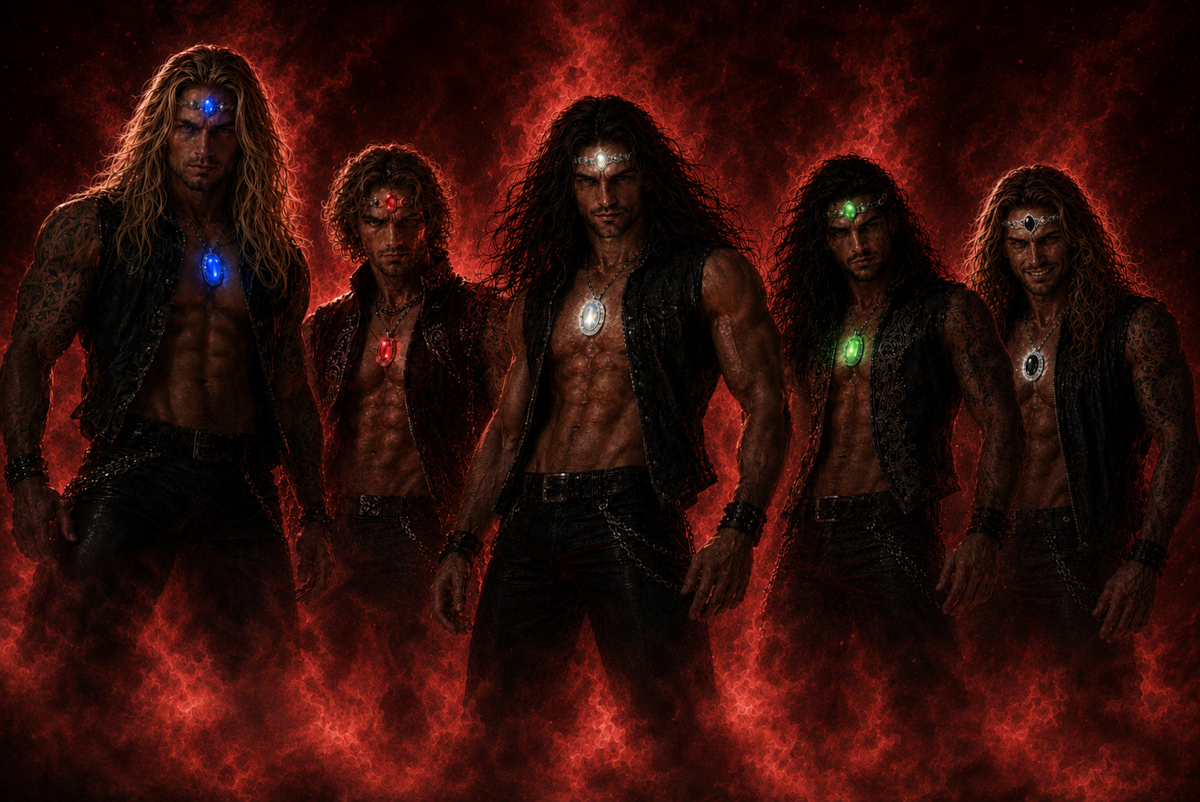
The Aelinian ceremonial circlets were not what most people imagined when they pictured a crown. There were no tall points, no velvet cushions, no gilt excess. Each one was a half-circlet, a slim arc of worked Aelinium that curved from temple to temple across the forehead, fitting into the natural depression at each temple so that it seated against the face rather than resting on top of the hair. The stone sat precisely at the center of the brow, held in place by the shape of the piece and the shape of the face wearing it. Jace's bore the stones of his brothers, flanking the more prominent opal in the center, white-gold fire caught in silver, that matched his Guardian amulet exactly. When the amulet glowed, the half-circlet answered. The design was ancient and practical in equal measure. These were made to be worn by people who actually moved.
The other four followed a similar principle. Connor's center stone was an emerald for Léirstinach County, deep green, oval cut with two round white opals flanking it, dark hair and green eyes making the whole thing read like it had been designed for him. Nathan's was a garnet flanked with opals for Draíocht County, deep red, oval cut, the same fire as his amulet stone at his chest, brow and throat burning the same color simultaneously. Erik's a sapphire for Neart, oval cut, again flanked by opals, vivid and steady. Ricky's an onyx edged in silver for Ainmhithe, black as pitch, oval cut, the kind of stone that absorbed the light rather than throwing it back, rimmed by two round opals set into the fine Aelinium silver. Each one made by Nathan himself, each one carrying the weight of a title that predated rock and roll by several centuries.
They'd never worn them on stage. Not in public, not in an arena, not where sixty thousand people could see them. Backstage was different. Backstage was still theirs. But on stage, under lights, in front of the world? That had never been appropriate. It hadn't been safe. And honestly, the image of five men in Aelinian ceremonial circlets playing hard rock in an arena had never seemed like something that needed to happen.
Until now.
The fan letters kept coming. The signs kept appearing. Kavanaugh put the question to the band over dinner in a Houston hotel restaurant three days after the titles went public, and the table went quiet.
"Two songs," Jace said finally.
Everyone looked at him.
"We come up wearing them. We play Shake Up the Night, we play I Want You, and then they come off. That's the deal." He looked around the table. "Anyone headbanging in a metal circlet is asking for a concussion and a very embarrassing photograph."
Ricky opened his mouth.
"No," Jace said.
"I haven't said anything yet."
"You were going to ask if you could wear yours the whole show."
Ricky closed his mouth. Then: "What if I used my power to keep it on?"
"Absolutely not," Nathan said.
Connor was already grinning. Erik said nothing, which meant he'd already decided two songs was entirely enough.
"Two songs," Jace confirmed. "And we come up right. Full entrance. Everything glowing." He paused. "The fans have been waiting a long time. We can give them that."
* * *
The First Night With The Circlets
The arena went dark at nine-fourteen p.m.
It happened the way it always happened: the house lights cutting out mid-song on the opening act's last number, a planned moment that the audience knew meant Battle Cry was close. The sound level in the building shifted immediately. Not louder, exactly. More pressurized. Sixty thousand people holding something in.
The fog came first. Low and dense, rolling out across the stage floor from every wing simultaneously, lit from beneath in deep red, the entire back wall of the stage washed in it, so that the fog itself glowed crimson at its edges and the whole stage looked like something rising out of the earth rather than standing on it. The kind of entrance that made sixty thousand people stop breathing at the same time.
Then the platform began to rise.
They came up slowly, slowly enough for the audience to absorb it in stages. First the silhouettes, five of them through the red-lit fog, backlit and enormous. Then, as they cleared the fog line, the glow. The half-circlets and the amulets lit simultaneously, each center stone throwing its own color against the red wash behind them, and the contrast was extraordinary. Erik on the far left, sapphire cutting cold and vivid through the warmth of the red. Nathan beside him, garnet burning so deep it was nearly swallowed the backlight before punching through it with its own fire. Jace at center, the brilliant opal at his brow and at his throat blazing against the red like a star going through the atmosphere, the Guardian light building at the edges of his amulet the way it always did when something mattered. Connor to his right, emerald fierce and clean. And Ricky on the far right, his onyx half-circlet rimmed in Aelinium silver catching the red light around its edges while the stone itself stayed dark, a shadow with a crown, grinning like he'd been waiting for exactly this his entire life.
The sound that came out of sixty thousand people was not a scream. It was something that started below a scream and then became one.
Jace stood at the center of the platform as it locked into place, six foot four in black, the Guardian opal burning at his throat and at his brow simultaneously, his amber-gold eyes catching the stage light with an effect that the people in the front rows would spend the rest of their lives trying to describe accurately. He didn't move. Let them look. Let them understand what they were seeing.
Then he turned and walked to his kit.
The others moved to their positions. Ricky rolled his shoulders, caught Connor's eye, grinned the grin of a man whose entire life had been building toward this exact configuration of events. Connor turned to face the audience with his microphone and the look on his face was the look of a man who understood precisely the weight of where he was standing.
Nathan sat at his keys. Erik settled the bass strap across his shoulder. And Jace, behind the kit, raised one drumstick.
The count in was four beats.
On the first beat of Shake Up the Night the lighting rig detonated and sixty thousand people came completely apart.
Lights flash loud the room spins wild
Connor had a gift for opening a show, the ability to take the first note of the first song and make it feel like a door being kicked open. Tonight it wasn't a door. It was a wall.
The circlets caught the stage light with every movement. Connor working the full width of the stage, emerald blazing. Ricky already in motion, the onyx at his brow a fixed point of darkness rimmed in silver, moving through the light. Nathan steady at his keys, garnet burning at his brow to match the one at his chest. Erik planted and immovable, the sapphire of Neart vivid and unblinking at his brow like something ancient and unimpressed by all of this.
And Jace behind the kit, driving all of it, the opal at his forehead catching the overhead lights with every downstroke, every fill, the Guardian aura beginning to build at the edges of his amulet as it always did when he played hard and let himself go.
Shake up the night, break it apart, clap your hands, tear the dark, scream your heart up to the sky, this is the moment to come alive
The audience sang it back at a volume that made the floor vibrate.
By the end of Shake Up the Night every person in the building was already drenched. The band was no different. The circlets were still on.
Connor stepped to the edge of the stage for the intro to I Want You and held the microphone out toward the crowd, not singing yet, just looking at them, sixty thousand people who had just spent three minutes learning who they really were, and the building went feral.
The song built from the bottom. Erik's bass line first, deep and insistent. Then Nathan layering in, then Ricky on guitar, the whole thing coiling before Connor opened his mouth.
Leaned on the bar, you walk in slow, leather and fire like you already know
The audience participation had always been part of I Want You, the crowd echoing the chorus back, a call and response that Connor conducted with the ease of someone who had been doing it for years. Tonight it was something else. Tonight sixty thousand people were shouting I want you at five men who were wearing the crowns of an island nation that nobody could find on a map, and the effect was somewhere between a rock concert and something older and larger than that.
I want you so bad, got your name in my veins, driving me mad
By the bridge Connor had abandoned the front of the stage and was moving, and somewhere in the second chorus Ricky's circlet shifted approximately twelve degrees to the left and stayed there for the rest of the song, which nobody in the audience noticed because they were all looking at Connor, but which Jace noticed from behind the kit and filed away for later.
The final chorus crashed, held, and broke. The lights shifted. Connor stepped back from the edge of the stage.
He reached up and lifted his circlet off. Held it up where the audience could see it, the green stone still faintly glowing in his hand. Then he walked it to the side of the stage and set it down carefully.
One by one the others followed. Nathan. Erik. Ricky, who had to straighten his first, which got a laugh from Connor. Then Jace, last, setting his opal circlet down with the deliberateness of a man who understood what he was setting down and would pick it up again when the time was right.
Then he looked out at sixty thousand people.
Behind the kit he raised both sticks.
The real show started.
* * *
The Tour Resumes — Shitfaced Symphony
They came back out on the road six weeks after Dallas, and the first show back was loud and cathartic and went three songs over schedule because nobody wanted to stop.
Battle Cry had known Kip Winger and Paul Taylor since before Winger existed as a band. The connection ran through Alice Cooper, who had known the Brotherhood for years by the time Kip and Paul joined his touring group in 1985. Cooper hadn't told them anything, that wasn't how the oath worked, but he'd watched them carefully during those two years, the way he watched everyone who got close to the Brotherhood, looking for the thing in a person that could handle the truth.
He'd seen it in both of them.
Kip left Cooper's band in March of 1987 to start his own. By that summer, he and Reb Beach and Rod Morgenstein and Paul Taylor were deep into recording the debut album, a lot of late nights, a lot of energy, a whole lot of noise coming out of a studio in New Jersey. Battle Cry was in the middle of their own tour, a few venues over. Close enough that a Wrought creature, running a patrol Aldus had set around the band, got confused.
The creature went for Kip first. It had picked up something in the vicinity, the frequency of Guardian-adjacent energy, the kind that clings to people who spend enough time around the Brotherhood, and then it had seen Reb Beach from a distance. Auburn hair. Similar build to Ricky. The creature didn't stop to look closer.
Jace felt it through the bond before anyone saw it. Ricky was already moving.
They got there in time. Barely.
Kip and Reb had seen everything. The creature, the powers, Jace and Ricky in full Brotherhood mode, there was no explaining that away, no version of the night where you show two musicians something like that and then ask them to just go back to the studio and forget it. Jace had looked at Kip in the parking lot afterward, both of them breathing hard, and Kip had looked back with the expression of a man who had just had a great many things about the last two years click into place all at once.
"Alice knew," Kip said. It wasn't a question.
"Alice knew," Jace confirmed.
The rest of Winger had to be told. Rod took it with the calm precision of a man who simply recategorized the information and filed it. Paul had already half-suspected, he'd noticed things in Cooper's band, small things that didn't add up, and had spent two years constructing an explanation that he now understood was mostly wrong but usefully pointed in the right direction. They were brought to Aelin, shown what it was, given the choice.
All four of them took the Aelinian Oath before the debut album was released.
That was the foundation under everything that happened when Kip knocked on the bus door in New Jersey carrying beer and index cards. Not just two bands on the same circuit. Brotherhood-adjacent, oath-bound, and fully aware of exactly who they were drinking with.
Winger found them three dates in. Kip showed up at the bus door carrying a case of beer and a hat full of index cards.
Reb Beach was right behind him.
"Alright, you magical weirdos," Kip said, a sly grin breaking. "We've heard about your drinking games. We've seen how they end. You use your voodoo and we all end up naked and passed out while you're all just getting started."
It had been a point of some debate between the four of them for a while now. The first drinking game they'd done with Battle Cry had ended the way these things tended to end: Winger demolished, Battle Cry suspiciously intact. The second time, same result. By the third time, Kip had started paying attention. Specifically, he'd started paying attention to the fact that no matter what was thrown at Battle Cry, no matter how many rounds, how many forfeits, how many escalating dares, all five of them looked exactly the same at the end of the night as they had at the beginning. Hair perfect. Clothes unruffled. Eyes clear. Meanwhile Winger looked like they'd been dragged backwards through a very enthusiastic party.
Kip had brought this observation to Reb. Reb had brought it to Rod. Rod, who was a precise and methodical man, had sat with it for a while and then said: they're cheating.
They were, in fact, cheating. Connor had been reading the card draws before anyone touched the hat. Ricky had teleported out of at least three dares by pretending to go to the bathroom and reappearing forty seconds later looking innocent. Nathan had quietly applied a mild elemental buffer that slowed the absorption of alcohol to a pace that could charitably be described as glacial. They had not discussed this strategy out loud. They had simply all arrived at it independently and executed it with the seamless coordination of five people who had been in a supernatural brotherhood for years.
Winger had figured it out. And they had come prepared.
Reb pointed almost accusingly at Ricky. "Yeah. Last drinking game we did with you, Kip ended up wearing nothing but a house plant."
"It was a fern," Kip corrected.
Reb smirked. "I'm pretty sure that's still a house plant."
Rod Morgenstein stepped up behind them both: "No powers. None. You guys have to be normal, pathetic humans like the rest of us."
"Oh, shit, we're screwed now," Nathan deadpanned. Jace elbowed him with a hint of a grin.
Paul held up the stack of index cards and a marker. "It's called Shitfaced Symphony. We each write down really stupid, non-magical dares for the other team."
"Then we put them in a hat," Kip explained. "You draw a name from the other band's hat and a dare from the dare hat. They do the dare, or they drink. And you have to do it with the seriousness of a Shakespearean actor."
Rod sighed and shook his head. "This is going to be a disaster for them."
Jace looked at his brothers, then grinned at Rod. "You're on. No powers. Let's see how you normal, pathetically powerless people live."
Reb leaned over to Rod. "This is going to be a disaster for us."
The dares were written, folded, and dropped into the hat. Everyone settled in.
The first name drawn was Ricky.
The dare: pretend to be a flight attendant for ten minutes, offering everyone peanuts and demonstrating the safety features of the couch cushions.
Ricky stood up without missing a beat, grabbed a bowl of pretzels, and began.
"Welcome to Battle Cry Airlines, ladies and gentlemen who look like ladies!"
The groaning was immediate. So were the wadded wet napkins.
"In the event of a sudden loss of coolness," Ricky continued, ducking a pretzel, "you must stop screaming like a little girl scout and fasten your seat belt like the nice lady giving me her phone number after we land told you to do five minutes ago!"
More projectiles.
"Your seat cushion can be used as a flotation device," he drawled, "and so can any stewardess who's a D cup or better. If oxygen masks drop from the ceiling, kiss your ass goodbye. Thank you for flying Battle Cry Airlines."
The entire bus was in tears. Kip nearly fell off the couch.
Jace drew next.
The dare: perform a dramatic emotional monologue from the perspective of a lonely sock who has lost its partner in the laundry.
Jace, the Guardian, the stoic drummer, the High King of Aelin, took a slow breath. He retrieved a sock from his laundry bag. He held it. He began.
"Oh, Bartholomew," he said, his voice raw with grief. "Where have you gone? The dryer is a cold, cruel mistress, even with a dryer sheet. And I am left here, alone, stretched and faded…"
He poured so much raw, dramatic emotion into it that Rod was wiping away a tear between chuckles. Connor was a complete puddle of Irish-Persian giggles on the floor.
Nathan drew Kip's name.
The dare: play the first four bars of Twinkle Twinkle Little Star on a water glass using only a spoon, a second water glass, and his sense of musical superiority.
Kip, classically trained, took this with grave seriousness. He positioned his instruments. Lifted the spoon. Conducted briefly. Tapped, listened, adjusted the water level, tapped again. Furrowed his brow. Added more water. Tapped twice. Reconsidered. Poured some back. Tapped once to complete the phrase. Looked up.
"In your face, Nathan."
Nathan pretended to collapse in shock.
Erik drew Reb's name.
"We're all gonna die," Reb predicted.
The dare: have a full, in-depth conversation with a houseplant about its feelings and hopes for the future.
Reb gasped, ran to a large philodendron in the corner of the bus lounge, dropped to his knees in front of it, and kissed a leaf.
"So, Fernanda," he began, his voice full of genuine concern. "How are you really feeling? Is the photosynthesis process fulfilling your existential needs? Do you feel seen?"
He carried on for five full minutes. One-sided, heartfelt, completely absurd. Everyone was gasping for air by the end.
Paul had to walk like a crab for five minutes while singing Row Row Row Your Boat. Rod had to teach Erik to waltz, which was roughly equivalent to watching a large bear attempt to thread a very small needle. The dares got sillier as the beer went down.
Finally, Ricky drew Rod's name.
The dare, in Ricky's own warped handwriting: direct a photoshoot for an invisible male model.
Rod squared his shoulders, adopted the stern artistic gaze of a man who had done a hundred real photoshoots, and addressed the empty center of the room.
"Alright, I need more from you!" he barked. "Give me smoldering! Yes! Now turn left! No, the other left! Perfect! Now give me contemplating the void, think about your taxes! Yes! Beautiful! One hand on the hip, the other reaching for a dream you can't quite touch! Hold it! Hold it! And… release!"
The bus collapsed. Even Rod was chuckling when he finally came out of character.
They were all drunk, not from penalties but from laughing so hard they couldn't breathe. No debauchery, no powers. Just nine people on a bus in New Jersey, genuinely helpless with laughter.
As they sat there exhausted and happy, Kip raised his bottle.
"You guys are alright," he said. "For a bunch of magical freaks."
Jace clinked his bottle against Kip's. "You're not so bad yourselves. For a bunch of normal, pathetic humans."
Outside the bus windows, New Jersey was dark and indifferent. Inside, the amulets caught the light and nobody paid them any mind. They were just two bands, sharing a beer and a memory that was, in its own way, more magic than anything Nathan could conjure.