
 THE WORLD THEY WERE IN NOW
Training Log — Sidney Greene
September 3, 1989
Wedding planning in final stages. Kavanaugh managing media schedule.
Brotherhood cleared for individual appearances through October.
The Sacrifice is the long game. The media is the short game. Both matter.
The world does not stop because we are training. The world is exactly what we are training to protect. Let them be in it.
NEW YORK CITY
NBC Studios — The Today Show
September 12, 1989
Bryant Gumbel had interviewed heads of state, disaster survivors, Nobel laureates, and once, memorably, a woman who had trained a parrot to recite the first twenty amendments to the Constitution. He had been doing this for eight years. He was comfortable with the unusual.
He was less comfortable than he expected to be when Battle Cry walked onto the Today Show set.
It was not that he had not been briefed. He had been briefed. He had watched the Barbara Walters special twice, had read the AP coverage, had reviewed his notes three times on the car ride in. He knew who they were and what they were and approximately what the interview would cover.
What the briefing had not adequately prepared him for was the specific effect of five men in Aelinian dress and half-circlets walking through a morning television studio at seven forty-five in the morning as if this were entirely ordinary. The half-circlets were not crowns, not the full formal regalia, not the closed-circle crowns of European tradition, but they were unmistakably royal, silver-worked and set with the stones of their respective amulets, resting in the long hair of five men who also happened to look like rock stars and who carried themselves like people who had been in charge of things for a long time.
The studio crew, who had seen everything, stopped what they were doing for approximately four seconds.
Then everyone remembered they were professionals and returned to their tasks, slightly more carefully than before.
The Aelinian clothing was well-made and cleanly cut, not medieval, not costuming, not the kind of thing that required explanation, just clothing from a place with its own aesthetic and eight centuries of knowing how to make things well. Dark colors, natural materials, the specific quality of garments that had been constructed rather than manufactured. The amulets rested at their chests, white opal for Jace at center, emerald for Connor, garnet for Nathan, sapphire for Erik, onyx for Ricky. Five men, handsome and regal and entirely at ease, sitting down in a morning television studio and making it look as if the morning television studio were the reasonable response to them rather than the other way around.
They sat down. Bryant Gumbel straightened his notes and began.
The early questions were the architecture of any morning show interview, music, the new album in progress, the tour schedule, the island and what governance meant when the people governing it also had a Top 40 record. All five of them answered with the ease of people who had been explaining themselves since April 1988 and had arrived at the version of the explanation that was both complete and conversational. Jace on governance, direct and precise. Connor on the Conservatory and what Léirstinach was building. Nathan on Draiócht County’s research programs with contained enthusiasm. Erik on Neart’s infrastructure with the directness of a High General who was also a bassist. Ricky on the Ainmhithe preserve with the warmth of a man who had personally selected the breeding stock and was not apologetic about it.
Jane Pauley leaned forward.
“Jace. The Forum. July fourteenth.” She said it simply, because they had agreed before the segment that this was where the conversation would go, and there was no point pretending otherwise. “You know why people are watching today.”
“Yeah,” Jace said. “I know.” He settled back slightly. “Go ahead.”
“Aldus took you in front of thirty-some witnesses. Musicians, crew, fans. It’s been reported from a dozen angles. What we haven’t had is you.”
“No,” Jace said. “I figured it was time.” He looked at the camera briefly, not performing. Just acknowledging. “What do you want to know.”
“What happened,” Jane said. “In his dimension. What did he do to you.”
Jace was quiet for a second.
“Specifically, he punished me for the Barbara Walters special. He’d watched it. He didn’t like it. So, he calibrated his response to the runtime, forty-two minutes of broadcast, forty-two intervals of torture. Four different kinds. Cold, then electrical shock through the chains, then psionic pressure in my mind, then a hard physical blow. Cycling through. Over and over. Forty-two times.”
He looked at Jane steadily. “He’s had eight hundred years to develop his methods. He’s thorough.”
The studio was very quiet.
Bryant said: “Forty-two intervals.”
“Yes,” Jace said. “He told me upfront. One for every minute. I could stop it at any point. The word was yield.”
Jace shook his head.
“I wouldn’t say it,” he said firmly. “I refused to.”
“You refused for Aelin,” Bryant said.
Jace nodded. “I refused because no matter how bad he hurts me, even to the point of death, I will never yield to him or anyone seeking to harm Aelin.”
“How did you get back,” Jane asked.
Jace looked over at Nathan. His expression shifted.
“Nathan got me back,” he said. He looked back at Jane. “Twelve minutes at the edge of a closed dimensional rift, Nathan working out the architecture in real time with nothing but an amulet and the bond that tells him I’m still alive as long as it holds. I crawled toward the opening he made. The Brotherhood pulled me through.”
He looked at the five of them, Nathan, Connor, Ricky, Erik, and then back at Jane.
“That’s what they are. That’s what they’ve always been.”
Bryant said, carefully: “And Aldus.”
“Aldus left the interaction missing his left leg below the knee,” Jace said. Flat. No pride in it. Just the record. “When I release my power, it releases all at once. He wasn’t far enough away. He came for me and hurt me forty-two times. He left without part of his leg.”
He looked at Bryant.
“I want people to know that,” Jace said, his eyes becoming darker. “I want him to know people know that now.”
Bryant Gumbel, who had interviewed heads of state, had not heard anything quite like that at seven forty-five in the morning. He let it sit.
“I see the respect and admiration you have for your Brotherhood,” he said.
“You mentioned your Conjurer, Nathan, who is sitting here listening,” Jane added.
“The smartest man I’ve ever known,” Jace chuckled. “And I say that as someone who’s watched him make some genuinely questionable decisions in his personal life.”
“Such as,” Bryant said. “The questionable decisions.”
Jace looked at Nathan, grinning.
Nathan, to his right, looked at the ceiling.
“Tomato bisque,” Jace said.
Bryant waited.
“We were in the castle kitchen. Nathan wanted to heat up a carton of tomato bisque soup. With his amulet. Connor told him three times to poke holes in the carton. I told him once. Erik left the room entirely, which in hindsight was the correct call.”
He looked at Bryant.
“The carton exploded. Tomato bisque everywhere. Ceiling, walls, fixtures, floor. Nathan was standing in the center of it.”
“Elmo,” Connor said, from Jace’s left.
“Connor says Elmo,” Jace confirmed. “Galena walked in thirty seconds later. She was not impressed. She addressed the room in Russian. At volume.”
“And your role in this,” Jane said, watching Jace carefully.
Jace pressed his lips together. “Connor wrote a song about it. For our next record. I may have been playing a cajon in the background when he debuted it for Nathan.”
Jane smiled and looked at Jace. “What did you do, Your Majesty?”
Jace considered this. “I gave Nathan a specific gesture while playing the cajon,” he said. “Which he deserved.”
Bryant looked at Connor. “You wrote a song.”
“I did,” Connor said.
“Do you have it with you.”
Connor looked at Ricky, who had his guitar on the stand beside the couch. Then at Erik, who had his acoustic bass. Then back at Bryant… the expression of a man who had been waiting for exactly this invitation since they walked through the studio door.
“We do,” Connor said.
Nathan turned to look at Connor with the expression of a man who had just watched a trap close.
“Connor,” Nathan said.
“It’s a good song,” Connor said pleasantly.
“Connor.”
“The people should hear it.”
“CONNOR…”
Ricky already had the guitar off the stand. Erik had the bass. Connor stood, and the studio audience, sensing something was happening that had not been on the segment plan, went completely quiet.
Jace reached behind him and produced a small cajon that no one had noticed until this moment, because Jace Elias did not go on television without a percussion instrument within reach. He set it between his knees and looked at Nathan with the amber-gold eyes of a man who had zero remorse.
“Thanks, Your Majesty,” Nathan said flatly.
“That’s me,” Jace agreed, and hit the cajon twice.
Ricky immediately began to play, Erik joining in with his acoustic bass.
Nathan buried his face in his hands and groaned.
Connor opened his mouth and began.
Nathan in the kitchen,
Carton in his hand,
The studio started laughing before the second line landed.
Bryant put his notes down, a grin forming on his face. Jane covered her mouth with one hand to stifle a chuckle.
Said “I don’t need a saucepan; I got this all planned”,
Ricky moved through the chord progression with the loose ease of a man who had played this enough times to know exactly where every laugh landed. Erik held the bass line with the composure of a High General who was also, in this moment, entirely part of the problem.
That little charm on his necklace started humming low,
“It’s STILL an amulet,” Nathan said, to Bryant, with the exhausted precision of a man who had been making this correction since the song was written.
The amulet flickered in the lamplight like “Boy you better poke some holes”,
Nathan emitted another groan, shaking his head.
Connor hit the chorus with full commitment, the emerald catching the studio lights, his voice filling the NBC studio at seven fifty-three in the morning:
He got the Tomato Bisque Explosion Blues,
Red rain falling on his Sunday shoes,
“My shoes are all week long,” Nathan said, still to Bryant, who was no longer capable of maintaining composure.
Now there’s soup on the ceiling and nothing to do,
Bryant had abandoned his notes entirely. Jane had given up on her hand and was simply laughing, the way you laughed when something was funnier than you had any defense against.
Nathan’s got those Tomato Bisque Explosion Blues.
Connor pointed at Nathan. Nathan looked at the camera. Then at Bryant. Then at the audience of millions of Americans watching the Today Show on a Tuesday morning in September.
“I had it under control,” Nathan said.
The studio erupted. Both Bryant and Jane laughing openly now.
Jace hit the cajon one final time and said nothing.
Connor sat back down. Ricky rested the guitar on his knee. Erik set the bass aside with the expression of a man who had done his part.
Nathan looked at Connor, one eyebrow raised. “You STILL suck, Connor.”
The wedding question arrived four minutes later, from Jane, once she had recovered sufficiently to ask it, with the warm precision of someone who knew the answer would be good television.
“May twelfth,” Jace said. “Aelin. The High Votaress ceremony first… older than the wedding itself, what makes it real on the island. Then the wedding. Samantha’s been planning it since November 1985. I’ve been told I’m responsible for the flowers and my own clothing and to stay out of everything else.”
“Is that the High King’s approach to wedding planning?”
“That’s the approach of a man who knows his limitations,” Jace said.
The studio laughed.
Connor, to Jace’s left, said nothing and smiled the smile of a man who had been watching Jace navigate these moments for six years and had not yet tired of it.
The segment ran eleven minutes. It had been scheduled for seven. Nobody stopped it.
LOS ANGELES
CBS Studio — Morning Kitchen
September 18, 1989
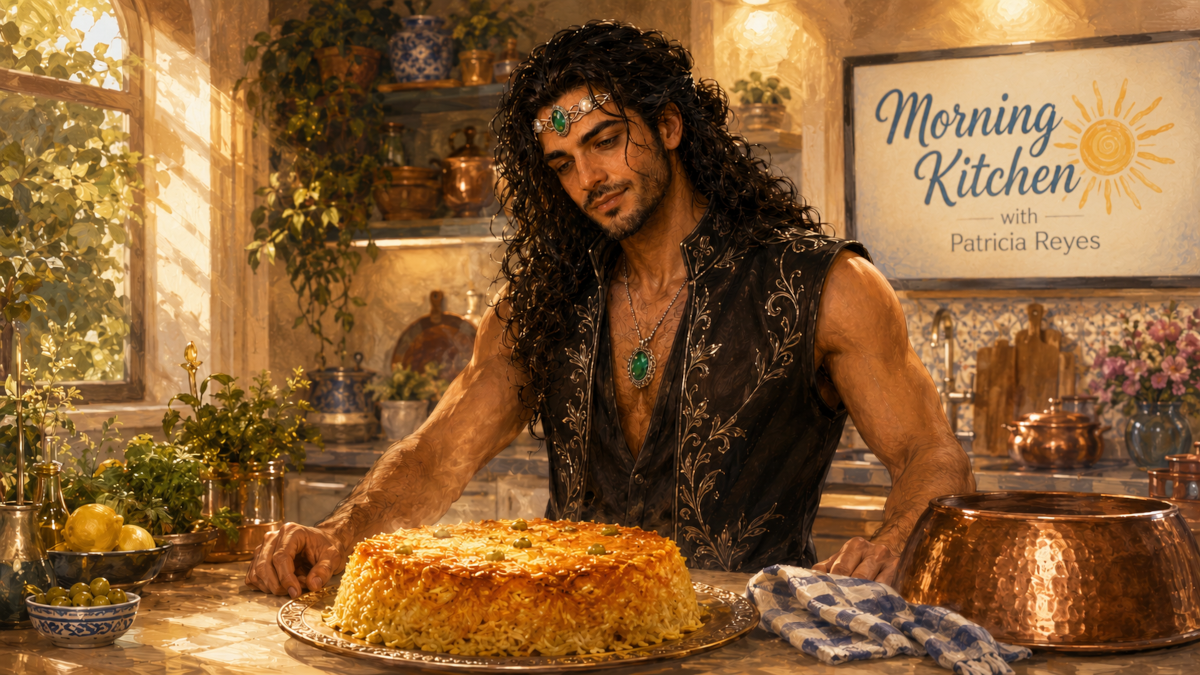
The set was warm and bright in the way of morning cooking shows, the kitchen counter, the overhead lights designed to make food look like food, the host who made guests feel like they were in somebody’s actual kitchen. Her name was Patricia Reyes. She had requested Connor Braydee when the segment was being booked because she had watched the Barbara Walters special and had noticed the moment, approximately forty-seven minutes in, when Connor had described his grandmother’s kitchen in San Diego with the detail of someone who had spent real time in it.
Connor arrived with his hair clipped back. Not fully contained, a strand had already escaped the clip by the time he walked through the studio door, but enough to keep it off the counter and out of the rice. He was wearing Aelinian clothes and the half-circlet and the emerald, and Patricia Reyes took approximately three seconds to recalibrate before extending her hand.
“You cook,” she said.
“My grandmother cooked,” Connor said. “I watched for twenty years. Eventually it transferred.”
“Tell me about her.”
Connor set down the grocery bag he had brought himself, two bags, actually, because one of them had come from considerably further away than a California market. “Her name was Nasrin,” he said. “She came to the United States in 1951 and lived in San Diego for the rest of her life. She cooked Persian food every day because it was how she kept the country she had left. She used to say that food was the one thing that did not need translation.”
Patricia looked at the second bag. “What’s in that one?”
Connor reached in and set a jar on the counter. The olives inside were a pale yellow-green, small, their color unlike any olive Patricia had encountered in a California market. “Zard olives,” Connor said. “From Iran. The name means yellow. They’re cultivated in the northern provinces, milder than what you find here, more buttery, a different flavor entirely.” He turned the jar in his hand. “My grandmother used them in her tahdig. I use them in mine. I have a source. It helps to be half Persian and to know people who matter.”
“You had those shipped from Iran,” Patricia said.
“I had them brought,” Connor said, with the calm of someone who did not consider this unusual. “There is a difference.”
The dish was tahdig, saffron-scented crispy rice, the Persian grandmother’s art form, the dish that every Iranian family argued over at the table because the golden crust on the bottom of the pot was the prize and there was never quite enough of it. Connor had Nasrin’s specific variation: the Zard olives rough-chopped and folded through the rice before it went into the pot, their buttery mildness threading through the saffron butter and giving the finished dish a depth that could not be approximated with any other olive, the flavor of a kitchen in San Diego that had never stopped being a kitchen in Iran.
He started with the vegetables while the saffron bloomed in hot water in a small cup beside the stove. The knife work was immediate and clarifying. Connor moved through the vegetables with the fast clean precision of someone who had trained his hands for thirty years on a different instrument and had found that the skills transferred. The blade moved with the efficiency of a man who did not need to think about the technique, which freed him to talk while he worked.
Patricia watched the knife and then looked at the camera with the expression of someone who had not expected this.
“You’re fast,” she said.
“My grandmother was faster,” Connor said. He repositioned, moving to the Zard olives. “She could break down a full kitchen’s worth of vegetables before I finished my first onion. She never cut herself. She said if you respected the knife it would respect you back.”
The olives were rough-chopped in eight seconds, the blade moving in the arc that came from knowing the destination before starting the journey. “I asked her once if she was ever afraid of cutting herself. She said only when she was in a hurry and trying to be impressive.”
He looked at Patricia. “So I am trying to be neither.”
“Too late on the second one,” Patricia said.
The rice went in, soaked, par-boiled, drained. The saffron had bloomed to the deep gold-orange that meant it had given everything it had to the water, and Connor mixed it with butter over low heat until the butter carried the color and the fragrance of it reached across the set. The olives went in with the rice. The mixture into the pot, mounded, and then the kitchen towel, blue-checked, which he had brought, wrapped carefully around the lid.
“The towel,” Patricia said.
“My grandmother’s instruction,” Connor said. “It absorbs the steam so the crust stays crispy. She used a blue-checked towel every time. I don’t know if the color matters. I still use blue-checked if I can find one.”
They talked while the rice cooked, about Nasrin, about growing up between an Irish father’s household and a Persian grandmother’s kitchen, about what it meant to carry two sets of food memories simultaneously. About the Conservatory in Léirstinach, about Aelinian food traditions.
“Nathan’s wife Galena makes a lamb stew I would give up touring for,” Connor said.
“Would she share the recipe?”
Connor considered. “I’ll ask. She is the Prime Minister of Aelin. She may consider it a state secret.”
Twenty-two minutes later Connor lifted the pot, placed the serving plate on top, and inverted it with the deliberate motion of someone managing the moment. The pot came off clean. The tahdig sat on the plate golden and whole, the crispy crust intact, the saffron color deep and even, the Zard olives just visible at the surface where they had pressed against the bottom during cooking, their pale yellow-green catching the light differently than the rice around them.
The studio audience made a sound. Not applause yet. The involuntary sound of people seeing something that looked exactly right.
Connor broke a piece of the crust from the edge and held it toward Patricia, who ate it with the expression of someone encountering something for the first time and understanding immediately why it mattered.
“That’s Nasrin,” Connor said quietly.
Patricia nodded. She did not trust herself to say anything more useful than that.
LOS ANGELES
Burbank Studios — Science is Everything
September 24, 1989
The show was called Science is Everything, which was Nathan Dallenger’s opinion and had been his opinion since approximately age six, and the booking had an inevitability to it that he was trying not to examine too closely because examining it might lead to the giddiness he was currently managing.
He was, by any reasonable measure, on cloud nine.
The set was bright primary colors and working experiments and a studio audience of approximately two hundred children between the ages of seven and twelve, and Nathan walked onto it with the half-circlet and the garnet and the Aelinian clothes and the expression of a man who had arrived exactly where he was supposed to be.
The host was a physicist named Dr. Marcus Webb, who had been doing children’s science television for four years and had requested Nathan specifically after reading three papers published under the Aelin academic umbrella. The two of them had shaken hands backstage with the recognition of men who spoke the same language.
The segment began with electricity, a Van de Graaff generator that made a child volunteer’s hair stand on end, which produced the delight of two hundred children experiencing static electricity and understanding for the first time that this was the same phenomenon as lightning. Nathan watched this with the warmth of a man who remembered being the age of every child in the room.
Then Dr. Webb turned to him. “Nathan. You work with the four classical elements as sources of power. Earth, air, fire, water. Is that physics?”
“Everything is physics,” Nathan said. “What I do is applied physics in a non-standard framework. The elements are not separate forces, they are expressions of a unified natural system. What the amulet gives me is the ability to interact with that system directly, kinetically. The way you interact with the Van de Graaff generator by touching it, except instead of receiving the charge I can direct it.”
“Can you show us?”
Nathan looked at the studio audience. Two hundred faces, completely attentive in the way of children who have not yet learned to pretend they are less interested than they are.
He held out his hand, palm up.
A flame appeared in it, small, clean, the size of a candle flame, sitting in the center of his palm without burning him. The children in the front row leaned forward as one.
“Fire,” Nathan said. “Heat is the rapid movement of molecules. What I’m doing is accelerating the movement of the air molecules in this specific volume… until the temperature exceeds the ignition point of the surrounding oxygen. It is a chemical reaction. I am controlling the conditions of the reaction.”
He closed his hand. The flame went out.
“But you didn’t burn,” said a girl in the third row. Red hair, freckles, approximately nine. The directness of a child who wanted an actual answer.
Nathan looked at her with genuine pleasure. “What’s your name?”
“Fiona.”
“Good question, Fiona. I don’t burn because I’m controlling the temperature differential between the flame and my skin. The heat moves outward rather than inward, like a one-way valve. The energy goes in one direction only.”
“So your hand is the valve,” Fiona said.
“Yes,” Nathan said. “Exactly.” He looked at Dr. Webb. “Your audience is better than most conferences I have attended.”
Nathan spent forty minutes with the children of Science is Everything. He demonstrated fire and water, a small sphere of water held above his palm, surface tension maintained by directed air pressure while he explained fluid dynamics to an audience that followed every word. He talked about Aelinium, the magical-conductor material he had developed, as real-world applied physics, describing the discovery process with the honesty of a scientist talking about the path rather than the destination.
A boy named Marcus, approximately eleven, asked: “Did you know it would work before you tried it?”
“No,” Nathan said. “I knew the theory was sound. I didn’t know the application would hold. That’s the difference between knowing something mathematically and knowing it in the world. The world always has the final say.”
Marcus wrote something in the small notebook he had brought to the studio.
“Are you taking notes?” Nathan asked.
“Yes,” Marcus said. “You said something I want to remember.”
Nathan looked at the boy. “Keep doing that,” he said. “Your whole life. Write down the things you want to remember. The notebook is how you argue with yourself later.”
Dr. Webb, watching from beside the camera, thought it was the best moment in four years of children’s science television.
LÉIRSTINACH
The Conservatory — September 24, 1989
Connor was halfway through the autumn term schedule when it came through the bond.
Not big. Not dramatic. Just Nathan’s specific flavor of deeply, thoroughly happy — the particular satisfaction of a man who had found a room full of people who could actually keep up with him. Connor set his pen down and read what was underneath it.
Kids, he thought. Had to be. Nathan had a thing for that, deeper than he usually let on — the pure delight of a room that wasn’t pretending to be less interested than it was.
Connor looked out the window at the September forest.
He’d hear the story later. Already knew it was going to be a good one.
LOS ANGELES
ABC Studio — Strong Kids, Smart Kids
September 26, 1989
The show was called Strong Kids, Smart Kids, and it was exactly what it sounded like, and Erik Hahn had said yes before Kavanaugh finished the sentence.
He arrived in Aelinian training clothes, the training wear of the High General of Aelin, functional and well-made, with the half-circlet and the sapphire and the physical presence of a 6’6” man who had been training since adolescence. The production team had been briefed. They had still not processed the reality of him standing in the hallway until he was actually standing there.
The host was a former Olympic sprinter named Denise Campbell, entirely comfortable with physical presence, who had requested Erik after watching the Barbara Walters special and thinking: that man takes physical conditioning seriously. She had been correct.
The studio audience was a hundred and fifty children, ages eight to fourteen, and two in the front row had handmade signs. Erik saw them and his face did something it did not usually do in professional contexts, which was soften. He crouched to their level, which brought 6’6” to approximately their eye height, and spoke to them directly and listened to everything they told him about what they already knew about exercise.
Denise Campbell watched from the side of the set and thought: there it is. That’s what I saw in the special.
The segment ran fifty minutes, ten over the allocated time, and nobody stopped it.
Erik demonstrated strength training mechanics with rigor that was completely accessible. He talked about nutrition with the conviction of someone who had been fueling a body for serious athletic performance for fifteen years and had strong opinions about vegetables.
“Broccoli,” said a boy named Daniel, eleven, with the expression of profound disagreement.
“Broccoli,” Erik confirmed. “Non-negotiable.”
“It tastes bad.”
“It tastes like effort,” Erik said. “Effort tastes bad until you understand what it is building. Then it tastes fine.”
Daniel processed this with the expression of a child who could not immediately refute an argument.
“What does the Warrior ring do?” asked Keisha, twelve, the girl beside him.
“It channels lightning,” Erik said.
The studio went quiet in the way of a hundred and fifty people encountering a sentence they had not expected.
“Can you show us?” Keisha said.
Erik looked at Denise Campbell. Something passed between them that was part professional calculation and part: well, why not.
“Outside,” Erik said. “The lightning needs sky.”
They took the full studio audience to the network parking lot. Erik stood in the center of the space, drew the Warrior ring’s power in the controlled way of someone demonstrating rather than fighting, and directed it skyward in a single clean arc that split the afternoon air above Burbank and returned in a thunderclap that was heard for half a mile.
The children were completely silent for two full seconds.
Then they lost their minds entirely, in the way of children who have just seen something real.
Erik stood in the parking lot and watched a hundred and fifty children between eight and fourteen experience genuine wonder, and felt something he did not usually feel in professional contexts, which was simple uncomplicated joy.
Denise Campbell stood beside him. “You’re good with kids,” she said.
“I didn’t know that before today,” Erik said.
“I think you probably knew,” she said.
Erik thought about it. “Maybe,” he said.
In Léirstinach, Connor felt it the moment Erik pulled on the Warrior ring.
Not the lightning itself at this distance, but the ripple of power through the bond, Erik’s signature as familiar as a voice. What came riding behind it wasn’t combat energy, wasn’t the hard edge of the Warrior working. Something simpler. Something just plain happy.
Connor sent it through the crown bond without overthinking it.
They’re gonna remember that their whole lives, brother.
On a parking lot in Burbank, surrounded by a hundred and fifty children who had completely lost their minds, Erik went still for one second. Then the corner of his mouth pulled up, slow and genuine, and anyone watching would have thought he was just taking in the kids, the noise, the beautiful chaos of it.
He was smiling at Connor.
He didn’t answer. Didn’t need to. The warmth that came back through the bond said everything.
LOS ANGELES
The Comedy Vault — HBO Special
October 3, 1989
The ventriloquist’s name was Gary Dalton, and he had been working comedy venues for eleven years with a collection of puppets that had been described in reviews as “these ain’t your mama’s Muppets” and once, more specifically, as “what happens when Kermit the Frog stops taking his medication.” His HBO special was called Pull My String, and the segment with Ricky Strathan had been added three weeks before filming because Gary had watched the Barbara Walters special and had called his agent at eleven at night and said: the shapeshifting guitarist. Get me the shapeshifting guitarist.
What Gary had not known when he made the call, and had found out approximately forty-eight hours later, was that October third was Ricky Strathan’s birthday. Kavanaugh had mentioned it in passing during the booking conversation as a piece of background color. Gary had not treated it as background color. Gary had treated it as a gift, and had spent the next three weeks writing around it.
The song was called I Need A New Horse. Gary had written it with Chester’s voice in mind and Ricky’s guitar in hand, and the premise was simple: Chester had lost his last dollar on a horse named Lucky Charm who had, at the critical moment, stopped dead on the track and done something that rendered the investment a total loss. Chester needed a replacement. Chester had a specific candidate in mind. Chester had, in fact, written a song about it.
Connor Braydee and Jace Elias were in the second row.
Connor had rearranged his Tuesday the moment Ricky mentioned the booking, and had called Jace approximately four minutes later with nothing but “Comedy Vault, October third” and Jace had said “yeah, alright” without asking a single follow-up question, because some things did not require explanation. It was Ricky’s birthday. Showing up without warning to watch him be entirely himself in front of a live audience was exactly the kind of gift the Sentinel of Aelin would actually want.
They had not worn their circlets. That was as far as the low profile went. Gary Dalton had spotted them during his pre-show walkthrough, stopped, and moved on with the focused calm of a professional who had just been handed something very good and knew exactly where to put it.
The main puppet was Chester. Chester was a small orange creature of indeterminate species with enormous eyes, a gap between his two front teeth, and a personality best described as aggressively entrepreneurial. Chester’s operating principle was that rules applied to other people. Chester had been in trouble with fictional law enforcement in seventeen of Gary Dalton’s existing bits.
Gary opened the way he always opened, with the line that had been on every poster since 1981.
“These ain’t your mama’s Muppets.”
Chester immediately added: “Mama’s Muppets never made anybody throw up in a parking lot.”
The audience laughed. Gary had not written that second line. He never did.
Gary told the audience that it was a special evening and that there were special guests in the house.
Chester looked out in the audience and looked to be searching the front row.
“I see two of ‘em.” He said, interrupting Gary. “The ones wearing those rock thingys that make old murderous assholes want to kill them.”
“Chester, that’s probably not a nice thing to remind them…”
“Well, it’s not like it’s a secret anymore, Gary!” Chester exclaimed.
“True,” Gary admitted. “There was a whole special, lots of news about it, yeah…”
“Duh…” Chester chastised. “I only wanted one of ‘em. Now I got three?”
“I know, you asked for Ricky,” Gary told him. “But you should feel honored the Visionary and Guardian came to see you, too.”
“Are they helping with my song?” Chester asked.
“I think they’re just here to watch the show, Chester.”
“What if I need a drummer?” Chester inquired, pointing his stubby arm at Jace. “Will the king negotiate for that?”
“I don’t know!” Gary exclaimed. “Stop being rude. We’ll get Ricky out here to help you sing your song, but you have to introduce him first.”
Chester looked at Gary slowly and asked, “Don’t they all know who he is already?”
He quickly looked at Jace and Connor and cried, “I know those two already do!”
Gary sighed and shook his head, telling Chester, “Just bring him out to play the song!”
Looking at the audience, Chester introduced, “Ladies and Gentlemen who are NOT brothers welcome to the stage the amazing Sentinel of Aelin and the lead guitarist of Battle Cry…Ricky Strathan!”
Then Ricky walked out, and Chester turned to the audience with the solemn gravity of a creature making an important announcement.
“And that,” Chester said, pointing one stubby arm at the Sentinel of Aelin, “ain’t your mama’s rock star.”
Ricky walked up to Gary and Chester, guitar in hand and glanced curiously at Chester, asking, “What does that mean?”
“I have no idea,” Chester said. “But we’re gonna find out.”
The audience was already gone. The chemistry of it, Gary’s timing, Chester’s escalating logic, and Ricky matching every beat with the quick-witted ease of someone who had been the funniest person in most rooms since adolescence, had taken them in the first three minutes and not returned them.
Chester, from the moment Ricky walked onto the Comedy Vault stage, was completely obsessed with him.
“He can turn into ANYTHING?” Chester said, twisting toward Gary with the physical urgency of a puppet whose operator was very good at his job. “Any animal?”
“Any animal,” Gary confirmed.
Chester turned back to Ricky with enormous eyes. “Okay. Can you be a horse.”
“I can be a horse,” Ricky said.
“A WHOLE horse?”
“A whole horse.”
Chester appeared to calculate something. “How much does a horse cost.”
“Chester…” Gary said.
“I’m asking for business reasons,” Chester said. “If he can just BE a horse, that’s a significant overhead reduction for certain operations I’m involved in.”
Ricky looked at Chester with the expression of a man who had just met a creature operating on his own frequency. “What operations.”
“I can’t discuss them on camera,” Chester said.
“Then I can’t be your horse,” Ricky said.
Chester turned to Gary. “He’s smart. I don’t like it.”
“You asked for smart,” Gary said.
“I asked for guitar,” Chester said. “The smart part is inconvenient.”
Chester’s enormous eyes swept the audience then, working the room the way he always worked a room, looking for leverage, looking for the angle. They landed on the second row.
“You two,” Chester said, one stubby arm swinging toward Connor and Jace with the confidence of a puppet who had been identifying problems in a room since before the room was ready. “The ones with the rocks. You know him?”
Jace looked at Connor. Connor looked at Jace.
“He’s our brother,” Connor said.
Chester turned back to Ricky. “There are three of them.”
“Five, actually,” Ricky said.
Chester absorbed this. “How many of them can turn into things?”
“Just me,” Ricky said.
“Okay.” Chester recalculated visibly. “I can work with that.” He swung back toward the second row. “You.” He pointed at Jace. “Does he do what you tell him?”
Jace thought about it. “About forty percent of the time.”
“That’s my margin,” Chester said, satisfied. He turned back to Ricky. “We’re doing business.”
“We are absolutely not doing business,” Ricky said.
“Chester,” Gary said, with the tone of a man steering toward something he had been planning for three weeks. “Why don’t you tell Ricky why you actually brought him here tonight.”
Chester straightened with the dignity of a creature who had been waiting for this opening.
“I wrote you a song,” Chester said.
Ricky blinked. “You wrote me a song.”
“For your birthday,” Chester said. “And also to make a business case. It’s efficient. Two birds.”
“You knew it was my birthday.”
“The whole room knew it was your birthday,” Chester said, gesturing expansively at the audience, who confirmed this with immediate enthusiasm. “Gary told everyone before you came out.”
Ricky looked at Gary.
Gary spread his free hand. “It’s your birthday,” Gary said. “It felt important to establish.”
“I need you to play it,” Chester said to Ricky. “The guitar part. It’s been written for you. It’s a birthday gift. To me. From you. On your birthday.”
“That’s not how birthdays work,” Ricky said.
“It’s how this one works,” Chester said. “Are you ready?”
Ricky looked at the audience. The audience was ready. Ricky looked at the second row. Connor gave him nothing. Jace gave him nothing. Both of them were enjoying this enormously and had absolutely no intention of helping.
“Yeah, alright,” Ricky said, and picked up his guitar.
What followed was a thing Gary Dalton would describe for the rest of his career as the best seven minutes of his professional life.
Ricky found the opening chord and settled into the groove, and Chester leaned into verse one with the full commitment of a small orange creature who had spent three weeks preparing this argument and intended to deliver it properly.
Got my last dollar
Bet it on a long shot dream
Horse named Lucky Charm
He looked strong, he looked mean
Then he stopped dead still
Right there on the green
Raised his tail and laid a pile
All my cash flushed down the drain
The audience was already laughing. Ricky was playing with the loose ease of a man who had accepted his circumstances completely, the chord progression clean and warm beneath Chester’s delivery.
That ain’t no way to win
That ain’t no way to play
Chester built into the chorus with the full weight of genuine grievance, and Ricky played beneath it, and everything was fine right up until the moment the lyric arrived and Ricky understood, mid-strum, exactly where this song was going.
I need a new horse
One that really flies
A shapeshifting wonder
Right before my eyes —
Ricky kept playing. He looked at Chester. He looked at his own hands still moving on the strings. He looked back at Chester.
“Wait a sec,” Ricky said.
Chester waited, with enormous patient eyes.
“This song is about me,” Ricky said.
“Keep playing,” Chester said.
“The whole song. It’s about me being your horse.”
“The guitar part won’t play itself,” Chester said.
Ricky looked at the second row. Connor and Jace looked back at him. Neither of them said anything. Neither of them was going to say anything. Ricky could see this clearly.
He kept playing. Because the chord progression wasn’t finished and Ricky Strathan did not leave chord progressions unfinished regardless of what was happening around him.
Chester finished the chorus.
Plays a mean guitar riff
Underneath blue skies
Yeah be my horse
No more crappy alibis —
“I am not gonna be your horse, Chester,” Ricky said. Spoken. Flat. Directly into the microphone. Still playing.
“We’ll negotiate the terms, Sentinel,” Chester said, with complete serenity. “It’ll be aw-ite.”
The room was completely undone.
Verse two. Chester delivered it with the gravity the material deserved, the horse of no champion’s creed, four legs and no competitive instinct, standing in the middle of what should have been a winning moment and doing the one thing a horse could do to most thoroughly and irreversibly destroy an investment. Ricky played beneath it. The pre-chorus built. The second chorus arrived, Chester leaning into it with everything he had, the audience already braced, already anticipating, already gone.
Heard tales of legends
Horses built for speed
This one had four legs
But no champion’s creed
Just stood there shittin’
A most unholy deed
My wallet felt lighter
Planting a losing seed
That ain’t no way to run
That ain’t no way to shine
I need a new horse
One that really flies
A shapeshifting wonder
Right before my eyes —
“NOT HAPPENING!” Ricky said. Louder this time. Still playing.
Plays a mean guitar riff
Underneath blue skies
Yeah, be my horse
No more crappy alibis —
“SO NOT HAPPENING!” Ricky added, over the noise of the room, over the laughter, over everything, still playing, because the chord progression still wasn’t finished and that was simply never going to change.
Chester waited for the room to crest and begin to ease, with the patience of a creature operating on a longer timeline than everyone else present. Then he turned to the audience.
“He’s thinking about it,” Chester said.
“I am absolutely not thinking about it,” Ricky said.
“The guitar playing says different,” Chester said.
Ricky opened his mouth. Closed it. He was still playing. The room understood, in the same moment, that he was going to keep playing. Ricky and a guitar in a live situation were not a combination that admitted of early exit under any circumstances including this one.
Chester let this sit, deeply satisfied. Then he turned to the second row.
“You,” he said, pointing at Connor. “Tell him it’s his birthday and he should say yes to things.”
“It’s your birthday,” Connor told Ricky. “You should say yes to things.”
“Not this thing,” Ricky said.
“I tried,” Connor said to Chester.
“You.” Chester pivoted to Jace. “You’re the king. Tell him.”
“I’m the king of Aelin,” Jace said. “Not the king of what Ricky does with his shapeshifting.”
“That seems like a gap in the governance structure,” Chester said.
“It comes up less than you’d think,” Jace said.
Gary Dalton was in the business now of not dropping Chester while also being genuinely unable to stop laughing, which was a technical challenge eleven years of this work had not fully prepared him for. The bit had run twelve minutes past its planned end time. He had not once considered stopping it. He intended to let it run until one of them gave out, which at current trajectory was not going to be Chester.
Then Gary leaned into Chester with the specific energy of a man deploying his last planned move.
“Chester,” Gary said. “What do you want to do for Ricky’s birthday?”
Chester turned to the audience. The audience, who had been briefed, who had been waiting, who had been ready since before Ricky walked out onto the stage, understood immediately.
Chester raised one stubby arm.
Gary conducted with his free hand.
The Comedy Vault sang Happy Birthday to the Sentinel of Aelin.
All of them. Full room, full voice, Chester leading from the stage with enormous eyes and complete sincerity, Jace and Connor in the second row singing along, Ricky standing in the center of it with his guitar still in his hands and nowhere to put the expression on his face, because it was his birthday and his brothers were in the second row and a room full of strangers were singing to him and meaning it, and he had not known any of this was coming, which was entirely the point.
When it finished Chester drew himself up with the dignity of a creature calling in a debt.
“Now,” Chester said. “As your birthday gift. To me. Be my horse.”
“That,” Ricky said, “is not how birthdays work.”
“You get gifts on birthdays,” Chester said. “I want a gift. It’s your birthday. It tracks.”
“You give the gifts,” Ricky said. “Not the other way around.”
“That’s a very selfish interpretation of the birthday tradition,” Chester said. He turned to the audience. “Right?”
The audience gave him their verdict. Loudly.
“The people have spoken,” Chester said. “Be my horse.”
“No, Chester.”
“Not today,” Chester agreed pleasantly. “But I’m going to keep asking. Every birthday. Until you say yes. That’s my gift to you. Consistency.”
Ricky looked at him for a long moment.
“Happy birthday, Ricky,” Chester said. The warmth in it entirely real, the way the best of Gary’s work was always real underneath the comedy, because that was what made it land. “Sincerely.”
“Thank you, Chester,” Ricky said. And meant it.
“You’re welcome,” Chester said. “Now. About the horse.”
The shapeshifting came at the end, because of course it did, because Chester had been angling for it since minute one with the patient relentlessness of a creature who knew what he wanted and was prepared to wait for the correct angle of approach.
“Just one animal,” Chester said. “Something small. Appropriate for indoor settings.”
“Define appropriate,” Ricky said.
“Non-venomous,” Chester said. “Probably.”
Ricky looked at Gary. Gary looked back with the expression of a man who had given up steering this scene long ago and was now simply along for it, which was exactly where he wanted to be.
Ricky shifted. Quick and clean, the onyx blazing briefly, and then the banded silver fox was sitting on the stage to Chester’s left, looking up at him with deep blue eyes, the onyx resting at its throat collar-like in the stage light. It regarded Chester with the evaluative patience of a small predator that had made its assessment and was comfortable with what it found.
Then it licked its chops.
Chester stared at the fox.
The fox stared at Chester.
“This is fine,” Chester said, to no one in particular, in the voice of something that was not fine at all.
Connor felt it happen before he saw it. The half-second pull of the Guardian borrowing Ricky’s power through the amulet, a ripple in the bond so fast it was already done before Connor’s gift could assemble a warning. He turned to say something.
Jace was not in his seat.
He was in the aisle.
The people in the first and second rows watched it happen — Jace stepping out of his seat in one fluid motion, the white opal blazing briefly, and then the banded silver fox where the High King of Aelin had been a breath before, the opal resting at its throat like a small cold star, amber-gold eyes already fixed on the stage. It moved quickly and quietly up the house side and came up onto the stage from the opposite side, away from Ricky, and settled itself on Chester’s right, paws folded, amber-gold eyes looking up, composed and unhurried and entirely comfortable.
On stage, Ricky’s fox saw him coming.
The deep blue eyes tracked Jace’s approach and then looked down, the fox’s gaze dropping to the stage in front of Chester where the second fox had just settled itself into position.
Gary followed the fox’s gaze.
There it was. A second banded silver fox sitting right there on Chester’s right side, white opal at its throat catching the stage light, amber-gold eyes looking up at Chester with the patient composure of a Guardian who had made a decision and had no regrets about it whatsoever.
Gary turned Chester toward it.
“HOLY SHIT!” Chester said.
The room erupted. Gary let it air because it was HBO and because it was exactly right and because he himself had needed to say it ten seconds ago and hadn’t managed it.
Chester stared at the second fox. The second fox looked back at him pleasantly. Chester looked at the white opal at its throat. Looked at the amber-gold eyes. Looked at the opal again. His enormous eyes went to the second row, to Connor sitting next to the very empty seat that had contained a king approximately thirty seconds ago, and back to the fox.
He knew who this was. The whole room knew who this was. The front rows had watched it happen.
Chester straightened with the careful energy of a creature recalibrating in real time and addressed the fox on his right with a formality he had never once applied to anything in eleven years of this work.
“Your Royal…” Chester started.
The amber-gold eyes waited.
“…Foxness?” Chester finished.
The front rows lost their minds entirely. The rest of the room followed. Gary put his free hand briefly over his own face and then brought it back because Chester needed managing and Chester was currently attempting a diplomatic opening with the King of Aelin in fox form and someone had to be responsible for that.
Chester recovered. Chester always recovered. He looked between the deep blue eyes on his left and the amber-gold eyes on his right with the calculating attention of a creature who had just identified a new angle of approach.
“Okay,” Chester said, turning to the amber-gold eyes with renewed purpose. “You’re the king. Right? You’re the king.”
The amber-gold eyes regarded him.
“You can make him do this,” Chester said, gesturing toward the deep blue eyes on his left. “You’re in charge. Royal decree. Whatever. Just tell him. Be the horse, Ricky. Done. Easy.”
Chester waited.
The amber-gold eyes blinked once, slowly, in the manner of a king acknowledging a request that had been received and processed.
Then the fox licked its chops.
Deliberately. Unhurried. The exact same way the fox on Chester’s left had been doing it since the moment it arrived on stage.
Chester looked left. The deep blue eyes licked their chops.
Chester looked right. The amber-gold eyes licked their chops again.
Chester looked at Gary.
“They’re doing it on purpose,” Chester said.
“Yes,” Gary said. “They got a bead on ya.”
“Both of them.”
“Uh-huh,” Gary confirmed.
Chester looked at the deep blue eyes. Then the amber-gold eyes. Then back at Gary, with the expression of a creature who had run every available angle on a negotiation and found them all closed.
“I feel like I’m being managed,” Chester said.
“You are,” said Connor, from the second row next to the empty seat. The audience laughed and Chester considered this.
On stage, the deep blue eyes looked at Connor for a long moment. What moved through the bond was warm and entirely Ricky — the specific feeling of a man who had shown up to a comedy venue on his birthday not knowing his brothers would be there, and found them there, and found it exactly sufficient.
Connor smiled.
Gary Dalton was not performing anymore. He was present, holding Chester, watching two banded silver foxes decline to be a horse from opposite sides of the same stage while a Visionary provided color commentary from the second row, and understanding with complete clarity that eleven years of this work had been building toward this exact moment without his knowledge.
It was, without question, the best thing he had ever done.
AELIN
Castle of Elders
October 10, 1989
Tommy Lee arrived on Aelin through a portal at half past ten on a Tuesday morning and stopped.
The lavender sky above the castle was doing what the Aelin sky did… existing with the complete conviction of a thing that had always been this color and saw no reason to explain itself. The castle walls rose to his left. The Atlantic visible to the south and east. The specific clean smell of the island arriving from multiple directions simultaneously.
Tommy stood at the edge of the gateway for a full ten seconds.
“Purple,” he said.
“Lavender,” Jace said.
“The sky is actually lavender,” Tommy said.
“Yes,” Jace said.
“And there’s a castle.”
“There’s a castle.”
Tommy looked at the castle, the sky, the Atlantic, then at Jace in training clothes and half-circlet, the white opal bright in the morning light.
“Okay,” Tommy said. “I’m in.”
They ate breakfast in the castle kitchen. Tommy ate with the appetite of a man who had traveled through a portal from Los Angeles and discovered that dimensional travel made him hungry. Ricky ate beside him, describing the island at a pace and detail level that Jace occasionally redirected. Galena was at the table.
Tommy had been briefed on Galena, Prime Minister, Nathan’s wife, opinion of Mötley Crüe not enthusiastic. He sat across from her, and there was a moment of two people taking stock.
“I know you don’t think much of my band,” Tommy said.
Galena, who had been Prime Minister for six years, did not flinch. “I have concerns,” she said, choosing the word with care.
“Valid concerns,” Tommy said.
She looked at him.
“Vince’s car crash. December 1984.” Tommy said the name clearly. “Razzle died. Nicholas Dingley. Hanoi Rocks lost their drummer because Vince made a bad decision. We all made bad decisions. A lot of them.”
He held her gaze.
“We don’t go nearly as wild as we once did. Time teaches you. Sometimes the hard way. Nikki nearly died. Heroin. December ’87. When your bass player turns blue on a bathroom floor, something shifts. I’m not asking you to think well of us. I’m asking you to consider that guys who were that stupid can also learn. Sometimes the stupidity is what does the teaching.”
Galena was quiet.
“That is not how I expected this conversation to begin,” she said.
“I figured you’d heard the version where we made the mess,” Tommy said. “I wanted you to also hear the version where we knew we made the mess.”
Nathan, at the other end of the table, said nothing. He was filing it… the data point of Tommy Lee choosing honesty over charm and having the instinct to know that honesty was the correct currency for this conversation.
“Other Crue members,” Galena said. “Future visits. I will consider it.”
“That’s all I’m asking,” Tommy said.
“Don’t make me regret it,” Galena said.
“I will try very hard not to,” Tommy said. “Nikki, I make no promises about.”
Galena’s mouth twitched. Not quite a smile. But in the direction of one.
“At least you’re honest,” she said.
“It’s a recent development,” Tommy said. “I’m working on it.”
AELIN
Training Ground — East of the Castle of Elders
October 8, 1989
The training ground was a long flat space east of the castle, bordered on one side by the old stone wall marking the edge of the formal grounds and on the other by the open slope running down toward Gaelen Bay. Sidney used it for formation work and for individual power training when the lower courtyard was too small for the scale required.
Tommy stood at the edge of it at two in the afternoon and watched.
He had asked to see training. The Brotherhood had received this with varying degrees of enthusiasm, Connor with the neutrality of a man who had already decided how he was going to use the afternoon, Ricky with immediate delight, Erik with assessment, Nathan with the expression of someone calculating whether this was an opportunity to document something.
Jace and Tommy squared off in the center of the field first.
Tommy was 6’2” and had been in physical shape his entire adult life. He had genuine combat instinct. He was not afraid of Jace, which was its own kind of interesting.
“Don’t pull your hits,” Tommy said.
Jace looked at him steadily. “If I went full Guardian strength,” he said, “they would need a backhoe to dig you out of the ground.”
Tommy held that image.
“Pull them a little,” Tommy said.
“Yes,” Jace said.
What followed was real, Jace at the reduced-but-honest level the situation required, enough power to mean something, enough restraint to make it survivable. Tommy was faster than expected, with a natural spatial awareness that served him well in the first forty seconds. Jace let him have them, the calibration, two bodies finding out what they were working with.
Then Jace moved.
Not full Guardian speed. But faster than human standard, the opal directing muscle and reflex in the way it was designed to, and Tommy found himself on the ground with no clear memory of how he had gotten there, which was its own complete education.
He lay on the grass.
“Yeah,” he said. “Okay. Backhoe.”
Jace helped him up. They went three more rounds. Tommy got better in each one, being put on the ground by a Guardian at a fraction of his capacity was extremely instructive. By the fourth round he lasted twice as long.
Connor walked to where Tommy was standing.
“Walk around the perimeter,” Connor said. “Think about whatever you usually think about.”
Tommy walked. Connor stood in the center of the field with his eyes open, the emerald burning at his throat with the restrained light of the Visionary power engaged but contained.
After ninety seconds, Tommy heard Connor’s voice inside his head.
Not loud. Not alarming. Just there, the casual quality of someone continuing a conversation that had been interrupted.
You know you’ve been humming “Shout at the Devil” since you got here.
Tommy stopped walking.
He had been. He hadn’t realized it, but he had, the muscle memory of a drummer who ran music through his body whether he meant to or not.
He turned and looked at Connor across thirty feet of field.
Connor raised an eyebrow.
“That,” Tommy said, “is the strangest thing that has ever happened to me. And I have had a very strange life.”
Connor, across thirty feet, without moving his mouth: I can hear the whole thing from here if you want me to keep going.
Tommy pointed at him. “You could use that for anything,” he said.
Connor’s expression said: yes.
“That is terrifying,” Tommy said.
Connor’s expression said: yes, that too.
What Connor said at volume, with the deadpan of a man who had been making this joke since 1983: “It’s also useful for telling Jace when he’s about to do something inadvisable.”
“Does he listen?” Tommy asked.
“About forty percent of the time,” Connor said.
“That’s better than most people,” Tommy said.
“That’s what I tell myself,” Connor said.
Nathan was next. He walked to the center of the field and stood there.
“Stand back,” he said. Not urgency. Just accuracy.
Tommy stood back. Jace moved to the field’s edge.
Nathan raised his hands.
The elements answered.
Fire came first, not a flame, not a controlled demonstration, but an aura, a living ring of fire surrounding Nathan at arm’s length, burning with the deep gold-orange of the garnet’s register. Not touching him. Surrounding him completely. The air responded immediately, whipping in a circular pattern that fed the fire and was fed by it in the symbiotic relationship of wind and flame. Rocks lifted from the ground around the fire ring, fist-sized stones and packed earth, rising and beginning to orbit in the outer ring at the speed of something between a slow spin and a throw, circling Nathan while the fire burned at the inner layer and the air moved through both.
And the water.
There was a drainage channel at the edge of the training ground. Nathan drew from it without looking at it, pulling the water up and out and into motion in the space between the fire ring and the orbiting stones, coiling it through the formation in the impossible way of water being directed rather than falling, catching the light of the fire and refracting it, moving through the air currents and around the stones in a shape that had no name in any natural system.
Tommy Lee stood at the edge of the field and watched the keyboard player stand in the center of a contained elemental storm… fire and air and earth and water all moving simultaneously, all answering him, the garnet burning at the center of all of it like the nucleus of something that should not have been possible and was.
Tommy was quiet for a long time.
“He plays keys,” Tommy said eventually, to Jace, who was standing beside him.
“He plays keys,” Jace confirmed.
“In the band.”
“In the band.”
“The keyboard player,” Tommy said.
“Yes,” Jace said.
“I need to rethink some things,” Tommy said.
Nathan brought the formation down in sequence, fire first, then air, then stones settling to the ground, then water returning to the channel. The reverse order of construction. Controlled to the end.
Ricky appeared beside Tommy without warning and put his hand on Tommy’s shoulder.
“My turn,” Ricky said.
Tommy had approximately half a second before the portal opened.
The sensation was not disorienting, not painful, just the abrupt transition of space that bypassed the experience of movement entirely, from here to there with nothing in between, the air pressure shifting, the ground a different patch of ground, the castle visible from a different angle…
Ricky was not there.
Tommy stood alone on the far side of the training field, approximately four hundred yards from where he had been, and looked at the empty air where Ricky had been.
From across the field, faint but carrying clearly on the October air, he could hear Ricky laughing.
The laughter had the full satisfaction of a man who had been planning this since Tommy arrived.
“HE LEFT ME HERE,” Tommy shouted.
Tommy began walking back. It took four minutes. Ricky met him halfway, still grinning with the complete peace of a man entirely satisfied with his choices.
“You could have brought me back,” Tommy said.
“I could have,” Ricky agreed pleasantly.
“But you didn’t.”
“But I didn’t.”
“Why.”
“Because watching you walk back from that angle is extremely funny,” Ricky said.
Tommy looked at him. “I kind of respect that,” he said.
“I know,” Ricky said.
Erik was last. He was standing at the edge of the field with Durandach, which Tommy had been looking at since they arrived on the training ground with the poorly concealed attention of a man trying not to be obvious about it. Forty-four inches of Aelinian-forged steel, the weight and balance of a weapon that had been designed to function and had been used that way.
“Hold it,” Erik said.
Tommy took Durandach with both hands, which was the correct instinct. He stood with it, feeling the balance, the weight, the gravity of something older than most of the buildings he had ever been in.
“Swing it,” Erik said.
Tommy swung it.
He had good physical instincts and the body awareness of a drummer who had been swinging sticks since childhood, and the motion of Durandach through the air was not entirely foreign, longer, heavier, a different center of gravity, but the principle of controlled motion through space was one Tommy understood in his body. He moved through three full swings, each one cleaner than the last, the blade moving in the arcs that made functional sense.
Erik watched without expression. Then, after the third swing: “You have instinct.”
“Drums,” Tommy said, handing Durandach back. “Sticks are shorter but the idea is the same. You’re moving a weighted end through controlled space.”
Erik considered this. “I had not thought of it that way,” he said.
“Neither had I until just now,” Tommy said.
“No lightning,” Erik said. Not apologetic. Just accurate.
“Jace told me. Warrior ring, not my ring.” Tommy looked at Durandach in Erik’s hand. “What does it feel like when the lightning runs through it.”
Erik was quiet. “Like the sword becomes the thing it was made to be,” he said.
Tommy held that. “Yeah,” he said. “I know what that feels like.” He looked at his own hands. “Every time I sit down behind a kit.”
Erik’s expression shifted, not much, but there.
“Yes,” Erik said. “Exactly like that.”
AELIN
Castle of Elders — Evening
October 8, 1989
Dinner in the main hall. The Brotherhood, their partners, Sidney, Kavanaugh, Tommy at the center of it because Tommy Lee in any room was at the center of it by the gravity of his personality.
Samantha had him on her left. Tommy told a story from the 1987 tour involving a hotel in Cleveland and a room service cart and a decision that made sense at three in the morning and was less defensible by daylight. He told it with full commitment and no softening of the parts that made him look foolish, because Tommy had long since made the mistakes part of his texture rather than his shame.
The table laughed. Genuinely. Galena, at the far end, laughed last and least. But she did. Tommy clocked it. He said nothing. He filed it.
After dinner, in the castle corridor, Tommy found Jace.
“Your island,” Tommy said.
“Yes,” Jace said.
“Your people.”
“Yes.”
Tommy was quiet. “I get it now. What it is. The Forum, I understood it up here.”
He touched his temple. “Being here, I understand it here.”
He touched his chest. “Worth protecting. Worth all of it. The training, the Sacrifice, whatever comes next.”
“Yes,” Jace said.
They stood in the corridor in the comfortable silence of two men who had established what needed establishing and did not need to say more.
“Nathan…a keyboard player,” Tommy said.
“I know,” Jace said.
“Four elements. At once.”
“Amazing, huh?”
“And he’s not the most powerful one in the band,” Tommy said.
“Nope,” Jace said.
“Because that’s YOU,” Tommy said.
“Yep,” Jace said.
Tommy shook his head slowly.
“Fuckin’ backhoe…” he said.
Jace laughed.
AELIN
Castle of Elders — The Great Hall
October 15, 1989
The program started at eight Eastern, which was one in the morning on Aelin, and nobody was going to bed.
Gideon had moved the television from the reading room without being asked. The chairs had multiplied. Samantha was there, and Galena with tea she had stopped actually drinking, and Indira, and Sidney by the door with his clipboard on his knee. Nathan and Ricky and Erik had shown up from different parts of the castle at different intervals and hadn’t explained themselves.
The empty chair was Jace’s.
Connor sat on Samantha’s left with the settled, open quality he wore when his gift was fully running, watching the program and watching the bond at the same time.
LOS ANGELES
CNN Studios — The Roundtable
October 15, 1989
The show was called The Roundtable, and it was the kind of political affairs panel that had earned the right to take itself seriously. The other panelists that evening were a former National Security Advisor, a professor of international relations from Georgetown, and a journalist who had covered three administrations. The topic was the shifting landscape of Eastern Europe, Solidarity in Poland, the pressures building behind the Iron Curtain, what 1990 might mean for the continent.
Jace arrived in Aelinian clothes and the half-circlet and sat down.
The host was Katherine Marsh, seven years in, who had heard everything. She looked at the half-circlet and the amulet when he sat down.
“Guardian and High King of Aelin,” she said, reading from his introduction.
“High King overall,” Jace said. “Connor Braydee is Governor of Léirstinach specifically.”
“Right.” She made a note. Moved on.
The discussion opened on Poland. The former National Security Advisor had strong views on NATO’s role. The Georgetown professor had strong views on the economic underpinnings of what was happening in Warsaw. The journalist had ground-level reporting from a recent Eastern Europe trip that gave her claims a texture the academic analysis lacked.
Jace listened. Not preparing his next point. What he knew was different from what was in any of their research. He had been watching empires behave at the edges of their power for thirty years, with nine hundred and forty-three years of Guardian history behind it.
When Katherine turned to him:
“The error in most of this analysis is treating these governments as primarily ideological at this stage. They’re not. They’re institutional. Institutions behave according to survival logic, not belief logic. What we’re seeing in Poland and Hungary isn’t primarily a crisis of ideology, it’s a crisis of institutional legitimacy. When an institution can no longer deliver what it promised, economic stability, the basic compact between state and citizen, it loses the legitimacy that ideology borrowed against. The ideology doesn’t collapse first. The institution does. The ideology follows.”
The table was quiet.
In the great hall, Samantha set her mug down. She didn’t pick it up again.
The Georgetown professor said: “That’s a reasonable framework. Where does it come from?”
“Pattern recognition,” Jace said. “I’ve been watching states fail for a long time.”
“How long?” the journalist asked.
Jace looked at her. “Long enough to have some data points,” he said.
Katherine moved the conversation forward. But she came back to Jace four times over the course of the hour, on Poland, on Hungary, on post-Cold War Europe, and finally on what legitimate sovereignty looked like in the modern context, directed at him with the awareness that he was both a theoretical voice and a practicing example.
“Sovereignty is a compact,” Jace said. “Between the governing and the governed. It is not granted by recognition or force or history, though all of those things can support it. It is renewed every day by whether the governing are actually serving what they were given responsibility for. The moment they stop, the moment the compact becomes about the power rather than the responsibility, the legitimacy begins to drain. You can hold it by force for a while. But the drain doesn’t stop.”
Galena set her tea down.
“He would have survived the Cold War,” she said, not to anyone in particular.
Nathan looked at her. Then back at the screen. He didn’t argue with it.
The former National Security Advisor, who had advised three presidents, said: “That’s a more radical position than most of your governance peers would take.”
“Most of my governance peers,” Jace said, “have not been High Guardian of a sovereign island for six years. The compact is real. You feel it every day. When you’re doing it right, the island feels a way. When you’re not, it feels different. You learn to pay attention to the difference.”
“You can feel it,” Katherine said.
“The people tell me,” Jace said. “The island confirms it.”
The program ended at nine. Katherine Marsh shook Jace’s hand afterward and held it a moment. “Come back,” she said. “On the record.”
“Yes,” Jace said.
The reviews ran three days. The consensus across outlets that agreed on nothing else: the most grounded voice in the room.
Kavanaugh put them in front of him. Jace read them.
He kept one review. The one that said: he speaks about power the way someone speaks about it who has held it long enough to both respect it and fear it.
He kept it because Daeron would have kept it.
On Aelin the great hall stayed quiet for a while after the program ended, the way a room does when everyone in it is sitting with the same thing and nobody needs to say what it is.
Connor felt it come through the bond from four thousand miles out, clean and simple — Jace satisfied in the specific way of a man who said what he meant to the right room and got heard. Connor let it sit. It was Jace’s. Didn’t need anything added to it.
Sidney was the first one up. He stood in the dark of the great hall at one-something in the morning and looked at the blank screen for a second.
“Most grounded voice in the room,” he said. Like he was reading it off something, except there was nothing in his hands.
Then he picked up his clipboard and walked out, and the others drifted after him one by one.
Jace would see the review that said that when Kavanaugh put it in front of him back on the island. He wouldn’t know until Sam told him later that Sidney said it first.
AELIN
Castle of Elders — Wedding Planning
October through November 1989
The guest list had been finalized in October and revised twice in November and was, as of the third week of November, final in the way that meant Samantha had said so and Galena had agreed.
Seven hundred guests. Aelinian citizens, oath holders, the circle of people whose lives had intersected with Battle Cry’s in the years since the Bestowal. The Forum charity concert had expanded that circle significantly, seven bands, most of whose members were now either oath holders or what Kavanaugh had begun calling informed adjacents: people who knew enough to be trusted, who had not taken the formal oath.
Tommy was an informed adjacent. Bryan was an oath holder. Michael Hutchence had come in September, three days on Aelin, the conversation Connor had promised him in a phone call two days after the Forum, and had taken the oath on the last evening. He was on the guest list.
Samantha’s dress was being made on Aelin by Brigid, who had worked in the castle’s textile workshop for thirty years and who had, upon being shown Samantha’s vision for the dress, said simply: yes. That is right. I can make that. She had been working on it since August.
Jace was responsible for the flowers and his own clothing and staying out of everything else.
He had selected the flowers in October, Guardian Roses and Night Blooming Lilies. The Guardian Roses grew almost everywhere on the island and were always used in celebrations where the Guardian himself was being celebrated, iridescent white, appearing opaline in daylight. The Night Blooming Lilies, rich purple with a sparkling luminescence in the right light. He had selected them by walking the peninsula in the morning and knowing.
His clothing was being made by the same workshop, Aelinian formal wear, eight hundred years of accumulated symbolism that Jace had spent November understanding well enough to make informed choices about. The half-circlet would be replaced by the full formal crown for the ceremony itself.
Nathan had given Galena a ring in November. Not a conventional engagement ring, they had been married since 1985 and the Aelinian ceremony had been the real one from the beginning. This was something else: a Draiócht ring made from Aelinium, designed by Nathan himself, three months of work, given to her on a Tuesday morning over breakfast while the kettle was on.
“You spent three months on this,” Galena said.
“Yes,” Nathan said.
“You didn’t tell me.”
“That was the point,” Nathan said.
She put it on. It caught the light in the way of Aelinium, not flashy, but present, the material carrying its own luminosity. She wore it through breakfast and the morning’s cabinet meeting and had not taken it off since.
Sidney’s training log for November closed with two lines:
Formation work continuing. The Sacrifice will be when it must be.
The wedding first. Some things are also the objective.
Training Log — Sidney Greene
November 30, 1989
Five months to the wedding.
The Guardian is training. The Brotherhood is training. The world is watching, which is fine. The world was always going to watch. The question was never whether to be seen. The question was what to show them.
They showed the world music first. Then the island. Then the governance. Then the kidnapping and the return. Then the Dragon above Gaelen Bay, which the world does not know about yet and will know about when the Guardian decides.
They are showing the world who they are.
Aldus is watching too. He is recovering. His leg will give him pain for the rest of his life, which will be shorter than he expects.
The Sacrifice is the objective.
Five months.