
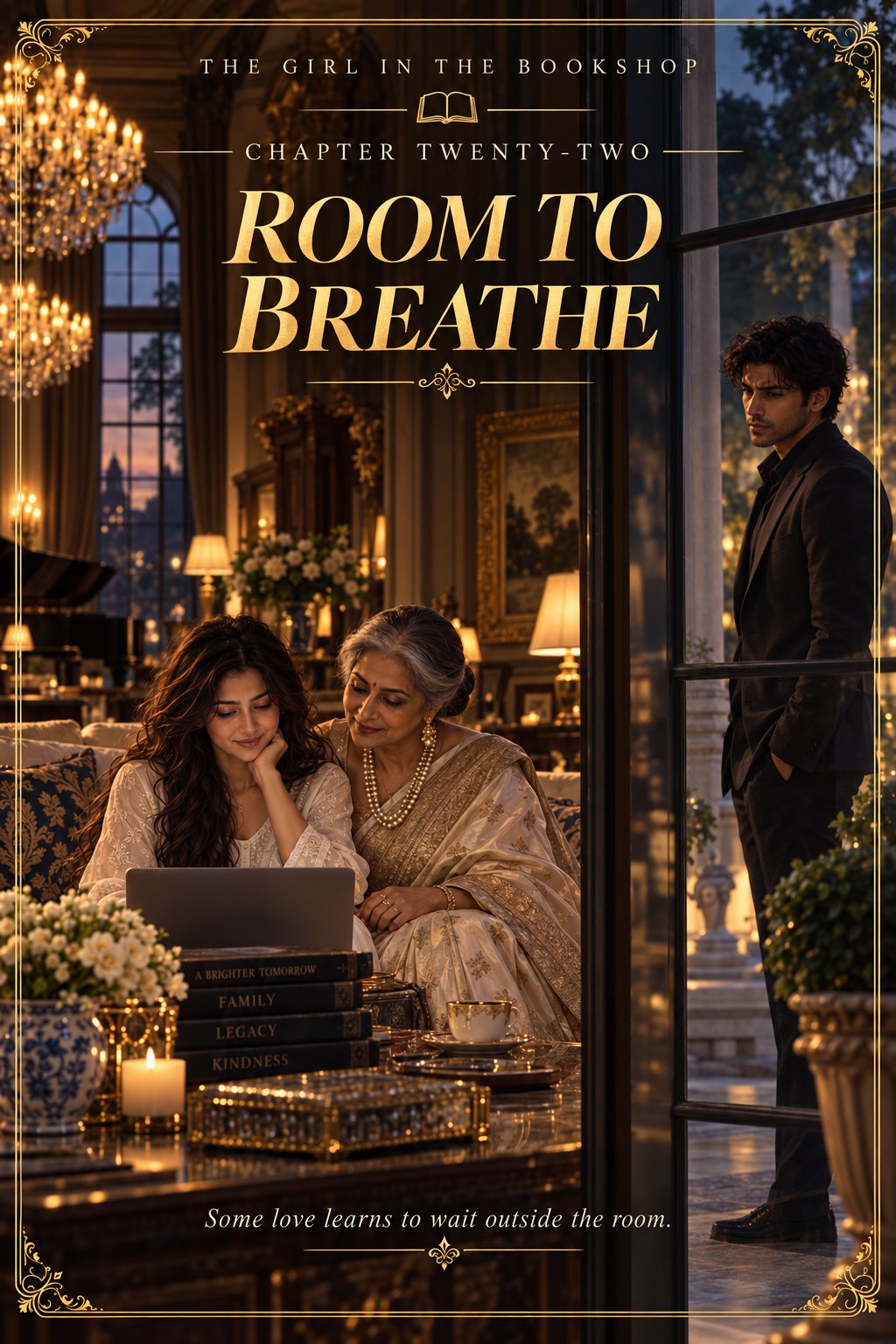
 Chapter Twenty-Two: Room to Breathe
Kian worked it out slowly. There was no single moment in which the answer arrived cleanly enough to call it a revelation. It came instead through smaller things he would once have dismissed as coincidence — Mira growing quieter when he entered a room, her shoulders tightening before she looked at him, the way she could sit at the breakfast table laughing with Tara, perfectly at ease, until his footsteps sounded in the corridor and some invisible part of her attention shifted toward the doorway.
Not fear. That would almost have been simpler. Awareness. Preparation.
She did not flee anymore — she had stopped doing that after the first few days. In some ways that was worse. She stayed now, sat through meals, answered other people, continued conversations as though Kian were no more significant than the chair three places away. But he had begun to recognize the effort involved.
She was managing him — accounting for where he was, whether he might speak, whether she would have to respond, whether a room that had been easy thirty seconds ago was still easy now. He had made himself another thing she had to handle.
Kian sat alone in his office late one afternoon, a spreadsheet open across two screens, staring at the same column until the numbers ceased meaning anything.
He had spent most of his life moving toward problems. If something resisted, he found leverage. If a door remained closed, he worked out who held the key. If a structure failed, he redesigned it. Mira had once liked that about him — or perhaps she had liked it before he turned the same instinct toward things that should never have been engineered.
He leaned back and covered his mouth with one hand. The obvious response had been the hardest one for him to accept.
Stop.
Not stop loving her — he had no idea how to do that. Not stop caring whether she ate, whether she slept, whether she laughed, whether she had received the result she had worked herself half to death for. Stop making any of those things hers to deal with.
If she wanted an evening in which she did not have to wonder whether Kian was watching her from the other side of the room, then he could give her one. If she wanted breakfast without deciding whether to acknowledge him, he could leave before breakfast. If she wanted his family without him attached to every interaction like a condition written in small print, then he could remove the condition.
The thought hurt. That did not make it wrong.
Kian closed the spreadsheet. For once, he did not try to solve the pain that followed.
The family noticed before Mira did — or perhaps Mira noticed and refused to give the observation enough attention to become fact.
Kian began leaving early. He had always worked long hours, so the first few mornings required no explanation. Someone mentioned a site meeting. Someone else said he had calls with Singapore. Devika complained that he had left without eating properly.
Then he missed dinner. Then another. Then a cousin's visit. Then Sunday lunch. His place at the table did not disappear — it simply remained empty more often than it was occupied.
Devika still had food kept aside for him. Rajendra still asked whether Kian had said when he would be home. Samar occasionally answered. Most people stopped asking.
Mira noticed sideways, the way one notices a clock after its ticking has stopped. She would enter a room already half prepared for him to be there and discover he was not. Relief usually came first. Afterward came irritation — not at him, at herself, for having prepared at all.
He appeared at dinner on Thursday. The reaction around the table was small enough to masquerade as ordinary.
Tara looked up as he took the empty chair beside Samar. "Look who lives here."
Rhea kicked her under the table. Tara jerked. "What?"
Kian glanced between them.
"Nothing," Rhea said.
"Clearly."
His voice was quiet, tired. The old dryness remained, but it had lost some of its edge.
Mira kept her attention on her plate. She could feel him three seats away. That had not changed. She hated that the body could remain loyal to habits the mind had already rejected.
Someone asked Kian about a project. He answered. Someone else complained about a contractor. Kian made one practical suggestion and then fell silent again. He did not look at Mira — at least not while she was looking at him.
An older relative arrived halfway through dinner, dropped into an empty chair, and said, "Well. We finally caught you."
Kian raised his brows.
"You've been impossible lately."
"Work."
"Of course." Something in the tone made Samar look up. The relative reached for water. "Very convenient, work."
Kian said nothing.
"At least you're becoming good at staying out of other people's decisions."
The table changed — barely. A spoon stopped against a bowl. Someone reached too deliberately for bread. Mira's head came up before she could stop it.
Kian had gone completely still. He did not look at her. His fingers tightened once around his glass, then loosened.
"Apparently." That was all. No retaliation, no surgical remark that would have left the other person regretting the sentence. Nothing.
Mira stared at him. The relative seemed almost disappointed. Conversation restarted around them.
Kian ate for another five minutes. Then he stood.
"Early morning."
Tara opened her mouth. Samar gave her a look. Kian left before dessert.
Mira watched his chair remain empty for the rest of the meal. She told herself the strange pressure beneath her ribs was anger. There were enough reasons for it.
Samar caught him upstairs. Kian already had his jacket on.
"You're leaving again?"
"I said I have an early morning."
"Tomorrow."
Kian looked at him. "That's generally when mornings happen."
Samar did not smile. The familiar answer died between them. Kian looked away first.
"Don't."
"Don't what?"
"Whatever conversation you're planning."
"I'm not planning one."
"You're standing in front of the stairs."
"Excellent observation."
Kian's jaw tightened. Samar leaned against the wall. Downstairs, laughter rose from the dining room — Mira's among it. Kian's eyes moved instinctively toward the sound. Samar saw. Of course he saw.
"You know nobody asked you to disappear."
Kian picked up his keys. "No."
"She asked you not to push."
"I know."
"That isn't the same thing."
Kian was quiet. Then he said, "When I'm there, she changes."
Samar's expression shifted. Kian kept his gaze somewhere past him.
"She gets quieter. She starts measuring every word. Sometimes she finishes eating faster. Sometimes she leaves."
"So you leave first?"
Kian looked down at the keys in his hand. "Yes."
Samar did not answer immediately. "That can't be permanent."
"I didn't say it was."
"What did you say?"
Kian gave a small shrug. "Nothing." Then, more quietly, "If she's comfortable here, leave it alone."
Samar watched him. "You're part of here."
Something crossed Kian's face, gone too quickly to name.
"Not for everything."
He went downstairs without waiting for an answer.
Mira began making lists. Lists were kinder than decisions — a decision required finality, while a list only required handwriting.
She sat in the library one afternoon with three university brochures, two notebooks, and a cup of tea growing cold beside her. One page held postgraduate programs. Another held application dates. A third had three columns.
She wrote the first heading easily. Shimla.
The second took longer. Delhi.
She stared at the blank third column. For several minutes, nothing came.
Shimla meant Uncle. Mehek. The bookshop. Rain on the roof. Her parents' photograph. Streets she could walk without thinking. It also meant Sunita aunty's house, which was hers and not hers in the same breath — old gratitude, old caution, the lifelong habit of calculating how much of herself was reasonable to take up.
Delhi meant something she had not expected to acquire. Daadi's room. Devika placing food in front of her without asking whether she wanted to be cared for. Tara barging into rooms. Rhea pulling her into conversations. Breakfast loud enough to make solitude impossible.
And Kian.
Mira's pen stopped.
No. Delhi did not belong to Kian. The thought came so sharply that she stared at the page. Neither did Shimla belong to Sunita aunty. Places were larger than the people who complicated them.
Still — there had to be another possibility.
Mira lowered the pen to the paper. Slowly, she wrote: Elsewhere.
The word looked strange. Almost arrogant, as though a twenty-one-year-old girl who had spent most of her life fitting herself into rooms other people owned had suddenly decided the world contained a room she had not yet seen.
Her heart beat faster. She did not cross it out.
Daadi found her there half an hour later.
"What are you doing?"
Mira looked up. "Thinking."
Daadi glanced at the papers covering the table. "That looks expensive."
Mira laughed. Daadi lowered herself into the armchair opposite her — Mira had learned not to rush to help unless Daadi actually needed it; she disliked assistance performed for its own sake.
For a while Daadi said nothing. Mira turned a brochure over, then another. Finally she asked, "Can I ask you something?"
"You usually do without permission."
Mira gave her a look. Daadi waited.
Mira tapped the end of her pen against the notebook. "What do you think is the most important thing in a woman's life?"
Daadi's brows rose. "Why a woman?"
Mira paused. "Fine." She corrected herself. "A person's life."
"Independence." The answer came without hesitation.
Mira frowned. "That's it?"
"You asked what was most important, not for a ranked list."
"I thought you'd say family."
"Family matters."
"Love?"
"That too."
"Then why independence?"
Daadi looked at her for a moment. "Because love is easier to recognize when you do not need it to survive."
The pen stopped against Mira's fingers. Daadi's voice remained matter-of-fact.
"People romanticize dependence when life is going well. Then someone dies. Someone leaves. Someone changes. A marriage fails. A business collapses. A family that felt permanent suddenly isn't."
Mira looked away. Daadi did not apologize for the bluntness.
"Independence doesn't mean you should live alone," she continued. "It means your life should not collapse because somebody else changed their mind about your place in theirs."
Mira looked back. "Financial independence?"
"Partly."
"What else?"
"Work you can do. Skills that remain yours. Money you control. Somewhere you can go if you need to." Daadi paused. "And the confidence that leaving one place does not mean falling out of the world."
Something tightened in Mira's throat. "Stability."
"Exactly."
Mira looked down at the notebook. "So independence is stability."
"At its best."
"And family?"
"Can be part of stability."
"Love?"
"Can be too." Daadi's expression sharpened slightly. "But neither should be the foundation under every other part of your life. Foundations should not be able to wake up one morning and decide they no longer want to hold you."
Mira stared at the three columns. Daadi followed her gaze. "Shimla. Delhi." Mira moved the notebook. Too late. Daadi's eyes shifted to the third heading. "Elsewhere."
"Please don't."
Daadi's mouth twitched. Mira looked back down. "I don't know where I belong."
The humor disappeared. Daadi settled deeper into the chair. "Belonging and dependence are not the same thing."
Mira was quiet.
"You can belong somewhere and still be able to leave it," Daadi said. Mira's fingers curled around the pen. "And you can love someone without building your survival around them."
The words settled into the room. Mira did not ask which someone. Daadi did not supply a name.
After a while Mira said, "What if I don't know what independence looks like for me?"
"Good."
Mira stared. "Good?"
"Then you haven't copied someone else's."
Mira almost smiled. Daadi gestured toward the page. "Work it out."
"That's all?"
"What were you expecting? A map?"
"It would help."
"No."
Daadi stood. At the door, she glanced back. "Make the third column wider."
Mira looked down. When she looked up again, Daadi had gone.
Mira stared at Elsewhere for a long time. Then she drew another line beside it. Made the column wider.
Kian watched her sometimes. Never long enough to be caught — at least that was what he told himself.
Once from the top of the stairs, while she sat in the courtyard explaining something to the teenager who had complained about physics before his exam. Once through an open doorway, while Tara painted one hand of Mira's nails and Mira objected to every color before eventually allowing one. Once from his bedroom window, while Mira crossed the garden with a book tucked beneath her arm, stopped near the gardener, and said something that made the older man laugh.
Kian watched her smile. Then the gardener said something else. Mira laughed. Kian realized with a small, uncomfortable shock that she knew the man's name.
Kian did not. He had grown up in this house. She had been here weeks.
Something about that lodged under his ribs. Not jealousy. Not quite shame either. Awareness, perhaps. Mira entered places differently — she noticed people without first determining what role they played. She had done that with him too, once. Before she had known what he owned. Before she had known the Dutt name properly. Before she had known there was land he needed.
Kian stepped away from the window. He did not go downstairs.
Family events became easier to refuse. The first time he said he had work, nobody questioned it. The fourth time, people did.
Viren caught him near the entrance after a small engagement dinner Kian had attended for less than an hour.
"Leaving?"
"Yes."
"You just arrived."
"Forty-three minutes ago."
Viren looked at him. "Thank you for the exact calculation."
Kian slipped his phone into his pocket. "I have an early start."
"You've had a remarkable number of early starts lately."
Kian said nothing. Viren's gaze sharpened. "Convenient how they always seem to happen when Mira is around."
Kian's jaw shifted. "Is there a point?"
"Several."
"Pick your favorite."
The old response came automatically, sharper than he intended. Viren's eyes narrowed. For a moment Kian almost welcomed it — an argument he understood. Then he looked past Viren. Mira stood across the room beside Rhea, listening to an older aunt say something. Her head tipped slightly. She smiled.
Kian's anger vanished. He looked back at Viren. "Actually, don't."
Viren studied him. "You used to argue when people accused you of something."
"I still do."
"Not lately."
Kian gave the smallest shrug. "Maybe I'm tired."
"Or guilty."
The word landed cleanly. Kian did not flinch. "That too."
Viren seemed almost thrown by the admission. Then, "People think you're running away because you don't want to face what you did."
"Let them."
"Kian—"
"I'm not interested in winning this conversation."
He moved to leave. Viren caught his arm briefly. "Then what are you doing?"
Kian stopped. For a second he looked genuinely unsure. Then he said, "Trying not to make her solve me."
Viren's grip loosened. Kian left.
Devika waited three more days before saying anything. She found him in his room on Sunday afternoon, changing his watch.
"Where are you going?"
"Office."
"It's Sunday."
"I know."
"You have nothing urgent."
Kian looked at her. "How do you know?"
"Because I'm your mother."
"That doesn't usually include access to—"
"Kian."
He stopped. Devika remained in the doorway.
"You've missed two dinners. Kavita's visit. Tara's thing. Lunch today."
"I've been working."
"Stop saying that."
Something in him tightened. Devika stepped inside. "You are making room for Mira."
Kian looked away. "She needs it."
"Perhaps." Silence. "But this isn't room anymore."
He looked at her. Devika's face softened. "You are removing yourself from everything."
"No."
"Yes."
"I come home."
"At midnight."
"I sleep here."
"That is not the same thing."
Kian's mouth hardened. Devika continued before he could respond. "You don't sit with us. You don't eat with us. You don't come to anything unless someone practically corners you. Half the time I know you're in the house because I hear your door."
"Ma."
"I am angry with you."
His gaze dropped. "I know."
"I am still your mother."
Kian's face changed, only slightly. Devika noticed. "This is still your home."
He looked toward the window. "I know."
"Do you?"
That made him laugh once — no humor in it. "Apparently that's everyone's favorite question lately."
Devika did not smile. "Do you think disappearing makes what happened fair?"
"No."
"Do you think punishing yourself repairs anything?"
"No."
"Then what are you doing?"
Kian's eyes closed briefly. When he opened them, the anger was gone. "She laughs when I'm not there."
Devika said nothing. Kian looked down at the watch in his hands. "She talks more. She stays longer. She doesn't check the door." His voice had gone quieter. "If I'm there, some part of her is waiting for me to become a problem."
Devika's expression changed. "So don't become one."
He looked up. "That isn't the same as leaving."
Kian's jaw tightened again. "It feels safer."
"For whom?"
He did not answer. Devika waited, then reached out and touched his arm — a small gesture, the kind she had barely made since the wedding.
"For her," Kian said finally.
Devika's hand remained there. "And for you?"
He looked away. That was answer enough.
Kian’s father asked for Mira two evenings later. Devika appeared at her door after dinner.
"Rajendra wanted to speak to you."
Mira's stomach tightened immediately. Devika noticed. "It's nothing bad."
She followed Devika down the corridor. The private sitting room adjoining their bedroom was quieter than the rest of the house. Rajendra stood near the window. He turned when Mira entered.
Devika remained by the door. Then, after a glance at both of them, she left. The door stayed open. Mira noticed. Rajendra did too.
"Sit."
She sat. Rajendra took the chair opposite only after she had. For a man who could apparently walk into rooms full of senior executives and make decisions involving numbers Mira did not want to imagine, he looked unexpectedly uncomfortable. That helped.
"Ninety-one point two," he said.
Mira blinked. "Yes."
"It is an excellent result."
"Thank you."
A pause. "I should have said that properly earlier."
"You did congratulate me."
"Not properly."
Mira did not know what distinguished proper congratulations from the kind she had already received, but decided not to ask.
Rajendra looked down briefly, then back at her. "I have not always known how to speak to you."
The admission surprised her. "I haven't known how to speak to you either."
Something shifted near his mouth. "Then at least the incompetence is mutual."
Mira smiled, only slightly.
Rajendra folded his hands. "You should tell me if there is something you need."
Her answer was immediate. "I don't need anything."
His eyes lifted to hers — not stern, not offended, just steady. "That was not the question."
Mira looked down. Of course. The sentence sounded exactly like something Kian might have inherited from him. That thought hurt unexpectedly.
Rajendra continued. "Whatever happens between you and Kian — whatever decisions you make later — you are not required to disappear from this family because something between the two of you failed."
Mira's throat tightened. "I don't know what failed yet."
Rajendra was silent for a moment. "Fair." That was all. No defense of his son, no correction. Mira's shoulders eased slightly.
"If there is something you want from me," he said, "ask."
Mira stared at her hands. Daadi's words returned — money, work, skills, somewhere to go, stability. Her father's face came with them, not sharply; it rarely did anymore. Eight years had blurred details she had once thought she would remember forever. But she remembered what it had felt like to ask him things. Permission to attend something. Permission to go somewhere. Advice he sometimes gave badly and confidently anyway. The uncomplicated assumption that if she asked, there would be someone standing behind the answer.
Mira swallowed. "Permission."
Rajendra frowned. "For what?"
She looked up. "To seek my independence."
The room went very still. For the first time since she had met him, Rajendra looked completely unprepared. Mira almost took the words back.
Then his expression changed. "Mira."
She waited.
"If you need my permission to become independent, then we have already misunderstood the word."
Her eyes dropped again. "I know."
"Do you?"
Silence. Mira rubbed her thumb against the edge of her palm. "No."
Rajendra said nothing. That made it easier somehow.
"When my father was alive—" She stopped. Rajendra's face changed. Mira tried again. "I think I would have asked him." Her voice softened. "Not because he could decide whether I was allowed. I just—" She looked down. "He would have been the person I asked."
For several seconds Rajendra did not speak. Then, "Then ask me. Not because I can grant it." Something burned behind her eyes. Rajendra's voice remained formal, but softer now. "Because perhaps saying something aloud to someone standing where a father might stand makes it easier to believe you are allowed to want it."
Mira breathed in. He waited. She realized he actually expected her to answer.
"I want to study further."
Rajendra nodded.
"I want to work."
Another nod.
"I want money that's mine."
"Good."
"I want somewhere that's mine." Mira looked toward the open door. "I don't mean a house necessarily."
"I know."
"I want to know that if I leave somewhere, I'm not falling." Her voice weakened on the last word. She forced herself to continue. "I want to be able to choose where I live without wondering whether someone will still keep me there."
Rajendra's face went completely still. Mira blinked quickly. "I don't want to ask anyone if I can stay."
The room became quiet. Then Rajendra said, "Good."
A watery laugh escaped her. "That's all you keep saying."
"What would you prefer?"
"I don't know."
"Then I am doing remarkably well."
Mira laughed despite herself. Rajendra's expression softened. "If you want advice, ask." She nodded. "If you want contacts, I have more than you could reasonably use." Another nod. "If you want neither, I will not interfere."
Mira looked at him. "And if I make the wrong choice?"
"You will." She blinked. Rajendra's mouth moved faintly. "You are twenty-one."
"That's reassuring."
"It is accurate." She smiled. Then he said, "Make your own mistakes."
Her smile faded. "That is different."
Mira nodded slowly. "Thank you."
Rajendra shook his head. "Don't thank me for something that should already be yours."
She stood. At the doorway, he said her name. Mira turned. Rajendra hesitated. The hesitation made what came next more meaningful.
"If your father were here, I imagine he would have been very proud of ninety-one point two."
Mira's face changed. Rajendra immediately looked almost uncomfortable, as though he was no longer certain he had been entitled to say it.
She swallowed. "I think so too."
That was all either of them could manage. Mira left.
That night she returned to the library. The three-column page remained open where she had left it.
Shimla. Delhi. Elsewhere.
Mira stared at them. Then beneath the headings she began writing practical things — programs, costs, applications, work, accommodation. Not decisions. Possibilities. The distinction mattered.
She had filled almost half the page when Tara appeared, complained that Mira had become boring, and dragged her into the family room.
"No."
"Yes."
"I'm doing something."
"You've been doing something for hours."
"That's how work works."
"Come be useless for ten minutes."
Mira looked at her. "Is that a family principle?"
"One of our strongest."
Mira gave up.
The family room was already crowded. Daadi occupied one end of the sofa. Rhea sat on the floor. Rajendra had a book open but appeared to have been reading the same page for some time. Devika pretended to watch television. Mira ended up beside Daadi with the laptop balanced across her knees, because she had refused to leave it behind.
"Still thinking?" Daadi asked.
"Apparently."
"Unfortunate."
Mira looked at her. Daadi glanced at the screen. "What's that one?"
"Bangalore."
"And?"
"Maybe."
"Delhi?"
"Maybe."
"Shimla?"
Mira hesitated. "Maybe."
Daadi nodded solemnly. "You have made tremendous progress."
Mira laughed. Across the room, Devika smiled. Tara threw a cushion at someone. Rhea objected. Rajendra finally gave up pretending to read. Mira leaned toward Daadi to show her something on the screen.
Outside, headlights swept briefly across the windows. Nobody looked up.
Kian stopped the car near the far end of the drive. He had come home earlier than usual — not early, just early enough that the house was still awake.
Through the windows he could see the family room. Warm light. Movement. People. Mira. He could not see her face clearly from here, but he knew which shape was hers before she leaned forward. Daadi beside her. Laptop across Mira's knees. His mother in the chair opposite. His father with a book. Tara on the floor. A room Kian had occupied thousands of times.
Mira turned the laptop slightly toward Daadi. Daadi said something. Mira laughed.
Kian's hand moved toward the door handle. Stopped.
Nobody had told him not to go inside. Mira had never asked him to stop being somebody's son, somebody's cousin, somebody's brother. She had never asked him to surrender rooms that had been his since childhood. He knew that.
Still, the room looked easy. Mira looked easy — not happy in the uncomplicated sense, not healed, but unguarded for one small moment.
Kian sat behind the wheel and watched her laugh at something he could not hear. Something inside him hurt. Something else loosened. His hand dropped from the door handle.
Inside, Mira shifted the laptop again. Daadi leaned closer. Kian smiled, barely. Then he started the car.
Headlights moved across the windows. This time Mira looked up, only because the light changed. By the time she turned toward the glass, the drive was empty.