
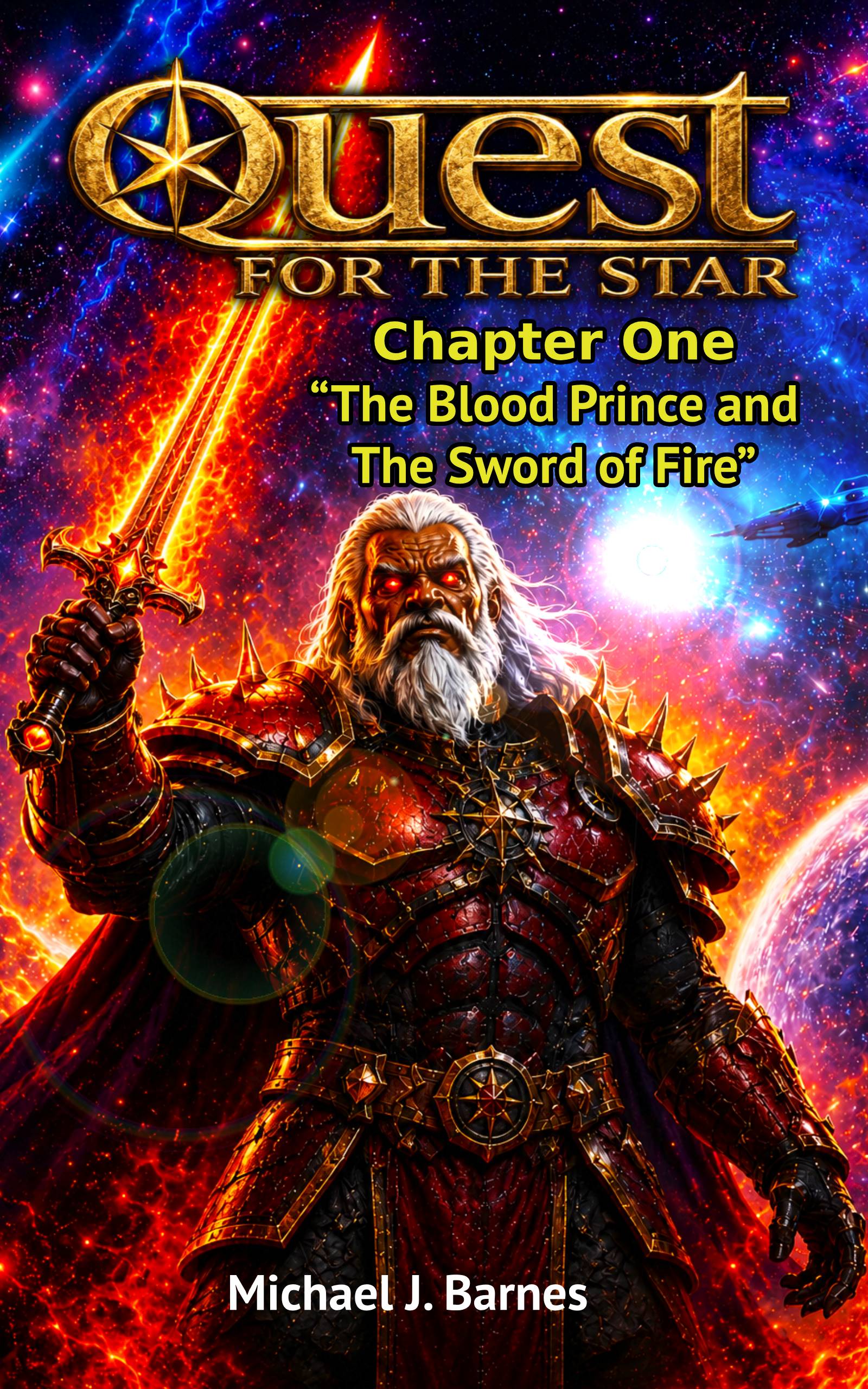
 From the Holy Scriptures, Second Testament,
The Gospel of Margus, Chapter 197
Before the Empire, there was only Atlantium, and Atlantium was a hundred crowns armed each against the others with the fire of the atom, and not one of the hundred would bow to another.
In those days there arose among them a man named Richard, and in his hand was the Holy Star.
And it came to pass that within his lifetime the hundred crowns became one, for none who looked upon the Star and refused him lived long in their refusing.
Some say the Star showed each king a path of love, and peace, and prosperity beyond anything his crown alone could promise him, until submission seemed not surrender but salvation. Others say only that Richard could not be killed, and that the kings who doubted the vision learned this at great cost to themselves. But this much is written and not disputed: a hundred kingdoms knelt, and one Empire rose in their place, and the Star did not leave his hand again.
Now Richard grew old, as even the makers of empires grow old, and in his final hour he sat alone with the Star. He called for no physician. He called for no son. He called for no one.
And with his will alone, he broke it.
Five shards it became. Five knights knelt before him, though he had not yet summoned them, as if they had known this hour before he did.
And Richard said to them: "When a Worthy Successor rises, the Holy Star shall be made whole again. Until that day, each of you must carry a shard to the farthest reaches of this world. Guard it. Protect it. And never falter."
And his voice broke upon the word worthy, and those of us who heard it have not ceased to argue what the breaking meant, nor will we, I think, before we too are dust.
Some say it was grief. Others say it was the first true doubt the Star had ever pressed upon the man who wielded it — for he had built an empire with it, and in his last hour he could not say whether it had ever made him worthy of one.
But of what followed there is no argument at all: he died smiling, and the answer died with him.
CHAPTER I
THE BLOOD PRINCE AND THE SWORD OF FIRE
The monastery of New Tullivor kept no guns inside its walls. This was not piety. It was physics.
That neglect was the only reason Guar could stand in its courtyard at all. New Tullivor was Imperial in name only — three jumps past the last garrison that mattered, the kind of world the Empire remembered to tax and forgot to defend. A Cori'an prince did not walk openly on Imperial soil. He was walking on it now, and no one here had the strength to make him stop.
He had the abbot off his feet before the old man's sandals finished scraping the flagstones, one gauntlet closed around a throat built for chanting, not for this.
"WHERE IS IT!"
His roar tore across the courtyard and set birds screaming out of the temple eaves. Not a man's voice — something underneath a man's voice, using it as a door.
He stood two heads and more above the tallest of his own soldiers, and outweighed them worse than that suggested. Leathery brown skin stretched taut over a frame built like siege architecture. Twin ridges rose from his brow into a mane of white hair and fur, matched by a beard gone the same bone-white, as though he'd aged backward out of something older than a man. Beneath the ridge his eyes burned a low, constant red — the first thing anyone saw of him in the dark, and often the last thing they saw at all.
In Cori'a they called him the Blood Prince, for the armor that had been red as a wound before it was ever red as a crown.
The monks of New Tullivor had heard the name the way children hear a warning meant for someone else's country. None of them, until this morning, had believed they would stand close enough to learn if the stories were true.
They were.
Soldiers herded the brothers of the order into the courtyard's center, prayers thinning to silence under charged rifles. Beyond the walls the valley rolled away green and unbothered — a brook cutting silver through grass, birds lifting off the water in white startled sheets at every shot. An obscenely peaceful place to be having this conversation.
The abbot of New Tullivor was one hundred and forty-two years old and had a habit, when frightened, of counting his own pulse against his tongue — a monk's trick, taught to him as a boy, meant to still the heart before it could betray the mind. He was counting now.
"Where is what?" the abbot said, when he had enough breath to say anything.
"Callaeous." Guar let the word sit between them. "My path led me here. Do not tell me it led me wrong."
No one in the Empire had laid eyes on a living Cori'an since the split — a thousand years gone now, the only one of Richard's hundred kneeling crowns ever to make its refusal stick. What had reached this far instead was rumor, thin and secondhand: a prince monstrous enough that entire garrisons went silent in his wake, out past the border where the Empire's maps thinned to guesswork.
The abbot's throat worked under Guar's gauntlet.
"Corporal." The roar dropped out of Guar all at once, and the quiet that replaced it was worse. "Kill one of them."
"Wait —" The abbot's composure broke, and something in Guar's chest eased at the sound of it, ugly and immediate, like a held breath finally let go.
"Tell me where it lies," Guar said, "or I burn them one at a time and let you count."
One day, my son, the fire will call. When it does, you must decide whether you carry it, or it carries you. His mother's voice, uninvited, the way it always was these days — and he shoved it down the way he shoved down everything that slowed him. Not fast enough. Something behind his ribs cracked, small and involuntary, like ice giving way under weight it had carried a long time.
The abbot's voice, when it came again, had gone strange — not braver, but further away, as if he'd stepped back from his own fear to look at it.
"The fire does not choose the strong," he said. "It chooses the worthy. And you are strong enough to break every bone in this courtyard, my Prince. You have never once had to ask whether that was the same thing."
"FIRE," he roared, eyes gone from ember to open flame, and the corporal's rifle came up —
— and a lance of energy took the soldier mid-motion, punched through his chest plate, dropped him smoking into the grass before the shot ever left the barrel.
Guar spun. No gun on this world had that signature. Another bolt cracked against a support column. He drew the crystal-bladed sword from his hip more from instinct than plan and caught the third shot on its edge.
Then the shooting stopped. Whoever it was had already gone.
"FIND HIM!"
His soldiers scrambled for their skyskimmers. He watched them go and felt, underneath the fury, the same cold thread the abbot had found and pulled. You have never once had to ask.
He was asking now. He hated that more than he hated the sniper.
The riders came back within the hour wearing the careful blankness of men who know their news will cost them something.
"The sniper escaped, my Prince. We augured the whole valley. No pulse. No trace."
Guar's sidearm found the trooper's skyskimmer before the man finished the sentence. The bike went up; the rider dove clear only because he'd learned, long ago, to read his Prince's hand before his Prince's mouth.
The second rider did not run. Something in Guar eased, briefly, to see it — a small, unwelcome respect for a man who hadn't flinched.
He turned back to the abbot and hauled him up by the collar. The old man's eyes were already waiting — not defiant, something closer to sorry.
"Where is Callaeous."
"You will not command it," the abbot said. "Fire does not kneel, my Prince. It burns its master as readily as its foe."
Burns its master. Guar's jaw worked. He flung the old man toward the huddled brothers hard enough that two of them caught him between them.
"Lies." He raised the pistol. "Tell me where the sword lies, or I turn this temple to glass."
The abbot straightened with another monk's help, blood tracking down one temple, and spoke quiet now — pitched for Guar alone.
"You want someone to tell you you're strong enough to deserve it," he said. "But strength was never the price. Somewhere, you already know that. It's why you're still asking me instead of simply taking the temple apart stone by stone until you find your answer."
Guar's finger closed on the trigger. Stayed there. Did not pull.
It was Denl'o's voice, cracking across the courtyard, that broke whatever was about to happen next.
"My Prince! We found it!"
Guar turned toward the sound with something close to gratitude, though he would sooner have bitten his own tongue than name it that. "Found what?"
"A pulse, beneath the temple. The chapel hides an entrance to the catacombs — old, and powerful, and the auger reads it as close kin to the signature we've chased across seven systems."
"Show me."
The foyer leading to the chapel was gold where the courtyard outside had been green and grey stone. Marble underfoot, five bronze saints standing sentinel around a statue of Emperor Richard holding aloft a facsimile of the Star he'd shattered.
Guar's stride slowed despite himself. This was the man who had taken a hundred warring crowns and made all but one kneel with nothing but a piece of rock and the nerve to use it — the man the very Empire Cori'a had bled to escape still measured itself against, five thousand years later. Guar looked up at eight feet of dead founder holding eight feet of dead relic and felt something close to envy: all that power, and Richard had spent his dying breath handing it away instead of keeping it.
Waste, Guar thought. Or wisdom. I don't know which frightens me more.
Denl'o found the seam in the wall, pressed it, and stone breathed cold air into the room.
"I'll never fit," Guar said, eyeing the passage.
"Not in that." Denl'o didn't quite smile. "Without it, you will."
Guar triggered the belt clasp and let the crimson plate dissolve back into its housing, leaving him in the black bodysuit beneath — leaner, scarred, less a prince than the thing a prince is built on top of. Beside him, Denl'o looked almost human by comparison: spy-caste, bred slighter and smoother-skinned, a build made to disappear into whatever crowd needed disappearing into. It was the only caste in Cori'a that could walk an Imperial street and be taken for one of the Empire's own — and Guar had never quite decided whether he envied that or pitied it.
He went first into the passage anyway, because letting Denl'o watch him hesitate would have cost more than the crawl through stone ever could.
Six soldiers and a scatter of hovering torchdrones lit the chamber below. Three corridors opened off it like the throats of something that had swallowed a great many people and was in no hurry to stop.
The first trap took a soldier before anyone had finished deciding which corridor to trust — one careless step, and the walls slammed shut and open again on empty air. No blood. No sound. No evidence the man had ever been more than a name Guar hadn't bothered to learn.
"Well," Denl'o said, a little too brightly. "If there was any doubt, my Prince, it's gone now."
Further in, the corridor itself seemed to watch them — no floor giving way, no fire, just a silence so total that three soldiers turned back the way they'd come without being ordered to, and had to be driven forward again at gunpoint. Denl'o pressed a hand to the wall and pulled it back like he'd touched something that flinched.
"It's not trying to kill us here," he murmured. "I think it's asking us something."
He said it half to himself, and something in his own voice startled him more than the wall had — a flicker of the same hunger the abbot had named in Guar not an hour before, though Denl'o would not have called it that, and would have denied it if asked. He filed the feeling away the way he filed everything: quietly, for later, where his Prince would not see it.
Guar didn't answer. He kept walking, because stopping to consider the question felt more dangerous than any of the traps had.
At the bottom, double doors of carved stone opened onto an empty chamber. A dead end.
"You led us to nowhere?"
"No, my Prince." Denl'o's face had gone the color of old parchment. "The auger still reads the pulse. It's beyond this wall — I'd stake my life on the reading."
"You may have to." Guar drew his pistol. "I'll blast us through."
"Fire at this wall and the chamber comes down on us. The path — and whatever's behind it — buried for good." Denl'o guided a torchdrone forward until its light spilled across the far wall: hundreds of stone tiles, each carved with a sigil, the Holy Star repeated at intervals like a rhyme the wall kept returning to.
"A key," Denl'o murmured, tracing them. "Fire, wind, earth, water — see how they ring the Star."
"Then touch them."
Denl'o did. Nothing answered.
Guar's rage rose to fill the silence — and stalled, caught on a line he hadn't asked to remember. When a Worthy Successor rises, the Holy Star shall be made whole again.
He moved Denl'o aside without quite deciding to, and laid his own hand against the symbols. For a heartbeat: nothing. He had already begun to pull his hand back, already composing the fury he'd need to cover the humiliation —
Then the tiles woke. Light bled up through old carving, stone ground against stone, and a door opened where there had been none.
Denl'o stared at his Prince with an expression he didn't have a name for and didn't like anyway. Perhaps he truly is the one, Denl'o thought, and could not decide, even as he thought it, whether that pleased him or terrified him.
The passage gave way onto a vaulted chamber built around a pit of living fire. Four hooded stone figures stood watch over a casket at its center. Above the casket, a crystal hung suspended in the updraft, blue and pulsing.
"That looks sinister," Denl'o said.
"Then we've found the right room." Guar's teeth showed. "Nothing worth taking is ever left unguarded."
A soldier broke rank — "I'll claim it for you, my Prince —" — and the crystal answered before Guar could stop him: a spear of light, then only a scorch mark and a silence even the fire seemed to observe.
Guar understood it distantly, the way you understand a rule by watching someone else break it: the crystal was answering a claim with a question, and the soldier's claim had been made on someone else's behalf. It had nothing to do with him yet.
"The path circles the pit," Denl'o said, tracing a seal where it ringed the flame — Callaeo, Atlantium's old god of fire, whom the sword had been named for. "It doesn't cross it."
Guar crossed tile to tile, used a statue's base as a foothold over a gap too wide to clear outright, and came down hard on the far side. He crossed the last span to the casket, circled it once, found no trap along the seams, and heaved the lid aside.
Bones. Old ones, arranged with a care that hadn't come from whoever put them here dying in this position — laid out, hands crossed, the way a body is placed by someone who loved it, not one who lost a fight. Wedged near the ribs, a scrap of cloth, deep monastery blue, torn rather than cut, the kind of tear cloth makes when someone pulls free of it in a hurry.
The plinth bore a name he'd known since before he could walk a straight line: Elijah. One of five. The one whose road, by every account he'd spent a war chest chasing down, ended here.
The word hit harder than the crystal's fire had. Not strength, the memory said, gentler than ash. Worth.
He slammed the lid down as if it could bury the memory with it, and the crystal answered — a lance of light through the space where he'd stood a heartbeat before. Not because he'd failed its test, he understood in the same instant, but because the thing it had been guarding was already gone, and an empty vow answers every claimant the same way: with fire, and no exceptions. He rolled clear as the dome shuddered apart around him, statues cracking, the architecture deciding, with terrible slowness, to fall. He ran the bridge, cleared the last tiles, and threw himself through the threshold as the vault came down behind him.
In the antechamber, chest heaving, he stared back at the ruin. "It was here. The abbot took it. And I will still have it."
He tore back through the catacombs faster than his soldiers could match, into the courtyard, and seized the abbot a second time.
"Where is it. What did you do with it."
The abbot's face was a ruin of its own, but his eyes had not stopped counting. He did not deny it — not with a word, not with the flicker of outrage an innocent man reaches for on reflex. "You will never know the power of Callaeous," he said instead, and paused, something shifting behind the blood on his face when he saw where Guar's stare had landed. He hadn't expected the Prince to need the inscription read to him. "You know the name," he said, quieter. "Then you know what it cost him. And still you came."
Guar threw him. The abbot struck the temple wall and did not rise, and the silence that followed was heavier than any of the rifles had been.
"Kill them," Guar said. "Leave none standing." He did not enjoy it, and did not let himself wonder, even for a moment, why that mattered less each time he said it.
"My Prince. The King commands contact."
Guar's hand twitched toward his blade before he stilled it. "Bring him through."
His father's hologram assembled itself in the ashy light — tall, sharp-eyed, carrying judgment ahead of him the way other men carried rank.
Guar knelt. "Rise," the King said, and Guar rose, though he kept his head bowed a fraction longer than duty required.
"You will return to me." His father's voice was tired more than furious, which was somehow worse. "Cori'a needs its heir, not a raider on borrowed time in Imperial territory. If New Tullivor reports a prince of ours on its soil, the peace our ancestors bled a thousand years to hold is over by morning. And it will not be the Empire that pays for it." He paused, and something older than anger moved behind his eyes. "You think this peace is about us. It has never once been about us. The Empire does not watch Cori'a to punish it. It watches Cori'a because we are still standing. Do you understand what a hundred kneeling worlds do, the day they see one that didn't?"
Guar had no answer for that, and hated that he had none.
"Father. The Sword of Fire is near. Give it to me and Cori'a never has to kneel to anyone again — not the Empire, not you, not even the fire itself. No power in this system will matter once I hold it."
"A sword will not undo a thousand years, Guar. And it will not survive first contact with an Imperial fleet, which is what you'll bring down on every world that shares our sky if you're caught." A pause, and when he spoke again the anger had gone somewhere quieter and harder to fight. "Your mother believed in this sword too. She called it destiny. I watched it hollow her out from the inside until there was nothing left in her that answered to her own name. I am not interested in watching it do that to my son."
For one long moment Guar could not draw breath at all.
One day, my son, the fire will call. He was a boy again, for exactly as long as it took his father to finish speaking. Then the boy burned away, the way the boy always did, and the Prince closed his fists hard enough to bleed and said, "It is no myth. I've felt it. It is mine to claim, or it unmakes me."
His father looked at him the way a man looks at a wound he's already decided will not heal. "Then prove yourself with war, not dreams. Strength you have. Worth—" a pause that lasted exactly as long as it needed to draw blood "—you have never shown me. Return, or be cast aside."
The hologram dissolved and took its verdict with it, but left the shape of it standing in the courtyard like a fourth statue among the three that had survived the fighting.
Guar's claws had drawn blood from his own palms without his noticing. For once in his life he found he could not roar. The quiet in him was louder than any thunder he'd ever made.
What if he's right.
He let the mask close back over his face before anyone could see it hadn't been there. To his soldiers he was the Blood Prince again, unshaken. He had gotten very good, over the years, at being looked at without being seen.
"Prepare the shuttle," he told his sergeant, and his voice had gone level as a blade cooled too fast — the rage hadn't left. It had only gone back to where it lived.
At the ramp he stopped and barred Denl'o's path with one arm.
"You're not coming."
"My Prince?"
"The abbot moved the sword before we ever reached that vault. If it left this world, it went through the starport. I need someone at the gate who knows how to be invisible." His eyes narrowed, and something almost like warmth moved through the words — the closest thing to trust he had left to give anyone. "You've always been good at that."
Understanding dawned, careful and a little too eager, across Denl'o's face. "If it left this world, I will find it."
"See that you do."
The hatch sealed. The shuttle lifted into a sky the color of dying coals.
"My father calls me heir," he said to the dark beyond the viewport, to no one. "The fire calls me chosen. If worth is the price, then I will make worth. If the fire refuses me, I will burn until even the fire kneels."
The words came out colder than his rage ever had. That, more than anything else that had happened today, should have frightened him.
Denl'o stayed behind in the wreckage, wind pulling at his robe, smoke thick enough to taste. He knelt beside the abbot's body and found, tucked in the old man's sleeve, a scrap of parchment burnt soft at the edges — a sigil on it that pulsed faintly, like something that had decided not to die on anyone else's schedule.
His breath caught. Whatever else was true, the fire was real. And it had left this world before Guar ever set foot in that vault — which meant, Denl'o understood slowly, that the tiles had not been testing whether Guar could carry the sword out of the temple. They had been testing something else. Something the sword's absence didn't change at all.
His fingers did not tremble with fear. He noted that too, and wondered, not for the first time today, which of them had taught the other that trick.
He tucked the parchment inside his robe and watched the sky where Guar's shuttle had already burned itself to a point of light and gone.
"The Prince will never know," he said, to the ruin, to the dead. "Not if I find Callaeous first."
Perhaps the fire had already chosen. Perhaps, this time, it hadn't chosen a prince at all.
The hunt for Callaeous had only begun.
Next in the Quest for the Star Anthology
The Wandering Ember
The Sword of Fire has vanished.
The temple lies in ruin.
And in the shadow of Guar’s fury, one name burns brightest—Denl’o.
Once the Blood Prince’s most loyal spy, Denl’o now walks the edge of empire and treason. Driven by whispers of freedom and the promise of a weapon forged from a shattered star, he will infiltrate the most secure starport in the galaxy to seize his destiny.
But every ember leaves a trail of smoke.
And far above, Guar watches—his vengeance as cold and unending as the void itself.
The hunt has only begun.
© 2026 Michael J. Barnes
Quest for the Star and all associated characters, locations, organizations, and story elements are the intellectual property of Michael J. Barnes. All rights reserved.
No portion of this work may be reproduced or distributed without permission from the author.