
We were born under the shadow of an inescapable inheritance. Our mother, Jess, seldom spoke of what seeped through our blood, or how it had ruthlessly dismantled our family from the inside out, generation after generation—leaving so many daughters before her bled dry and stripped of any real promise for a better future. Instead, Jess chose silence most days. She offered forewarnings for the dangers that lay in wait within the darkness, but only in quiet, deliberate increments as we grew, as if naming the shadows too loudly might manifest them into our own home once more.
I had grown used to observing how she carried herself. I could sense the exact moment her mind drifted backward into the trauma of her own troubled childhood. Her gaze would wander far past our immediate surroundings—fixating on a distant, unreachable decade, as if she were no longer living in her present reality.
As Jess grew, she learned how to carry her history like a concealed weight, balancing it so naturally that to anyone else, her hyper-vigilance could easily be mistaken for simple quietness.
When I approached my mid-twenties, I found myself living once more under the sagging roof of another run-down home in Nebraska that my mother occupied. I realized, then, that her silence had never come from a place of peace; it was an active, exhausting defense mechanism built through years of neglect and abuse from those who knew and loved her most.
In the corner of her bedroom—every single one of her bedrooms—sat the sole permanent anchor of her chaotic existence: a narrow, chipping green-and-brass-trimmed trunk. That trunk had somehow managed to endure every frantic move, every sudden midnight departure across state lines, and every broken promise left behind in the dust. The brass latches were tarnished to a dark, smoky bronze, pitted with tiny specks of rust from humid southern summers, while the green canvas exterior was scuffed down to the bare fibers at each of its delicate corners. Just like my mother, it had grown weary of the life it had been forced to survive. Yet somehow, it managed to thrive in the beds of rusted pickup trucks, on the floorboards of crammed sedans, and within the damp corners of half a dozen rental homes scattered throughout the heartland.
To see that trunk was to look at the physical collection of my mother’s flight and defense. It held what few clothes she owned and a handful of torn photographs that were starting to fade into nicotine yellow around the edges. It trapped the unseen weight of a childhood spent running from things with no true physical form—along with a precious ring tarnished with age, a little girl’s pink bow, and an old flip-phone that had sat for over a decade powered down. Each held sacred value known only to her and her children.
“Some things don’t belong to the light,” she told me once, her voice rising just barely above the ruckus of her four rowdy mutts. She didn’t look at me when she spoke; she kept her eyes fixed on her favorite contoured Coca-Cola glass tinted in Georgia green. She took a small sip of her freshly home-brewed, old-fashioned tea. After a short pause, she started swishing the iced slush around. The ice clinked against the pristine glass between her work-worn fingers as if she could drown our shadows.
“You’re digging around in broken soil where your ancestors were buried, and all you’re gonna do is find answers that you don’t want to unbury.”
Recognizing my own internal war reflecting within my mother only made our shadows feel more ominous. I began to wonder how many generations before us had fought these same eternal battles, and whether the bond between my daughters and myself had already been destined for darkness as well. One thought haunted me the most: could anyone truly banish these shadows that lurked around my family for so long, or had all hope already been drained from the blood of my blood?
My mother framed our whole genealogy—not as an elegant, ancient tree with deep, sturdy roots, but more as a patch of poisoned earth best left untended. Yet, despite her best efforts to bury the past, the past was the only thing that gave context to the rest of us.
To understand why the shadows lurked around us, we have to follow its chains back to when it had been first forged. Long before my grandmother, Winnia, ever conceived my mother, my family abandoned our sun-bleached compound—a cluster of weathered shacks dusted in harsh rustic red, buried deep within the southernmost stretches of the Oklahoma prairies. The sun down there didn’t just warm the land; it baked it until the earth cracked open like dry bone.
Our original homestead sat isolated on that endless wasteland, a place where heat clung to skin from dawn until long past midnight. Because of the extreme heat and sticky humidity, the timber of those makeshift shacks would shrink and groan under the blinding glare of the prairie sun, and gritty red dust found its way into every crack and crevice. It blew through thin spaces in the peeling window frames, settling over all of their furniture and staining everything in sight with a brick-red hue. No matter how many times a broom swept across those floorboards, the grit remained, grinding underfoot—a constant, stubborn reminder of where our blood had been born.
To grow up on that desolate compound was to live inside a slow pressure cooker. My Great-Grammy Max spent years watching the horizon from those rickety old porches, witnessing her family fracture piece by piece until everyone was left emotionally broken and hollow. The shacks stood battered by merciless sunlight and generations of neglect, becoming just as forsaken as the women who withdrew within their claustrophobic walls. It was an atmosphere shaped by heavy silences, sudden tempers, and a quiet, intergenerational rage that had rooted itself directly into the cracked red clay.
It had taken me half a decade to learn that my Great-Grammy Max possessed the same willfulness for change that my own mother later showed me. Of course, it had been born from an atmosphere as bitterly cold as the maternal connections that formed within our family. Between the foggy, suffocating dawns and the metallic, blue-streaked evenings, those white-capped peaks caught the last frolicking rays of light, morphing into impenetrable walls of deep, bruised purple against the collapsing horizon. It was a breathtaking, cinematic view for my mother and aunt to thrive underneath, but it cruelly masked the bitter reality of surviving in their shadows.
Jess told me when I was a young child that she had been born surrounded by the soulless Wyoming mountains—a detail she offered like a distant fairytale. What Jess couldn’t comprehend—and what I couldn’t fully grasp until years later—was that her father had already been a subtle fixture in the earliest years of her childhood, before she ever knew the truth. Richard had ended his volatile relationship with my grandmother, Winnia, and in retaliation she forbade him from seeing little Jess. It would be a lingering heartache for both Jess and Terrie as Richard had treated Terrie as his—even teaching Terrie how to ride a bike and how to have somewhat of a normal childhood.
When Jess grew old enough to grasp that they were fatherless, her innocently curious mind filled with endless questions. Terrie couldn’t bear to deceive her baby sister any longer, so she broke down and told Jess the truth. When Winnia found out, her reaction was rooted in pure, untamed rage. The explosion that followed Terrie’s confession shattered what little stability remained in that home. Terrie had been forced to pack her belongings into her only tattered book bag while five-year-old Jess cowered behind the hallway door, hoping her mother’s fury wouldn’t be unleashed onto her as she carefully peeked through the slim crack with big blue, terrified eyes. As Terrie began her trek out into the unknown, a terrified Jess popped out from behind the door and pleaded with her older sister. Jess wasn’t ready to lose the only safety she had known, but Terrie knew she was far too young to protect them both. In the end, five-year-old Jess broke down, exploding with a rage of her own—a raw manifestation of the hurt that ultimately left its ugly scar on their sisterly bond that would last a lifetime. At fourteen, naive and terrified of the vast world outside, Terrie was shoved out their front door in the twilight. She headed east toward the cornfields—the same yellow fields Jess would one day know.
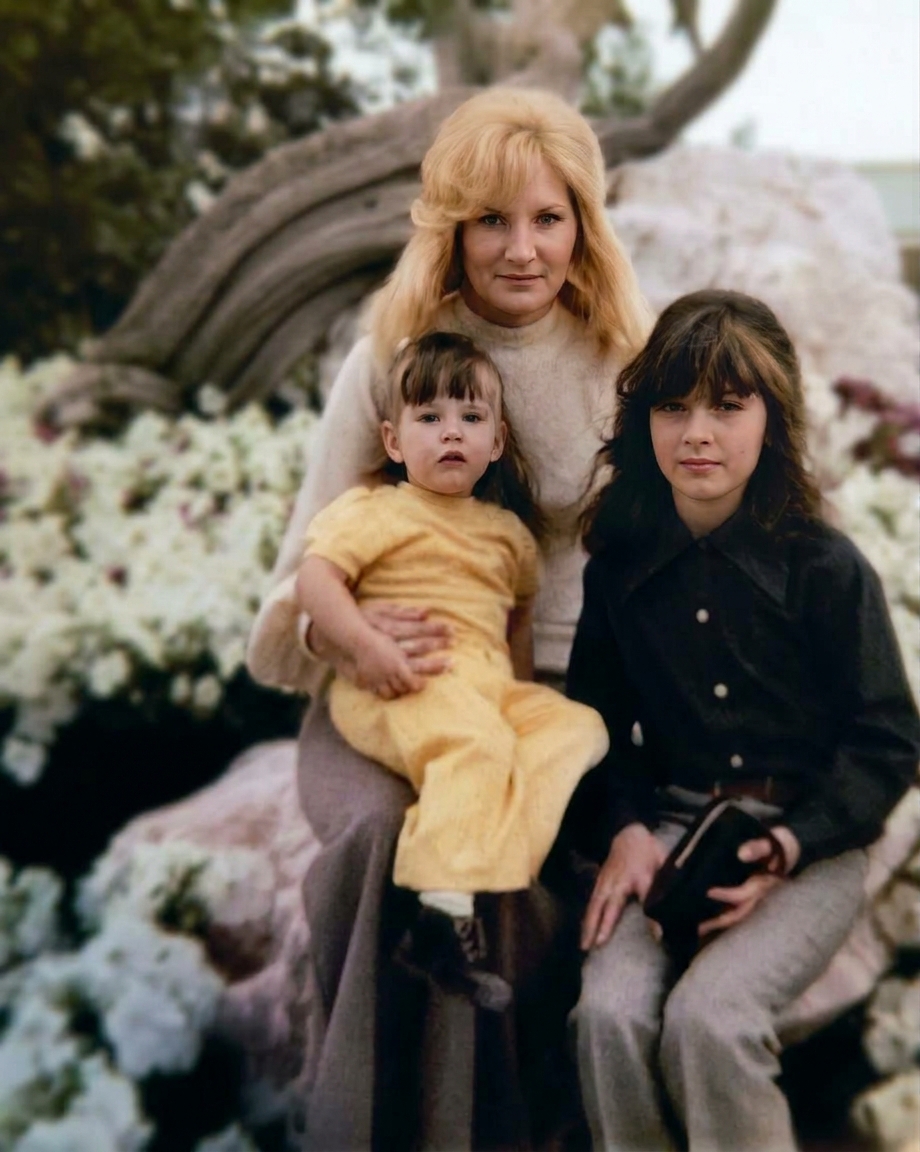
Not long after, Winnia gave birth to her third and final sweet baby girl—my aunt Bandi. Jess was almost eight when her sister came crashing into their broken world. I believe my grandma and great-Grammy Max realized Wyoming had nothing left to offer them.
My mother’s immediate family—consisting of Grammy Max, Winnia, Bandi, her father Kenny and my mother Jess packed up their few belongings. This had been the first time my mother remembered packing what would become her only sanctuary—this small green trunk. They headed back toward the prairies of the southern plains, returning to their rustic Oklahoman compound. Great-Grammy Max’s hope of a new, brighter future for the blood of her blood had vanished completely within the winds of Wyoming, utterly surrendering to the brick-red clay of the vast prairies surrounding them in every direction.
It wasn’t until I was a young adult, living in my mother’s run-down house once more on the Nebraskan prairies, that she finally admitted the truth about what happened next. I had known my grandmother’s name for over two decades—I would learn even with a fragile relationship, Jess would still honor her own mother, though on record, my grandmother’s official identity was recorded as Joan Winnia Chestnut.
My mother had a tendency to withdraw completely from any conversation involving the man who had helped create her. There was an everlasting pain in her eyes—a haunting fracture born from the absence of a father figure—and the silence that followed was always deafening.
She told me how, as a wild sixteen year old, adrift on the streets of an unfamiliar Nebraskan town, she set out to seek her paternal origins. Her search began with a birth certificate that offered only deception; her father’s name was falsely recorded. It was a bitter detour—a dead end that left her chasing a man who belonged to someone else. I can still picture her sitting on the cold, frayed carpet of her mother’s bedroom as she dug through a stack of Winnia’s documents, finding the official record hidden at the bottom of the pile, her hands trembling. She told me how delicately she traced the old ink of the stranger’s name with her thumb: “GARDNER” lay scribbled in the father’s place. When she realized her mother had written a lie into law before Jess was even old enough to understand, her chest burned with the weight of yet another betrayal.
I found out years after my mother slipped away that she had unknowingly known her true father when she was just a toddler, but over the decades, those memories had faded as the world around her took its ugly toll. My aunt Terrie told me what she remembered of that horrific day. The reality is, I’ll never fully understand how much Jess remembered of her childhood, but I could see it in the way it had perpetually shaped her spirit and her personality until her final heart-beat.
I never did learn how she finally uncovered his name, but once the truth surfaced, she set out across those exhausting miles toward the desolate tract of the Wyoming wilderness with nothing left to lose.
Her composure never quivered when I pried the truth from her stubborn lips. She had appeared on his doorstep without warning, stepping out of thin air like a specter coated in prairie dust, catching him completely off guard—a forgotten fragment of his youth standing on his graveled country road, peering into the quiet, orderly life he had constructed with his new wife and their house full of children. She couldn’t help but imagine how her life might have turned out had she been raised there beside them.
She walked onto his horse ranch while the morning mist still clung to the restless pastures. When he stepped out from the weathered timber of his barn, wiping his farm hands onto his jean overalls, he froze. Standing before him was no longer a lost memory, but a living, breathing ghost in a worn denim jacket. For a few brief seconds, behind his eyes, he was back in his youth, looking at the child he had been shunned away from. Among the calming pastures and weathered barns, he offered very few words, but his presence anchored her failing spirit and gave her a reason to believe again.
His wife, however, was shattered—her perfect world held no place for a daughter from his former life. Jess watched her through the kitchen windowpane: a woman standing rigid behind clean white curtains, her face hardened into an unyielding wall of rejection. Jess spent a single week in his shadow before his new wife grew weary of her presence, shutting the door on her once and for all.
She didn’t fight their quiet verdict. She gathered what few clothes she owned into her green-and-brass-trimmed trunk—the single permanent anchor in her chaotic existence—and set out alone on the long, grueling journey back to the Nebraska cornfields, crushed under the realization that both parents had now cast her aside.