
“Inside of me there are two dogs. One is mean and evil and the other is good and they fight each other all the time. When asked which one wins I answer, the one I feed the most.”
— Sitting Bull
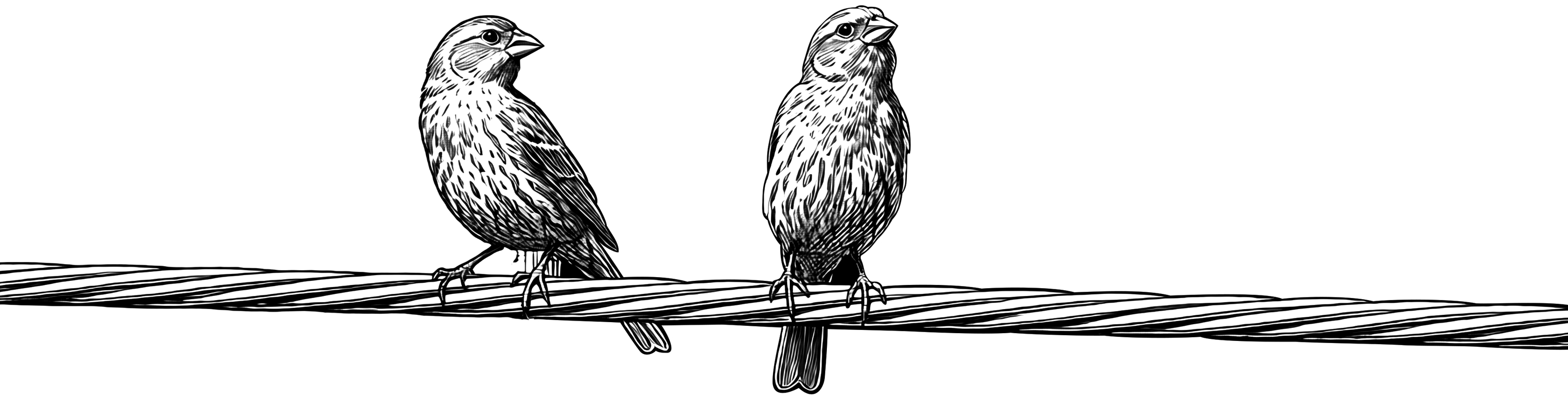
The finches were back.
Dan Abernathy sat in his ten-year-old Honda Civic in the DataTech parking garage, watching the small brown birds perch on the steel barrier cables that ran around the structure's perimeter. He'd been watching those finches for six years, ever since he'd started working at DataTech Solutions. Sometimes he'd eat lunch in his car, scarfing down a turkey sandwich while they hopped along the cables, chattering to each other in their high-pitched chirps.
They were house finches, Alicia had told him once when she had met him for lunch. "The males have the red on their heads," she'd said, pointing at one. "They're actually not native to Colorado. They were introduced from California in the 1940s."
Dan had loved that about Alicia from the day they met. Her mind was full of little facts like that, details that made the world more interesting. She could turn a parking garage finch into a story about migration patterns and adaptation. She could make anything beautiful.
This would be his last time watching the finches. This would be his last time sitting in parking space G-47. His last time seeing the oil stain on the concrete that looked like a map of Italy. His last time nodding at the security guard, Marcus, who always worked the Friday late shift.
Because Dan didn't work at DataTech Solutions anymore.
The firing had happened hours ago, though it felt like both seconds and years had passed since Thomas Rooker had called him into his office.
Dan kept glancing at the digital clock on his dashboard, watching the numbers change: 2:47 PM. 2:48 PM. 2:49 PM. His former colleagues were streaming past his windshield now, returning from their Friday afternoon coffee runs, laughing and talking, completely unaware that Dan was sitting in his car like a ghost, invisible to them all.
Or maybe not completely unaware. Sarah from accounting had glanced at his car as she walked past, then quickly looked away. Did she know? Had word spread already through the office grapevine? DataTech had two hundred and forty-three employees, and Dan had learned over six years that news traveled fast in a company that size. Especially bad news. Especially firings.
He looked at the cardboard box sitting in his passenger seat. His entire professional life, reduced to one file box that used to hold reams of printer paper. The box contained: one coffee mug with the Star Wars logo that Alicia had given him for his birthday three years ago. A framed photo of Alicia and Jacob at Jacob's first soccer game. A stress ball shaped like a globe that he'd never actually used. His noise-canceling headphones. A hoodie that said "DataTech Development Team" that he'd earned after his first year. Some pens. A half-empty bottle of Tums.
That was it. Six years of ten-hour days, weekend emergencies, late-night coding sessions, missed dinners with his family, canceled vacations, arguments with Alicia about work-life balance—all of it now sitting in a box that used to hold paper.
The meeting itself had lasted exactly five minutes and thirty-two seconds. Dan knew this because he'd been staring at the clock on Rooker's wall the entire time, watching the second hand make its slow circuit around the numbers while Rooker delivered the news in that flat, corporate voice he'd perfected since his promotion to VP last year.
"Dan, thanks for coming in. I'll make this brief." Rooker hadn't even looked up from his computer screen when Dan entered. His thick fingers continued pecking at the keyboard with the same mechanical precision he brought to everything else—email, presentations, firing people. "We're implementing some budget restrictions company-wide. That means we're restructuring the web department. Your position is being eliminated."
Dan had stood there for what felt like an eternity but was probably only thirty seconds, waiting for Rooker to explain the joke or at least acknowledge that they were talking about a human being's livelihood. But Rooker just kept typing, his face illuminated by the blue glow of his dual monitors, showing no emotion whatsoever.
"Tom," Dan had finally managed to say, his voice sounding strange in his own ears, like it was coming from somewhere far away. "I've been here for six years. My performance reviews—"
"Are irrelevant." Rooker's eyes had flicked up then, just for a second, cold and dismissive behind his expensive glasses. "This isn't about performance, Dan. It's about budgets. Numbers. The company needs to cut costs, and web development is overstaffed. We're consolidating. HR will handle your final paycheck, which will be direct deposited next week. Security will escort you out."
And that was it. Rooker went back to typing before Dan had even processed the words. The VP's door was already opening, and Marcus the security guard was standing there with an awkward, apologetic expression on his face, holding an empty cardboard box.
The walk from Rooker's office to his cubicle had been the longest of Dan's life. Colleagues had looked up from their desks as he passed, their eyes sliding away when they saw Marcus following with the box. Everyone knew what that meant. Everyone had seen it before when the company did layoffs. Everyone knew to look busy, to avoid eye contact, to pretend they didn't see you becoming the office ghost.
Only Matt had acknowledged him. Matt Henderson, his best friend and fellow programmer, had been at his own desk when Dan walked past. Their eyes had met, and Matt's face had gone pale. He'd started to stand up, but Dan had shaken his head slightly. Not now. Later. Matt had sat back down, but Dan could feel his friend's eyes following him all the way to his cubicle.
Packing his desk had taken less than three minutes. Six years of work, and he could pack it all in three minutes. Marcus had stood a respectful distance away, not watching but not leaving either, and Dan had methodically collected his few personal items while trying not to look at the code still open on his monitors. He'd been in the middle of debugging a login sequence. Someone else would finish it now. Someone else would get credit. Or maybe they'd just scrap it. Maybe it didn't matter anymore.
The elevator ride down had been mostly silent. Marcus had tried to make small talk—"Nice weather we're having" and "Any plans for the weekend?"—but Dan couldn't respond. He'd just stood there watching the floor numbers decrease, each one feeling like a step further down into a hole he'd been digging for years without realizing it.
"I'm sorry, man," Marcus had said when they reached the parking garage. "This sucks. You're a good guy. It ain't fair."
Dan had nodded, not trusting himself to speak, and had walked to his car with the box in his arms like he was carrying his own coffin.
That had been two hours and twenty-three minutes ago.
Now Dan sat in his Honda, watching his former colleagues return from coffee, from lunch, from meetings. He watched them swipe their badges at the elevator bank. He watched them disappear into the building where they still had jobs, still had purpose, still had a reason to show up on Monday morning.
His phone had buzzed seven times with texts from Matt, but Dan couldn't bring himself to read them. He knew what they'd say—expressions of outrage, promises that Rooker was an asshole who'd get what was coming to him, invitations to blow off steam over beers that Dan could no longer afford.
Dan couldn't deal with Matt right now. Couldn't deal with the sympathy. Matt meant well, but Dan needed to be alone right now. Needed to figure out how he was going to tell Alicia that their already precarious financial situation had just gone from bad to catastrophic.
He looked at the clock on the dashboard: 2:59 PM. Jacob's soccer game started at 6:00. Dan had been planning to leave work at 5:30, fight traffic, and arrive late as usual, creeping in during the second quarter while Alicia gave him that look that said she was disappointed but not surprised. He'd miss Jacob's warm-ups. He'd miss the first few plays. But he'd be there for most of the game, and that was what mattered. Right?
Except now he could be there for the whole game. Could leave right now, be home by 3:30, help Jacob get ready, drive with Alicia instead of meeting them there. They could all go together like a normal family.
The thought made him want to vomit.
Because the only reason he could be there for the whole game was because he'd been fired. Because he'd failed. Because Thomas Rooker had decided that Dan's six years of loyalty and overtime and weekend emergencies were worth less than the line item in the budget that represented his salary.
Dan leaned back against the headrest and closed his eyes. He could see Rooker's face in the darkness behind his eyelids. Thomas Rooker, with his expensive suits and his Porsche Boxster and his corner office with the view of the mountains. Rooker, who'd been promoted to VP of Marketing last year and had immediately started making changes. Efficiency initiatives. Streamlining. Consolidation. All the corporate buzzwords that meant firing people and making the survivors do more work for the same pay.
Dan and Matt had built DataTech's web platform from scratch. They'd coded it together, late nights fueled by energy drinks and pizza, creating something elegant and functional and scalable. They'd been proud of it. The company's revenue had tripled in the three years since the platform launched. Three years of growth directly attributable to Dan's work.
And now Dan was unemployed, sitting in a parking garage, watching finches and trying to work up the courage to drive home and tell his wife that their lives were about to fall apart.
His phone buzzed again. This time it was Alicia: How's work? Don't forget Jacob's game at 6! Followed by a soccer ball emoji and a heart.
Dan stared at the message. How's work? Work was over. Work was in a cardboard box in the passenger seat. Work was Rooker's cold eyes and Marcus's apologetic face and the empty cubicle he'd never sit in again.
He should respond. Should tell her he'd be home early. Should prepare her for the news. But his fingers hovered over the keyboard, unable to type the words. What would he even say? "Got fired today, see you soon"? "Budget cuts, I'm unemployed"? "Remember all those bills we can't pay? Well, good news, we definitely can't pay them now"?
Instead, he typed: See you soon and added a smiley face that felt like a lie.
Dan took a deep breath and looked at the box next to him one more time. The Star Wars mug. The photo of his family. The hoodie he'd worn so proudly when he'd earned it, thinking he was part of something lasting, something important.
Things weren't going well for Dan. He had dug himself deep into a hole. So deep, he felt, he was digging his own grave. Some people say, "You got yourself into a pickle," when it comes to these dark moments in life. But for Dan, it was more than just a pickle. It was a hole; a miserable, descending hole with no way out and all he could do was just keep on digging like a frightened dog.
He started the Honda. The engine coughed to life, and the low fuel light immediately came on. Of course it did. Because Dan had exactly two dollars in his wallet and an eighth of a tank of gas. Because the universe had a sense of humor.
He pulled out of parking space G-47 for the last time, driving slowly past the elevator bank where he'd walked out with his box of shame. Past the parking attendant booth where he'd waved hello every morning for six years. Past the barrier gate that rose automatically when it scanned the DataTech parking sticker on his windshield—a sticker he'd have to peel off soon.
As he turned onto the street, Dan looked in his rearview mirror at the DataTech building growing smaller behind him. Seven stories of glass and steel, the company logo gleaming in the afternoon sun. He'd spent nearly a quarter of his life in that building. He'd celebrated birthdays there, eaten hundreds of lunches there, stayed late on anniversary dinners and Jacob's boy scouts meetings and Alicia's art shows.
And now it was just a building. Just glass and steel and people he used to know.
The drive home took twenty-three minutes, twenty-three minutes of rehearsing different ways to say the same terrible thing. Dan practiced in the rearview mirror, trying on different expressions. Casual: "Hey babe, funny story..." Confident: "Actually, this is going to be great. Now I can find something better." Apologetic: "I'm so sorry. I don't know how this happened."
None of them sounded right. None of them would make the truth any less awful.
The truth was this: They had $83 in their checking account. Dan had verified this morning when he logged in to pay their internet bill, only to realize they didn't have enough to cover it. The internet bill was $147. They were three weeks past due, and the email said service would be disconnected if they didn't pay by Monday.
But the internet bill was just the beginning. Rent was due in seven days: $1,650. Electric bill: $238, already overdue. Car insurance: $167, due in three days. Student loans: $450, the minimum payment on the $73,000 they still owed from Dan's computer science degree and Alicia's art school education.
And then there was the emergency room bill. $2,847.
Two weeks ago, Jacob had been playing soccer—the same game he'd be playing tonight—when he'd slipped on wet grass and hit his head on the goal post. He'd been dazed, seeing stars, and Alicia had panicked. They'd rushed him to the ER, terrified of concussions and brain bleeds and all the awful things that can happen when a nine-year-old's head meets metal at high speed.
Jacob had been fine. The doctor had done a CT scan—$1,200 right there—and declared him perfectly healthy. No concussion. No bleeding. Go home, give him Tylenol if he gets a headache, watch him for twenty-four hours just in case. Total time in the ER: three hours. Total cost: $2,847.
They had insurance, technically. Dan's employer-provided health insurance through DataTech. But the deductible was $5,000, which meant they had to pay the first $5,000 of medical expenses out of pocket before insurance would cover anything. They'd already paid $2,152.37 toward the deductible this year thanks to Alicia's sinus infection and Jacob's strep throat and Dan's annual physical.
So the ER bill was all theirs. Dan had paid it from their savings account. The account that was supposed to be for emergencies and possibly a vacation someday. They'd had $2,913 in that account. After paying the ER bill, they had $65.63 left.
Between checking and savings, they had $148.63 to their name. And now Dan didn't have a job.
Dan pulled into the parking lot of their apartment complex—Ridge View Apartments, though there was no ridge and no view, just a three-story stucco building that was painted beige because beige was cheap and showed dirt less than white. Their apartment was on the second floor, unit 2B. It was small, the water pressure was terrible, and the neighbors upstairs had a baby that cried at 3 AM, but it was close to DataTech and that had mattered when they'd moved in three years ago.
Now it was just a place they could no longer afford.
Dan sat in the parking lot for a few more minutes, the engine ticking as it cooled, trying to work up the courage to go inside. Through their second-floor window, he could see movement—probably Alicia, working at the kitchen table where she did her freelance graphic design work. She'd set up a little workspace there with her laptop and her Wacom tablet and her color reference guides, and she'd spend hours creating logos and posters and website designs for clients who found her on Fiverr and Upwork.
Alicia's freelance work brought in about $800 a month, sometimes more if she landed a good client, sometimes less if the work dried up. It had been their safety net, their cushion, their way of having a little extra money for emergencies. Now it would be their only income.
Dan finally grabbed the cardboard box from the passenger seat and got out of the car. The box was lighter than it should have been, like his professional life weighed nothing at all. He climbed the outdoor stairs to the second floor, his keys heavy in his hand, each step feeling like walking to his own execution.
Through the window, he could see Alicia more clearly now. She was exactly where he'd pictured her, at the kitchen table, bent over her laptop, her dark wavy hair tucked behind her ears the way it always was when she was concentrating. She was wearing her favorite sweater, the gray one with the thumbholes that she'd bought at Target three years ago and wore so often it was starting to pill.
She was beautiful. Beautiful in a way that made Dan's chest ache sometimes, not just because of how she looked but also because of who she was. Kind. Patient. Optimistic even when there was no reason to be. She'd married Dan when he was a broke junior developer making $35,000 a year. She'd supported him through two job changes and a failed startup attempt. She'd given him Jacob, who was the best thing that had ever happened to either of them.
And now Dan had to tell her that he'd failed. Again.
He unlocked the door and stepped inside. The apartment smelled like the vanilla candle Alicia kept burning on the coffee table because it masked the smell of the neighbor's cooking. The TV was on low volume, showing some HGTV show about people buying houses they couldn't afford. Jacob's backpack was on the floor by the door, and Dan could hear the shower running—Jacob getting ready for his game.
Alicia looked up from her laptop as he entered. Her face immediately shifted from concentration to concern. "You're home early," she said, standing up. "Everything okay?"
Dan set down the cardboard box on the floor. The Star Wars mug rattled against the other items, and Alicia's eyes flicked to the box, to the DataTech hoodie visible at the top, and Dan watched her face as understanding dawned.
"Dan?" Her voice was small now, cautious, already bracing for impact.
He looked at his wife. Alicia Martinez-Abernathy, who deserved so much better than this. Who deserved a husband who could provide stability and security and a future that didn't involve cardboard boxes and panic and financial ruin.
"I got fired," he said.
The words hung in the air between them like smoke from a fire that was just beginning to burn. Dan watched Alicia's face go through a series of micro-expressions—surprise, denial, understanding, fear—each one flashing across her features before settling into the careful neutrality she wore when she was trying not to make things worse.
She didn't say anything for a long moment. The shower shut off in the bathroom. On the TV, a couple was touring a four-bedroom colonial with granite countertops and a chef's kitchen. The vanilla candle flickered on the coffee table.
"What happened?" Alicia finally asked.