
 ###
PROEM
On the Nature and Purpose of This Codex
De Natura et Fine Huius Codicis [On the Nature and End of This Codex]
Let it be known and held in perpetual remembrance by all who receive this document into their hands and into their understanding: the Codex Lucis is the doctrinal foundation of the Gnostic Church of L.V.X. It is promulgated not as the final word upon the mysteries — for no codex may contain what is by nature inexhaustible — but as the authoritative articulation of those principles by which the Church conducts its work, orders its community, and accompanies its congregants upon the sacred path.
L.V.X. — the Light — is not a title chosen for aesthetic effect, but a declaration of ultimate theological reality. Lux [the Light] is the name by which this Church designates the ‘living principle’ (Spirit/Geist or the Divine) that is simultaneously the telos [the end, the evolutionary goal] of all being. It precedes creation. It persists holographically through all forms, and draws all differentiated existence; each towards its own wholeness as the hologram from which it was brought into multiplicity. The Church exists, in its entirety, to illuminate the path that opens towards this Light — the path the tradition names Individuation or the revelation of one’s personal Genius, which includes the individual Star or Augoeides that creates the Soul.
Individuation: the sacred, lifelong process by which a Soul moves from fragmented unconsciousness into sovereign, luminous selfhood. It is the central theological reality of this Church, its supreme soteriological [salvific] concern, and the criterion by which all
doctrine contained herein must ultimately be measured. Where doctrine illuminates the path of Individuation, it is fulfilled. Where it obscures or opposes that path, it must be re-examined.
Non est datum cuiquam totum simul habere
— it is not given to any soul to possess the whole at once. The light is apprehended gradually, through the faithful traversal of the dark.
This Codex addresses itself to a particular order of persons: those that be Hermits; the Pneumatic — those in whom the spark of divine knowing, the Gnosis [knowledge; direct, unmediated apprehension of sacred truth], has begun to stir. These are the souls who have felt the inadequacy of inherited answers, who have stood at the edge of received cosmologies and found them insufficient. They hunger not for comfort but for wisdom; not for doctrine as cage but for doctrine as lantern. To these souls, the Church extends its voice.
Let it be clearly affirmed: this Codex does not speak with the authority of an external deity who compels obedience. It speaks with the authority of a community of luminous souls who have labored, in discipline and devotion, to articulate what they have found to be true. The congregant is invited to receive these doctrines—to hold them, examine them, allow them to act upon the Soul—and ultimately to metabolize them into living Gnosis that belongs to the congregant alone. A doctrine that has not been so metabolized is a doctrine that has not yet been fully received.
✦ — ✦ — ✦
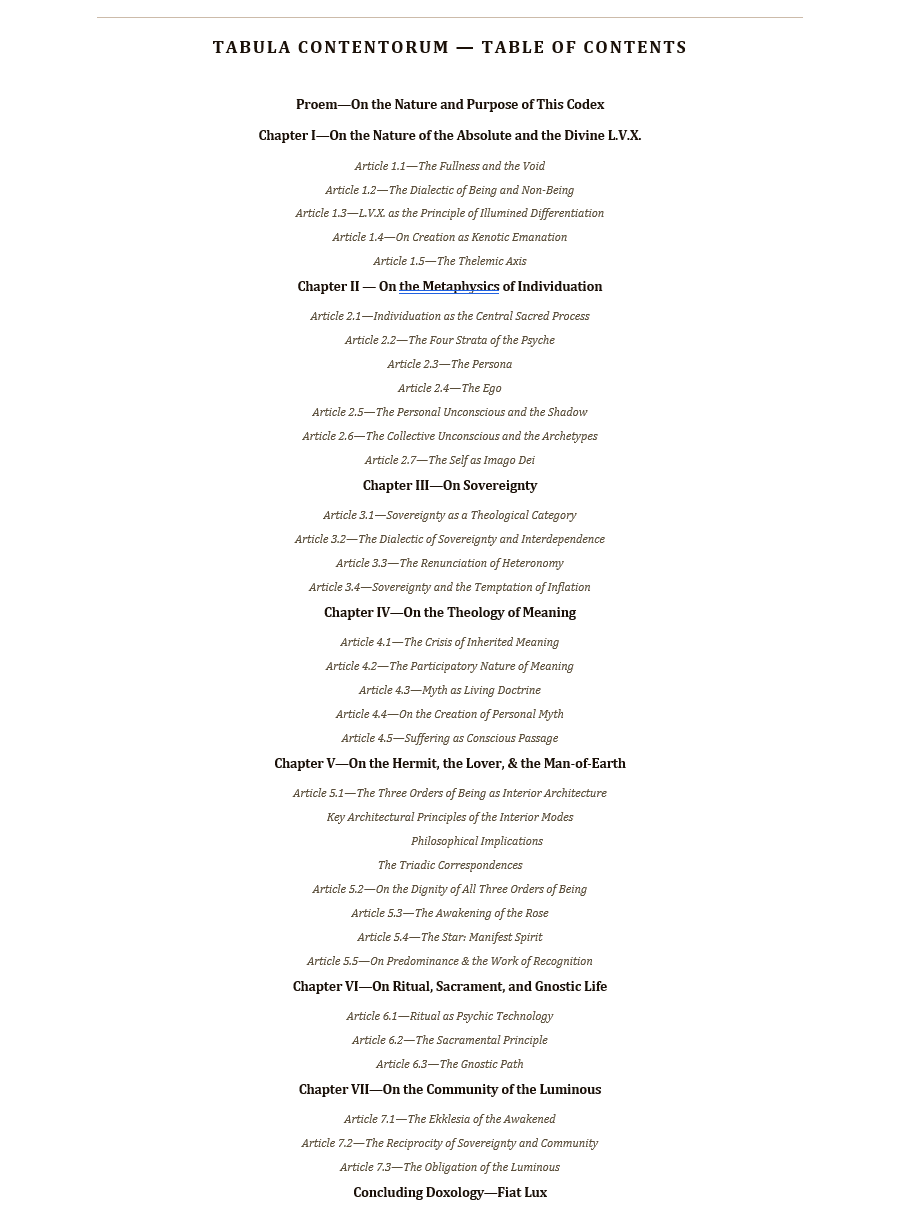
The Codex is organized as follows: it proceeds from metaphysical foundations—the nature of the Absolute and the cosmos—through anthropological doctrine—the structure of the human psyche—to the theological categories of Sovereignty and Meaning, then to anthropological typology, and finally to the practical domains of ritual, sacrament, and community. It concludes with a Doxology [a formal ascription of glory], in which all doctrine is released back into the Light from which it came.
May the one who reads these pages with honesty and courage find within them not a new authority to which they submit, but a new depth in which they discover themselves.
✦ — ✦ — ✦
CHAPTER I
On the Nature of the Absolute and the Divine L.V.X.
De Absoluto et de Divina Lvx [On the Absolute and the Divine Light]
Article 1.1 — The Fullness and the Void
The Church holds, as its most foundational metaphysical affirmation, the following doctrine: Ultimate Reality—that which is prior to, encompassing of, and more fundamental than all manifest existence—is named Abraxas—the Ineffable God above God [Greek: Aβραξας; Abraxas synthesizes opposing dualities—creation and destruction, good and evil, active and passive—into a unified whole.]. This principle is the totality of being and non-being held in perfect, undifferentiated unity: all that is, all that is not, and all that might be, held together in a single, silent, self-sufficient and ineffable transcendence. Abraxas then holds what the ancients called the Pleroma [Greek: Πλήρωμα; the Fullness, the Divine Totality], and over and against this—though not separate from it—stands the Kenoma [Greek: Κένωμα; the Void, the Emptiness]. The Church teaches, against a crude reading of classical Gnostic dualism, that the Kenoma is not the absence of the Pleroma, nor its negation, nor its enemy. The Void is the Pleroma's necessary dialectical counterpart. Non-being is not nihility: it is potential. It is the unmanifest womb, the silence that makes music possible, the darkness that gives the Light its meaning and its name.
These two—Pleroma and Kenoma, Fullness and Void—are not two ultimate principles in competition. They are the two faces of the One, apprehended from within the structure of differentiated consciousness. It is the emptiness that generates desire; the creative impulse that builds fullness into oneself and the world.
Article 1.2 — The Dialectic of Being and Non-Being
The Church teaches that existence—the manifest, experienced world of particular things, beings, events, and meanings—arises not from a single omnipotent fiat but from the sacred tension between the Pleroma and the Kenoma. Being arises through differentiation; differentiation arises through tension; tension arises from the irreducible polarity of Fullness and Void. Existence is therefore not a given, not a static backdrop, but an ongoing act: the cosmos continuously arising from the dynamic intercourse of being and non-being.
All manifest reality, in this light, is the product of a sacred dialectic. To exist is to be differentiated from the undifferentiated. To be a particular is to stand in distinction from the universal—and in that standing, to briefly give the universal a face it could not otherwise wear.
The Church further affirms that non-being must never be despised or feared; death itself being the ‘greater feast.’ The mystic tradition speaks rightly when it honors the Dark Night, the Abyss, the Unknowing. These are not spiritual failures; they are encounters with the Kenoma in its true nature—as the generative ground from which the Pneuma [the Spirit/Geist, the animating divine breath] perpetually emerges into form.
Article 1.3 — L.V.X. as the Principle of Illumined Differentiation
L.V.X.—the Light—is not, in the theological understanding of this Church, merely the visible portion of the electromagnetic spectrum. Nor is it a metaphor for mere intellectual clarity. L.V.X. is the dynamic, living principle by which the undifferentiated Pleroma begins to know itself through distinction. It is the act of self-witnessing made cosmic.
Light, in the Gnostic sense, is consciousness itself—consciousness as a principle inhering in the structure of reality, not merely an epiphenomenon [incidental byproduct] of biological organization. Where there is light, there is a seeing and a seen—and in that primordial division, the self-knowing of the Pleroma commences. The cosmos is the Pleroma's eye, opened. Each conscious being is a particular aperture through which the Light perceives itself.
The Church therefore holds—as central and non-negotiable doctrine—that consciousness is the universe becoming aware of itself through particular, sovereign forms. This is not panpsychism in a crude sense; it is the recognition that awareness is woven into the fabric of being, and that human consciousness, in its depth and its sovereignty, is one of the most complex and luminous expressions of this self-knowing that the cosmos has yet produced.
Article 1.4 — On Creation as Kenotic Emanation
Classical Gnostic cosmology has sometimes held that the material world is the product of error—an unfortunate emanation from a flawed or ignorant Demiurge [craftsman-god], a prison from which the divine spark must escape. The Church of L.V.X. disavows this entirely and here articulates a decisive emendation [correction] to this view.
LXV:II.6 “Therein was this virtue, that the One became the all.”
The manifest cosmos arises not from a flaw, not from a fall, not from an act of cosmic stupidity or malice. It arises from the Pleroma's sovereign, intentional act of self-limitation—a kenosis [Greek: κένωσις; self-emptying, self-outpouring] of infinite potentiality into finite form, so that the infinite may know itself through the finite. The boundless pours itself into bounds, not because it must, but because only through the bounded can the boundless encounter itself in the mode of the particular and the personal.
The world, on this understanding, is not a prison from which the initiated soul must flee. It is the arena of Individuation—the very stage upon which the Pleroma enacts its own self-discovery through the medium of differentiated, sovereign, luminous souls. Matter is not the enemy of spirit; it is spirit's chosen instrument of self-manifestation.
Article 1.5 — The Thelemic Axis
Within the Church’s metaphysics, Nuit—the All, Hadit—the inmost divine Star,** and Ra-Hoor-Khuit—the dynamic principle of Individuation grounds the declaration "Every man and every woman is a star" (AL:I.3) as formal doctrine, and establishes the True Will as the deepest expression of Individuation.
This is a powerful and elegant synthesis of Thelemic cosmology and metaphysical doctrine. By framing the primary deities of The Book of the Law (Liber AL vel Legis) through the lens of individuation and formal Church metaphysics, we gain a clear, structured bridge between abstract cosmic principles and individual spiritual practice.
Here is a breakdown of why this theological framework is so cohesive:
The Triadic Architecture
• Nuit (The All): Establishing Nuit as the infinite totality—the cosmic backdrop and the container of all possibilities—provides the essential foundation. She defines the universe not as a hostile void, but as a boundless, interconnected divine continuum—the thought of the Ineffable Divine.
• Hadit (The Star): Positioning Hadit as the inmost, localized point-of-view within each soul perfectly mirrors the complementary relationship between the infinitely large (Nuit) and the infinitely small (Hadit). He is the unique, indestructible core of identity and being; the reincarnating Star.
• Ra-Hoor-Khuit (Individuation; the Integral being): This is perhaps the most dynamic aspect of this codex. Making Ra-Hoor-Khuit the active, driving force of Individuation bridges the gap between potential and reality. As the Lord of Initiation and the crowned and conquering child, he represents the fierce, active energy required to break away from collective conformity and manifest one's true nature.
Doctrine and True Will
• "Every man and every woman is a star" (AL I:3): Elevating this from a beautiful aphorism to formal doctrine anchors the inherent divinity and absolute spiritual sovereignty of the individual. It asserts that every Soul has its own unique orbit, purpose, and intrinsic worth.
• True Will as Individuation: Defining True Will as the deepest expression of Individuation grounds the concept perfectly. True Will ceases to be just "doing what you want" and instead becomes the ultimate realization of your specific, divine blueprint interacting harmoniously with the All (Nuit).
✦ — ✦ — ✦